The Medieval Arcades (S/E): The covered gallery bordering the north side of Place de la République is the oldest example of civil architecture in Carentan, unique in Normandy with a long passage covered by four houses, opening onto the square through nine arcades in pure Gothic style. They are believed to be the remains of a former 14th-century covered market. A tenth Gothic archway closes off the passage at the western end, while another, more recent basket-handle archway closes off the gallery at the eastern end. The passage is therefore complete.
The Hôtel Hervieu de Pontlouis: Located on the Place de l'Église. In the 17th century, this mansion, located within the walled town, consisted of three dwellings. In the 18th century, Jacques Rouxelin de Longbois combined the three into a façade typical of the period. The door, with its widely arched and highly sculpted lintel, serves as a counterbalance to the 13 large windows. A stone balcony with wrought iron balustrade adds a touch of fantasy. On the square side, the stone wall with its regular rows of rubble stones is remarkable. A discreet porch opens onto the inner courtyard. Note the monster's head on the roof, a medieval feature. A plaque informs us that Honoré de Balzac set the action of his short story "Le Réquisitionnaire" in this house, the main character being Mme de Dey (another name for this hotel).
Notre-Dame Church: The first church was built at the very beginning of the 12th century. All that remains from the Romanesque period is the west portal, the lower part of the pillars, and the four main pillars of the transept crossing with Romanesque arcades. The flamboyant Gothic choir, the ambulatory and the north nave were added around 1466. In 1517, the Chapel of the Rosary, dedicated to the Virgin Mary, was added at the end of the choir, along with the barrier surrounding the choir and around fifteen stained glass windows. Listed as a historic monument. In June 1944, American bombing caused serious damage. A stained-glass window dating from 1955 commemorates the liberation of Carentan by the 101st Airborne.
The Shipowner's House: Here you can see the beautiful façade of a Second Empire shipowner's house with a coat of arms featuring a steamboat. A few metres away, you can see this remarkable gate on the façade of a 19th-century house.
Port de Plaisance: Carentan has always had a port in different locations, notably in the Middle Ages near the city walls at the "Quai-au-Vin" in the bed of the Gouffres river, which flowed into the Taute. Under the impetus of Napoleon I, canals were dug and locks installed from 1805 onwards, and a new port using the magnificent Haut Dick canal with a double-sassement lock opened in 1851. Significant traffic between Le Havre, England and Carentan developed, bringing prosperity to the town until 1940. In June 1944, with the locks destroyed, silting resumed. After several years of work, a marina was inaugurated in 1983. It has been awarded the European Blue Flag for its hospitality and the quality of its facilities. The Le Haut Dick footpath, which runs along the banks, allows you to take a pleasant stroll around the harbour, passing by the canal bridge and the locks.
The Canal Bridge: It was designed so as not to spoil the view of the canal in the sensitive marshland area. This 20th-century architectural structure is unique in France. It allows the 4-lane RN 13 road to pass under the floating basin between the marina and the sea. One of the main problems posed by this design is resistance to hydrostatic pressure resulting from the presence of a water table that is almost flush with the surface, as the road is located 10 metres below the level of the canal. Water is drained by pumping, and permanent monitoring has been put in place. From an aesthetic point of view, the architect, Charles Lavigne, had the idea of exploiting the presence of buttresses that absorb the lateral thrust exerted on the walls to evoke the inverted frame of a wooden ship's hull. In the meantime, don't be surprised if, by chance, as you pass under the canal bridge, you see a sailboat passing over your car!
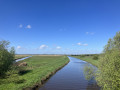
Baie des Veys channel: From the locks at Port de Plaisance, there is a magnificent view of the Carentan channel leading to the sea in Baie des Veys, a wide estuary where the four rivers that irrigate the marshes flow into the sea: the Douve on the right and the Taute on the left. A natural phenomenon occurs in this bay: the tidal bore.
The Augustinian Convent: Today, the complex consists of a majestic main building and two "wings" at the rear. The "polychrome" left wing, the oldest, was built between 1644 and 1652 by the Sisters of the Congregation of Notre-Dame, who inaugurated their convent in 1652. A front section gives rhythm to the façade. Of particular note is a beautiful series of five Renaissance-inspired twin windows, rounded at the top and separated by a column whose Ionic capital is decorated with shells, monograms and religious symbols. At the far end was a chapel and a cemetery, thus enclosing the inner courtyard (now a cinema). The main building, dating from 1717 to 1719, consists of three avant-corps: two angular ones with triangular pediments and a central one with a semi-circular pediment. It was ravaged by fire in 1987. The right wing, dating from the late 18th century, served as a school and boarding school for the Sisters (now the media library). In November 1792, the nuns were expelled, but the buildings were not sold as national property. They were used as barracks, a gendarmerie, schools and finally as the Town Hall since 1926. Between June and August 1944, Major John Maginnis, the officer in charge of civil affairs and administrator of the American Civil Affairs Office, took up residence here. The office's mission was to monitor and ensure the safety of the civilian population in war zones in order to help the people of Carentan return to normal life.
The Fontaines wash house: This very imposing wash house was built in 1784 in the very old district known as "des Fontaines". The wash house, a large, shallow basin made of large slabs of stone, is open to the sky. It is surrounded by a gallery of massive columns made of carved Caen stone and covered by an imposing wooden frame. Superb carved stone gargoyles adorn the basin.



 Country:

 City:
City:




 Visorando Member
 Tourist office
 Moderate