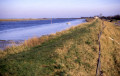
In the Picauville marshes

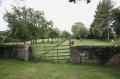
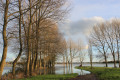
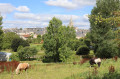
Picauville is surrounded by two rivers, the Ouve to the south and the Merderet to the east, and forms a peninsula in winter when the marshes are ‘white’. It rises to an altitude of 29 metres. The suggested route runs alongside the marshes before heading into the bocage along sunken lanes or ‘chasses’.

Details

8021636
Creation:
Last update:
Last review:
  • Walking
    Activity: Walking
  • ↔
    Distance: 13.85 km
  • ◔
    Average duration: 4h 05 
  • ▲
    Difficulty: Moderate

  • ⚐
    Back to start: Yes
  • ↗
    Ascent: + 33 m
  • ↘
    Descent: - 31 m

  • ▲
    Highest point: 27 m
  • ▼
    Lowest point: 1 m

Photos

Description of the walk

Park in the town hall car park.

(S/E) Take the Chasse du Marais, heading south. Cross a stream and turn left immediately after it. Continue along a path at La Couture and head to the next crossroads.

(1) Carry straight on, passing through the hamlet of Clainville whilst staying on the same road. Turn right at the end of the road and stay on the road until you reach Port Beurey.

(2) Turn left to follow the Douve before taking the first path on the left. At the next junction, turn left, then right a little further on, and head for the start of a dirt track on the left.

(3) Take this track and join the D70, keeping to the right. Turn right onto this road.

(4) After about a hundred metres, take a track on the left (do not take the road leading to the hamlet of Béthanie). Pass in front of the Béthanie farm and continue along the track to Le Hamel au Sort.

(5) Turn left in the village, then immediately afterwards, follow the dirt track to the right. Continue straight on until you reach the road at the water tower.

(6) Cross the road and take the path opposite. Turn right at the next junction, rejoin the road and continue straight ahead along it. At the end, turn left to reach Gueutteville.

(7) Turn left then right towards the D15.

(8) Cross the main road and continue straight on without leaving this road. Turn right at the next junction towards Veins Castle and pass in front of it.

(9) At the end of the road, turn left, then left again a few hundred metres further on to reach Chemin Jack Schlegel.

(10) Turn right and continue straight on to reach the hamlet of Les Buts Dorés (D 69) and its houses. Turn left and continue to the Y-junction.

(11) Take the road on the right called Chemin des Buts Dorés, then leave it at the left-hand bend to take a path on the right. You will reach a dead end; follow it to the end.

(12) Turn left twice, then right onto Rue de Carneville. Turn left onto Rue de la Marne, which will take you back to the starting point in the village of Picauville. Take the opportunity to have a look at the information board on Place du Général de Gaulle, situated on the left-hand side of the street just before the (S/E).

Waypoints

  1. S/E : km 0 - alt. 17 m - Car park
  2. 1 : km 1.36 - alt. 3 m - Carrefour - Clainville
  3. 2 : km 2.54 - alt. 3 m - Port Beurey - Douve (fleuve)
  4. 3 : km 4.04 - alt. 9 m - Junction
  5. 4 : km 5.2 - alt. 21 m - Crossroads - Ferme de Béthanie
  6. 5 : km 6.23 - alt. 4 m - Le Hamel au Sort
  7. 6 : km 7.37 - alt. 22 m - Route - Water tower
  8. 7 : km 8.6 - alt. 5 m - Gueutteville
  9. 8 : km 8.89 - alt. 12 m - Crossing the D15
  10. 9 : km 10.22 - alt. 18 m - Crossroads
  11. 10 : km 11.04 - alt. 17 m - Jack Schlegel Trail
  12. 11 : km 12.55 - alt. 23 m - Y-junction
  13. 12 : km 13.55 - alt. 12 m - D501E1 road
  14. S/E : km 13.85 - alt. 17 m - Car park

Notes

This walk is part of a guidebook featuring 13 short walking routes ranging from 8 to 30 km, marked in yellow across the Cotentin Bay area.

Worth a visit

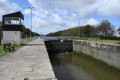
Port Beurey (2): this was once a port for gabarres (traditional cargo boats) that transported various materials—clay, reed, lime, and even animals—with unloading quays. Crossings were subject to a fee. This activity ceased in the 1930s.

Hill 30 served as the assembly point for American paratroopers at dawn on 6 June 1944. Along some of the paths leading to the top of the hill, you can admire some remarkable trees, such as beech trees that are several hundred years old.

Bernaville Castle: built in the late 18th century and remodelled in the 19th century, it is surrounded by a wooded park featuring a neo-Gothic chapel and a pond, a refuge for local aquatic wildlife. This castle was occupied by the Germans during the Second World War. It was near the château that the German general Falley lost his life, along the road where Jack Schlegel, an American veteran who took part in this battle, was stationed. The final stretch of the route takes you through the hedgerows of the ‘haut pays’. Former airfield. Disused 19th-century flour mill.

Information board: a copy of the Terrier map allows visitors to visualise the landscape as it might have appeared in the 16th century. This document, drawn up under Henry III in 1581, provides a fairly precise survey of the Picauville area, including a representation of the ‘clos’ – plots of land enclosed by hedges, whether grassed or ploughed. It also distinguishes the lowlands or “wet land”, corresponding to the floodplain of the Douve, consisting of pastures for cattle, horses and geese, from the “dry land” or highlands, consisting of arable fields. The current landscape is a bocage mosaic of pastures bordered by hedgerows of ash and pollarded willows. The village of Pont l’Abbé, within the commune, was bombed by the US Air Force in 1944, resulting in the ubiquitous architecture of the post-war reconstruction.

Picauville Church: a 13th-century church (listed as a historic monument), the only one in Normandy dedicated to Saint Candide: a long nave with six-bay aisles, influenced by the architecture of the Île-de-France region and elegantly reinforced in the 16th century by imposing buttresses and flying buttresses. Cornice known as the ‘Beauvaisine’. Square bell tower with an octagonal spire and a flamboyant-style balustrade flanked by pinnacles, similar to those at Périers, St-Côme-du-Mont, etc. Impressive 15th-century porch. Cemetery cross, tombs and gravestones. In the village near the church, the complex comprising the presbytery (17th–18th centuries) and the former town hall (late 19th century). 19th-century schools, the manor house known as the Prieuré (late 15th–16th centuries), and old houses and farmhouses.

The route is dotted with hamlets or linear villages such as Clainville, where ponds or routoirs were used for soaking or retting flax. There were also wash houses and fountains. On leaving the hamlet, you may sometimes spot some large birds typical of the marshes, such as grey herons, storks, swans or egrets. Site of the Battle of Normandy: plaque.

(4) The Béthanie farm, built in the 19th century and formerly known as the Baudienville farm, is currently managed by the Bon Sauveur Foundation. Farm shop selling dairy products: yoghurts, cream, butter and fromage blanc.

In Gueutteville: you will discover farms and manor houses with distinctive architecture featuring towers and dovecotes, some of which date back to the 16th century.

Vains Castle: it has retained its 16th-century round tower, its chamfered mullioned windows, its arrow slits and a tower in the ‘d’Argouge’ style.

Reviews and comments

4.6 / 5
Based on 5 reviews

Reliability of the description
4.6 / 5
Ease of following the route
5 / 5
Route interest
4.2 / 5
rAoule66
rAoule66

Overall rating : 4.7 / 5

Date of your route : Apr 15, 2025
Reliability of the description : ★★★★★ Very good
Ease of following the route : ★★★★★ Very good
Route interest : ★★★★☆ Good
Very busy route : No

A lovely, easy and peaceful walk.
No real must-see sights, but lovely for its peace and quiet and beautiful natural surroundings!
Thanks ☺️

Machine-translated

lïbë
lïbë

Overall rating : 4.7 / 5

Date of your route : Apr 02, 2025
Reliability of the description : ★★★★★ Very good
Ease of following the route : ★★★★★ Very good
Route interest : ★★★★☆ Good
Very busy route : No

A lovely, easy walk along very accessible paths (with little tarmac) even after a spell of rain. Most of the route follows hedgerow paths; only the first section (from the start to point 3) crosses the marsh. Although the description mentions it, the title of the walk suggests that the marsh is the highlight of the route; this is a (slight) disappointment. And to make the most of what’s out of the ordinary, it might be better to do the route in the opposite direction to the one suggested. Finally, for Lebar’s benefit (previous comment), it is indeed the Douve that takes its name from the Ouve, and not the other way round (see, for example, https://fr.wikipedia.org/wiki/Douve_(fle...))).

Machine-translated

Lebar
Lebar

Overall rating : 4 / 5

Date of your route : Aug 26, 2024
Reliability of the description : ★★★☆☆ Average
Ease of following the route : ★★★★★ Very good
Route interest : ★★★★☆ Good
Very busy route : Yes

As for the rivers, there is indeed the Merderet; the second one is the Douve, not the Ouve.
The starting point is not the Town Hall.
According to the map, it would be closer to Place du Général Leclerc or Place de la Médiathèque.

Machine-translated

Goultard
Goultard

Overall rating : 5 / 5

Date of your route : Aug 07, 2024
Reliability of the description : ★★★★★ Very good
Ease of following the route : ★★★★★ Very good
Route interest : ★★★★★ Very good
Very busy route : No

A wonderful route, very pleasant, with lovely paths through the countryside. The route is clearly signposted.

Machine-translated

Gilbert-Visorando
Gilbert-Visorando

Overall rating : 4.7 / 5

Date of your route : Jul 17, 2023
Reliability of the description : ★★★★★ Very good
Ease of following the route : ★★★★★ Very good
Route interest : ★★★★☆ Good
Very busy route : Yes

The section running alongside the marshes and the river is the most interesting; there are some lovely farmhouses along the way, and a beautiful sunken lane lined with magnificent beech trees

Machine-translated

Other walks in the area

For more walks, use our search engine .

The GPS track and description are the property of this route's author. Please do not copy them without permission.