


Refine your search for walks in Col de Berdaritz (691m)
Col de Berdaritz (691m) walks


 The Zarkindegi loop from Les Aldudes
 Visorando Member
 6.39 mi
 +1,870 ft
 -1,857 ft
 4h 35
 Moderate
 Departure from Aldudes (Pyrénées-Atlantiques)
A lovely hike, taking in part of the western ridges of the Aldudes valley, which guarantees magnificent views.
The Abraku from the village of Les Aldudes
 7.56 mi
+2,165 ft
-2,139 ft
5h 20
Moderate
Departure from Aldudes (Pyrénées-Atlantiques)
A steep climb right from the start, along a small road, then we take the HRP and the GRT5.
Zarkindegui via the Beartzun valley
 9.83 mi
+2,533 ft
-2,513 ft
6h 45
Moderate
Departure from Baztan (Navarre)
The Beartzun valley, situated east of Elizondo in the heart of the Baztan valley in Navarre, offers some lovely hiking opportunities on the French-Spanish border. We’ll pass through the hamlet of Beartzun, leave the old Roman road known as Napoleonen Bidea (Napoleon’s Way) behind to reach the border at the Belaun Pass, then climb up to Zarkintegi (860 m). We’ll return by following the north-western flank of the valley along the higher ground.
Walks near Col de Berdaritz (691m)
Moulin de l'Enfer and Palacio de Azkolegi
 12.90 mi
+3,143 ft
-3,182 ft
8h 40
 Difficult
Departure from Baztan (Navarre)
A lovely walk through the heart of the Bastan valley, starting from the Etchebertzekoborda restaurant and passing by the beautifully restored “Moulin de l’Enfer” and the Palacio de Aizkolegi (at the top of the Bertiz estate).
Roncesvalles - Esteribar
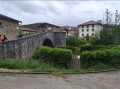 20.74 mi
+1,480 ft
-3,114 ft
10h 50
Difficult
Departure from Orreaga/Roncesvalles (Navarre)
The forty-seventh stage of the Camino de Santiago. A long stage but less gruelling than the previous day’s, despite a somewhat arduous descent towards Zubiri. Along this route, you’ll alternate between landscapes of beech and pine forests and charming little villages with typical Navarran architecture. From this stage onwards, the signposting on the Camino de Santiago in Spain consists of yellow arrows—either painted on the ground, on building facades, on rocks or on trees—or specific European signage featuring a stylised yellow scallop shell on a blue background. This logo may also take the form of bronze scallop shells nailed to walls or set into the ground in the major towns along the route, indicating the direction towards Santiago de Compostela.
From Saint Jean-Pied-de-Port to Bidarray
13.73 mi
+1,749 ft
-2,041 ft
7h 50
Difficult
Departure from Saint-Jean-Pied-de-Port (Pyrénées-Atlantiques)
A beautiful stage in the Pyrenean foothills along country lanes.
From Saint-Jean-Pied-de-Port to Roncesvalles
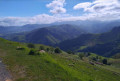 15.48 mi
+4,380 ft
-1,795 ft
10h 55
Difficult
Departure from Saint-Jean-Pied-de-Port (Pyrénées-Atlantiques)
The forty-sixth stage of the Camino de Santiago. A physically demanding stage, featuring the ascent of the Pyrenees, splendid views of the surrounding Basque Country if the weather permits, free-roaming herds, a sense of being high up, and the excitement of crossing into Spain.
After a long, steep descent, you arrive at the Monastery of Roncesvalles. Given the altitude of the finish point and the cool temperatures, I preferred the monastery dormitory to camping. From Saint-Jean-Pied-de-Port, a whole new journey begins. The landscapes are no longer the same, nor are the pilgrims. From here on, there are ten times as many people on the paths. Very few French people and lots of Koreans, Australians, Americans, Filipinos and, of course, Spaniards. From here on, you have to speak Spanish or English or use Google Translate. But you always manage to make yourself understood and get by. That’s the magic of the Camino de Santiago.
The Alkurruntz tour from Urdax
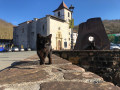 11.03 mi
+2,680 ft
-2,677 ft
7h 25
Difficult
Departure from Urdazubi/Urdax (Navarre)
From the beautiful little Navarran village of Urdax, we set off to conquer Alkuruntz. There are several picnic spots to choose from and the view is magnificent on both the French and Spanish sides.
Crossing the Baïgura massif from Ossés to the leisure centre
5.92 mi
+2,533 ft
-1,959 ft
4h 55
Moderate
Departure from Ossès (Pyrénées-Atlantiques)
There are many ways to tackle the Baïgura. The simplest is to set off from the Mendionde leisure centre via the discovery trail. The route is signposted and there is an information board at the start.
I suggest doing the full traverse of the massif from south to north, starting from Ossès. For this, you’ll need two cars.
In my opinion, the paths are much more varied and rarely used, with many running along ridges offering magnificent views of the mountains and villages of the Basque Country.