

 Country:
 City:
City:



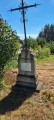
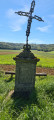
Park near the church in Dompcevrin.
The route is signposted with blue directional signs and is approximately 12 km long.
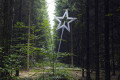
(S/E) Take the path leading uphill opposite the church. Behind the water tank on your left is a large picnic table. From there, you can enjoy the panoramic view over the Meuse valley, stretching from the Dompcevrin quarries to Saint-Mihiel. Continue your ascent along the white track through farmland. As you approach the forest, look out for ‘Le Théorème des dictateurs’ (Vincent Mauger, 2009) behind the first trees.
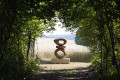
(1) Follow the path until you enter the forest, then carry on straight ahead. As you emerge from the forest, you’ll walk alongside the field on your right. Further on, on your left, there is a clearing where ‘Dreaming rebirth of ninth dragons’ (Byoung-Tak Moon, 2002) stands.
(2) Continue towards the entrance to the forest, then turn right at the crossroads.
(3) A little further on, on your right, you’ll see the Gros Caillou, which gives the walk its name. Carry on, walking alongside the wire fence on your left. High up on your left, you’ll see ‘Lilith’ (Damien Deroubaix, 2015).
(4) About fifty metres past the fence, on your left, you’ll find a fluorescent green sign indicating an access path leading to ‘La molécule du territoire’ (Évariste Richer, 2010). Retrace your steps; at the next junction, turn left, then you’ll see ‘Le mur de Ligier Richier’ (Nayel Zeiter, 2017) on your right. Take the path that leads down to the white track.
(5) Turn left and carry on straight for about 900 metres.
(6) Turn right onto the dirt track and carry on. On your left is a signpost indicating an access path which you must take to reach ‘Cachée’ (Lorentino, 2006); then retrace your steps.
Continue along the main path and you’ll come across “Nul caillou n’est un faux” (Béat Lipert, 2018) 10 metres to your left. Continue straight on until you reach the white path.
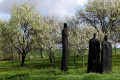
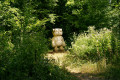
(7) You’ll see ‘Immigrare I’ (Sanaz Azari, 2007) on your right. Follow the path and, at the end of it, turn right onto the forest track until you spot ‘Bee’s Bunker’ (Nicolas Floc’h, 2015) in a clearing. Retrace your steps back to the white path and carry on straight ahead. A few metres further on, on your right, stands ‘Columbarii’ (Daniel Nadaud, 2016). Walk on and turn right at the junction. Look out for ‘Dédale’ (Maire/Schneider, 1999), signposted on your left.
:8:: You’ll come to a fork in the path; you can see the Marcaulieu hunting lodge below – turn right. Then carry on until you reach the tarmac road.
(9) Turn left onto the tarmac road, then right onto the stony path. Walk on and you’ll see ‘Das Aldernest’ (Clément Laigle, 2008) on your left, above ‘Lieu de rêve’ (Walther Piesch, 2002). Carry on to see ‘Enraciné’ (Douglas White, 2014). Then walk about a hundred metres to reach ‘Pierre dorée’ (Frédérique Lecerf, 2006). A few metres further on, on your right, is a small path leading to ‘Aire cellulaire’ (Sébastien Lacroix, 2010). Return to the main path and continue to ‘La Ballade des pendus’ (Emmanuel Perrin, 2003), which is situated high up in the trees on your right.
(10) About 150 metres after ‘Les pendus’, take the path leading down to your left. At the bottom of the slope, turn right. A few metres further on, by the spring, you’ll find ‘Les métamorphoses de Champey’ (Christophe Doucet, 2019) on your right. Continue along the path; a sign on your right points to a path leading to ‘La source escamotée’ (Aleksey Sorokin, 2001), situated in the stream 50 metres further on. Then retrace your steps and continue along the path for about fifty metres; on your right you’ll find ‘Labour A, B, C’ (Conilh de Beyssac/Guissart, 2016). Carry on, and you’ll then see ‘Notre stère qui est aux cieux’ (Buttier/Crémel, 1998). Further on, on your right, you’ll see a 7-metre-high column of wool; this is ‘Intrusion’ (Yushin U Chang, 2014). About a hundred metres further on, you’ll see ‘La migration du rhinocéros’ (Roger Gaudreau, 1999). Continue until you emerge from the forest.
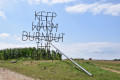
(11) At the edge of the forest, you’ll be drawn to a sign reading ‘Dehors Dedans’ (Miguel-Angel Molina, 2004). After the sign, walk along the edge of the field until you see ‘The Guardian’ (Marek Borsanyi, 1997) on your left. Carry on along the path until you reach the tarmac road.
(12) Follow this road to the right. Continue for one kilometre, pass the cemetery at the entrance to the village, carry on and, about a hundred metres further on, turn left to walk up to the church and return to the starting point (S/E).


 Visorando Member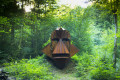
 Easy
Easy