Country:
 City:
City:


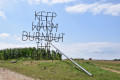
In the village of Pierrefitte-sur-Aire, opposite the square and the large mural depicting a forest, take the road marked with fluorescent green signage. Then continue by car along the dirt track on your right for 2 km. The start is from the Fond de la Pompe car park.
The walk is signposted with yellow directional signs and is approximately 10 km long.
(S/E) Take the path that climbs to the left for about 300 m before you come to ‘Tranchée’ (Alexandra Engelfriet, 2013) on your right. Continue on to reach a junction.
(1) Turn left and, about a hundred metres further on, you will see “Mobilier désurbanisé” (Made, 1997). Follow the path for a few hundred metres; on your right, the yellow markings lead you to a path entering the forest. After a few metres, you will come across “Le silence des icebergs” (Laurent Pernot, 2008). Continue.
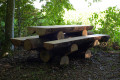
(2) On your left, before the white path, there is a picnic table and an impressive large hornbeam, which gives this walk its name. At the white path, turn right and continue for 600 m until you reach a fork.
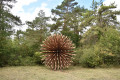
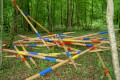
(3) Take the path going uphill on your right. Follow this path alongside the coniferous trees on your left; you will then see “Entrelacs (fatras)” (François Génot, 2005) on your right. Continue along the path, go down the slope and take the access path on your right leading to “Hannibal” (Marina Le Gall, 2016). Retrace your steps, go up to the right and continue for about 200 m to find “Cent clés” (Made, 1997).
(4) Continue along the path to the right and, when you reach the signpost for “Chemin de vie” (Liliane De Vito, 2002), turn right and walk about fifty metres to see the artwork. Then, return to the main path and continue to the signposted junction.
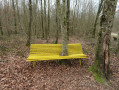
(5) Turn right and walk to the edge of the forest, where you can sit on “Sylvia” (Stéphane Vigny, 2011). Continue across the field. Stop in the middle of it to view “Les variables obsolètes” (Nicolas Boulard, 2012). Continue into the forest, then turn left at the edge to discover “L’oiseau source” (Jean-Pierre Brazs, 2000).
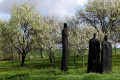
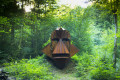
(6) Continue by turning slightly to the right, walk along the cleared area on your left, then take the small path on the right leading to “Peuple migrateur” (Katarina Kudelova, 2007). Walk down to the signpost for the “Jardin des méditations” (Erik Nussbicker, 2017), which will guide you along a winding path through the woods, where you will also see the “Tourelle d’y Voir” (Erik Nussbicker, 2018).
(7) Continue to a crossroads. On your left is the artwork “Saphira” (Claudia Comte, 2010). Take the signposted path on the right and continue for several hundred metres. On your left, you will see “Solstice et systole” (Alain Domagala, 2009). About 300 m further on, take the access path to “Diorama” (S. Pelletier/O. Ducet, 2014). Right next to it, you’ll see “28” (Simon Berheim, 2008). Follow the path for about a hundred metres to discover “3x4-12” (Miguel-Angel Molina, 2004) on your left.
(8) Walk for about 100 metres and you’ll reach a junction where you’ll find “Two Thumbs up Monument” (Guillaume Pilet, 2009). Continue straight on until the next fork.
(9) At this junction, turn right and follow this path for 300 m before heading down towards “ʁu.ba.to” (Amandine Arcelli, 2018). Retrace your steps, turn right and then walk all the way down the slope to find “Renaissance” (Ryszard Litwiniuk, 1998) on your left.
(10) You are now on a white path; turn left to see ‘7.5m² de frontière’ (Aï Kitahara, 2004) further ahead on your right. Then continue for a few hundred metres before discovering ‘Turbo Tango’ (Julia Cottin, 2013) in a small former stone quarry on your right. Finally, about a hundred metres before the end, you’ll come to “Laboratoire II” (Jean-Louis Hurlin, 2005), the last artwork before the return (S/E).

 Visorando Member

 Moderate