Country:
 City:
City:


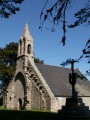
(S/E) Car park at the Chapelle de Tronoën or Tronoan in Saint-Jean-Trolimon.
Yellow markings
From the car park, cross the road to admire this chapel and its famous calvary, considered to be the oldest in Brittany.
Then take the road on the right heading south. Ignore thePR®® trail which branches off to the right and carry on to the next junction.
No signposting
(1) When you reach the first road, turn left (signposted ‘Chapelle Beuzec’) and follow this road.
(2) After passing two imposing houses on the left,
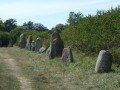
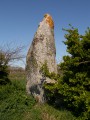
turn right and follow the path between the fields to visit the menhir visible through a hedge. Turn back and continue to the right along this road to reach Beuzec Chapel and its wayside cross.
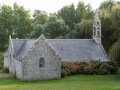
::3: Walk round the enclosure to admire this remodelled chapel. Leave the enclosure, take the road opposite heading east, pass a cross and arrive at a crossroads.
(4) Turn right towards Kerégard Vraz, pass through the hamlet and continue straight on to reach Keregou.
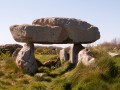
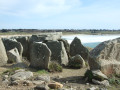
(5) Turn slightly to the right. The T-shaped Kerugou dolmen is situated on the left on a small hillock. Join a road and follow it to the left
Yellow markings andGR®®34H (red and white)
(6) Turn right onto the wide signposted path and continue south-west. The path runs alongside fields where bulbous perennials are grown (tulips, irises, hyacinths, grape hyacinths, etc., in bloom from April). Cross a road and look out for the sheds of SARL Kaandorp, a flower grower, on your left.
Carry on straight ahead, cross another road and walk past the water reservoirs for irrigating the fields on your left. You’ll come to a house.
No signposts
(7) At the house, turn left onto a track and follow it to a road. Turn right to cross a car park and head towards the sea, following the paths across the dune.
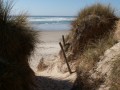
(8) At a memorial stone commemorating 15 young people murdered in July 1944, head towards the sea via a path through the dune. You are now on the large beach at Baie d’Audierne. To your left is the famous Pointe de la Torche. Turn right and walk along the dune. Pass a wide gap carved out by storms and climb back up the dune via a path at the end of the wooden stakes.
(9) From the top of the dune, head straight on to reach the wide path set back from the dune massif; take this path on your left.
Yellow markings andGR®®34(red and white)
Please note, these markings are sparse: stick to the main path. Signs urge you to stay on the paths to prevent trampling and to respect the dune, a nesting site for many birds.
(10) When you see houses on your right, a signpost directs you to turn right and go round them. Follow theGR®® which turns right towards Pen ar Vouëz then left to reach a road. Cross this road and continue straight ahead (no entry sign, no residents). Pass two houses on your left. After the second one, turn right then left.
(11) At a sandy bend, turn right towards the east along a small grassy path on the dune. Take care here, as there are no signs indicating that you should turn. TheGR®®34, a wider path, continues straight on.
Yellow markings
Follow this path and, after a short while, you’ll come to the first yellow marker. Carry on to the road, cross it and take the path towards Kervellec Vian (marked as Kerveltré on the map). The route shown on the map isn’t entirely accurate, as the path is actually directly opposite.
(12) Follow this path, turn right and carry on straight ahead to the hamlet of Kerveltré, where you turn right.
(13). At this point, look out for a small, rustic fountain on your right, which deserves to be showcased. Continue along the wide path which leads to the road. Turn left to reach the car park; keep the chapel in your sights.
If you haven’t already done so, take the time to admire this chapel (known as ‘the cathedral of the dunes’) and examine the various friezes on the calvary (S/E).
.



 Visorando Member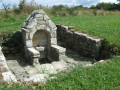

 Difficult
 Easy
Easy