Country:
 City:
City:



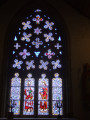
Car park near Tronoën Chapel (Tronoan on the IGN map).
(S/E) Leave the car park on the right and head for the road. Follow it to the right until you reach the nearby three-way junction.
YellowPR® markings.
Follow the road sign for Plonéour-Lanververn, then turn right at the sign for Kerdapon. Follow this wide path between the fields until you reach a small, rather derelict fountain and wash house on the left. Its location on the map is inaccurate.
No signposting.
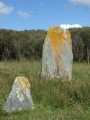
Leave thePR® path, which heads left, go round the buildings and continue straight on to the crossroad where there is a fluted Iron Age stele, found broken into four pieces and skilfully reconstructed.
(1) Turn left onto the small road and turn right at the first junction, signposted Pont Devet, Lanvoran. Head towards these places and then turn left heading due east until you reach the crossroad.
(2) Turn right, pass the Lanvern campsite on your left and, about a hundred metres further on, look out for a round house on the right and the sign for the fountain (dead end). Follow this street alongside the houses until you reach, on the right, this beautiful, well-maintained fountain. This is the fountain belonging to the Saint-Budoc Chapel in Beuzec-Cap-Caval. The date 1399 is inscribed on its pediment.
(3) Retrace your steps back to the road and continue to the right until the next three-way junction, where you turn left. At the next junction, turn right onto a cross-road where a tall, cylindrical medieval stele stands, topped by a stone cross.
GRP® yellow and red markings.
(4) Head right towards the Chapel of Saint-Budoc, which can be seen to the west. Climb the small stone steps to reach the fenced area of land. This chapel served as the parish church of Beuzeg-Cap-Caval until the Revolution. Walk around the chapel and its calvary, then head back down to the road and follow it to the right for about 400m.
(5) Leave the road by turning right onto the track that serves a few houses. Continue straight on along the grassy, shaded track as it continues, then along the farm track between the fields. Cross the first road and continue straight on until the next crossroad.
(6) Turn right onto this wide track leading to the lodge village of Kerdrafig. When you meet a path coming from the right, leave theGRP® which heads off to the left. Its route on the IGN map is not accurate.
No signposting.
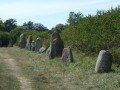
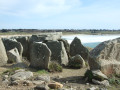
A few metres further on, look out for a boulder and an old, illegible sign on the right indicating the path to the two Kerharo menhirs visible from the roadside. The route to them is clearly marked in the dune.
(7) Retrace your steps and continue to the right towards the hamlet of Kerdrafig (a beautifully restored group of buildings that blends well into the landscape). Cross the hamlet and head due west across the dune to reach the seashore. Take the gap in the dune to reach the sea (a steep climb up the sand).
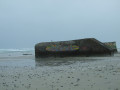
(8) Follow the top of the beach to the right and continue to the next access point near a car park, just before a blockhouse on the beach.
Leave the seafront, go past the car park and shortly afterwards look out for theGR®34on the right, a wide path through the dunes.
GR34 White and red markings (sparse).
(9) Turn right onto the dune, then veer left towards some houses and follow the path that goes round them. This path turns right, crosses a footbridge and reaches another group of houses, which you go round on the left.
PR route, yellow markings (very faint).
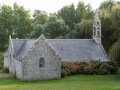
(10) Let theGR® head off to the left and continue eastwards. The track follows the edges of fields and reaches a thatched cottage (view of the bell tower of Tronoën Chapel through the trees). Follow the access path to this house and you’ll come to a road.
(11) Turn left and carefully make your way up this road. Very soon, at a signpost, turn left into a newly cleared path leading to the calvary and the chapel.
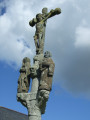
Take the time to explore this calvary, the oldest in Brittany, dating from between 1450 and 1470.
Cross the road at the pedestrian crossing to reach the car park opposite (S/E).


 Visorando Member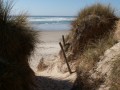

 Difficult
 Easy
Easy