Country:
 City:
City:


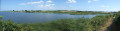
Access: on leaving Plonéour-Lanvern towards Plozévet, at the cemetery, turn left onto the D156 towards Tréguennec. Drive through the village and continue along the Route de Saint-Vio. Before the chapel, at a junction of small roads, turn right towards the sea onto the Route de Prad ar C'Hastel or Prat ar Hastel until you reach the imposing remains of the pebble crusher (archaeological site on the map).
The car park is on the left where the road ends.
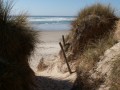
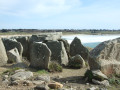
(S/E) With your back to the car park, head north-west, passing between the remains of the pebble crusher used in the construction of the "Atlantic Wall". Admire the murals decorating it. At the end of the last building, go up to the left onto the ramp leading to the beach (panoramic view of the sea and the dune area). At the end, go down and take a short detour to the left to enjoy a panoramic view of the beach. Note, to the right and left, the blockhouses that have rolled down the dune and now lie on the beach.
Turn back and continue towards the car park, visible about 400m away, passing a signpost marked "Route de l’Étang de Trunvel".
Signposting:GR®®34(white and red) +PR®® (yellow).
(1) At the car park, turn left and follow a wide path through the marsh (see During the walk), then veer right behind a house and join a cross-path. Turn left and cross the D156 road leading to the sea.
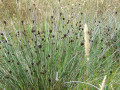
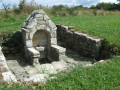
(2) Continue straight ahead along the Impasse de Palud de Kermabec (signposted) and reach the edge of the Étang de Trunvel reedbed, which you will follow until you reach the beautiful Kervaillant estate (lodges). Note the wash house on the estate (fountain on the map).
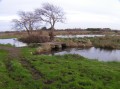
(3) At the junction of small roads, turn left to cross the hamlet and continue along a path lined with blackthorn hedges which, in places, form a veritable tunnel. Further on, the pond comes into view against the backdrop of the sea, with the village of Trunvel on the opposite bank.
Continue along the edge of a field from where the pond is somewhat obscured by a hedge, then head down to the left along the path that crosses a coniferous wood and reaches a small road marking the end of the pond’s watery section. Follow it to the left for about a hundred metres, letting theGR®® continue straight ahead.
PR®® Yellow
(4) Turn right (sign prohibiting motorised vehicles) and walk along the reed bed. The wide path turns right and climbs up alongside a wooded area, always following a branch of the reedbed on your left. Just before the end of the climb, look out for a clearing on the left leading to a discreet fountain and, a little further up, still on the left, a collection of wooden sculptures depicting various mushrooms. You’ll reach a junction of small roads.
(5) At the signpost marked “Return to starting point”, keep to the right and follow the small road which leads to a crossroads near the Kerlaz campsite (cross with a slightly disproportionate face of Christ, 1867).
No signposting.
Turn left, skirting the campsite facilities, and arrive at a dead end (you can continue for about a hundred metres to the parish church of Notre-Dame de Pitié and retrace your steps).
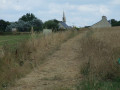
(6) Turn right or left if coming from the parish church at the Chemin Hent Balanou cul-de-sac, then take a grassy path on the right between the houses, which runs between two large fields and leads to the state school. Note the size of the old buildings, which indicates that the population was much larger: in 1930, 2.5 times larger than today. You will arrive at Venelle de la Mairie.
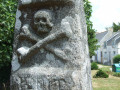
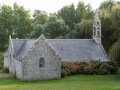
Turn left onto Route de Saint-Vio, then veer right to enter the fenced area of land surrounding the Chapelle Saint-Alour, built in 1878 on the site of a building that was previously the parish church. Note the Christianised and engraved protohistoric stele.
(7) Cross the road (Rue du Vieux Bourg) and continue straight ahead along the small road towards Kergueoc (signpost) until you reach the junction with a side path where you will find the PR®® markings.
PR®® Yellow (not very visible).
(8) Turn right and, after about a hundred metres, you’ll come to a path on the right marked by an old wooden sign bearing the indication “Kerguellec 1.5km”. Follow this straight path, from which you can see the sea, and ignore the Yellow Cross at the junction with a path coming from the hamlet of Cosquer. You will come out onto a small road; take it to the left for about a hundred metres.
(9) Before the “Give Way 150m” sign, look out for an old wooden sign on the right and follow this path until it joins a small road, which you take to the left for about 50 metres.
(10) At the sign for Chemin de la Palue de Kerguellec and the municipal campsite, turn right onto this road, which is signposted as a dead end. Continue straight on and, at the campsite, look out for various sculptures made from driftwood and garden gnomes on your right. You will come to a car park.
GR®®34White and Red markings
(1) Leave thePR®® which heads off to the right and follow theGR®® to the left towards the clearly visible pebble crusher. At the road, turn right to return to the car park (S/E).


 Visorando Member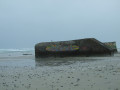
 Moderate
 Difficult