Villatte Canal

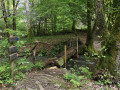
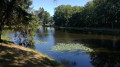
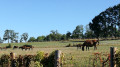
An easy route that takes you past an old canal which still carries water and close to the Domaine de la Rivière, a former mare stud belonging to the National Studs, now a sports training centre.

Details

n°1111576
Creation:
Last update:
Last review:
  • Walking
    Activity: Walking
  • ↔
    Distance: 6.88 mi
  • ◔
    Average duration: 3h 35 
  • ▲
    Difficulty: Moderate

  • ⚐
    Back to start: Yes
  • ↗
    Ascent: + 505 ft
  • ↘
    Descent: - 518 ft

  • ▲
    Highest point: 1,358 ft
  • ▼
    Lowest point: 1,099 ft

Description of the walk

Park in the car park near the town hall and the church.

(S/E) Walk past the church in Saint-Sornin-Lavolps and continue straight on along the road until the next junction. At the Chapelle Saint-Roch, turn left, walk through the hamlet of Lignac and head down to Laugerie.

(1) At the end of the road, in Laugerie, turn left (bamboo grove on the right) until you reach the next crossroads (elevation 355). Turn left again and continue to the Moulin de Lignac, then on to the departmental road at a place called Les Rouverades.

(2) On the road, there’s a view of the Meyjade Forest. Turn right towards the La Rivière mare stud. Before reaching the estate, turn left onto the departmental road.

(3) Near the estate’s pond, turn right towards La Villatte, then take thesecond gravel track on the left (orange markings), which runs alongside the Petite Loire downstream to the right. Opposite the buildings, continue to the right until you reach the Mazelle bridge.

(4) Turn left towards the village, cross it keeping to the right and reach the three-way junction at the village exit. Turn slightly left, then pass the recycling centre on your right.

(5) Turn left at the crossroads and head towards the entrance to Beyssac.

(6) About 100 metres after the village entrance sign, turn right, then right again towards Pompadour on the D7E. Take care. At the next junction, keep right.

(7) At a place called La Rigole, turn left towards Saint-Sornin-Lavolps.

(8) Go round the Moulin des Jeunes on the right, the pond on the left, and the campsite, then head up to the church. Turn right to reach the car park (S/E).

Waypoints

  1. S/E : mi 0 - alt. 1,273 ft - Church Square in Saint-Sornin-Lavolps
  2. 1 : mi 0.89 - alt. 1,201 ft - Laugerie, on the left
  3. 2 : mi 1.66 - alt. 1,250 ft - Les Rouverades
  4. 3 : mi 2.28 - alt. 1,145 ft - Pond, on the right
  5. 4 : mi 3.9 - alt. 1,158 ft - Mazelle Bridge
  6. 5 : mi 4.61 - alt. 1,293 ft - Turn around here, left
  7. 6 : mi 5.14 - alt. 1,273 ft - Small path on the right
  8. 7 : mi 6.07 - alt. 1,352 ft - La Rigole, on the left
  9. 8 : mi 6.53 - alt. 1,230 ft - Turn left between the Moulin des Jeunes and the pond
  10. S/E : mi 6.88 - alt. 1,273 ft - Church Square in Saint-Sornin-Lavolps

Notes

Route No. 6, marked in orange.

Worth a visit

Along the Villatte Canal, 500 metres before the Mazelle Bridge, you’ll find the remains of a mill, the leat and the reservoir.

In Saint-Sornin, the cruciform church is thought to date from the early 15th century. In the sacristy, there was a 17th-century reliquary containing the remains of Saint Radegonde, Saint Donat and Saint Modeste. In the south chapel, there is a fine statue of Saint Radegonde and a 15th-century wooden Pietà. The oldest bell dates from 1592. Saint Radegonde was particularly venerated in Saint-Sornin-Lavolps.

A fountain in the village is dedicated to her. Its water was said to cure scabies and skin diseases. Furthermore, all manner of miracles were attributed to the village’s patron saints. Saint Donat, in particular, was invoked to ward off storms.

The Saint-Roch Chapel, in the commune, is a former oratory annexed to the priory of Tulle in 1318. It was moved to its present location from the village of Boissiaux around 1820. It is thought to date from the time of a particularly severe cattle plague. Few saints were as famous in the West as Saint Roch between the 14th and 17th centuries. A contemporary of the Black Death, from which he was miraculously cured, he was often the last resort for a humanity decimated by the epidemic that wiped out almost half of Europe’s population. In Saint-Sornin-Lavolps, he is celebrated every weekend leading up to 15 August with a blessing of the herds. In the past, the priest would also bless a handful of ‘plague herbs’, which, when hung in the stables, were believed to ward off disease in the animals.

The racecourse hosts 11 meetings a year featuring flat and jump races – the perfect opportunity to try your hand at betting!
And fishing enthusiasts can indulge their passion at the pond situated near the village, below the Les Etoiles campsite.

You’ll pass close to the former National Stud Farm at La Rivière, where, in the mid-19th century, Messrs Gayot and De Lespinats created the Anglo-Arabian breed, which combines the stamina of the Arabian thoroughbred with the speed of the English thoroughbred.
All that remains of the castle’s ruins is a round tower topped with a thatched roof, which adds to the site’s unique character.
They are examples of the Flamboyant Gothic architectural period (late 14th – early 15th centuries), whilst the chapel still bears traces of an ancient 15th-century polychrome decoration. Privately owned; organised visits take place from time to time – please enquire at the tourist office.

In Beyssac, in the heart of the village, the church commemorates Pope Innocent VI, who was born in Les Monts at the end of the 13th century. He commissioned its construction between 1352 and 1362, the final years of his papacy. This relatively rustic-style building features gable buttresses, radiating window patterns and decorative masonry carvings in the vaults…
Innocent VI, born Étienne Aubert in Beyssac in Limousin in 1282 and died on 12 September 1362, was Bishop of Noyon and Bishop of Clermont, before becoming the 199th Pope of the Catholic Church in Avignon from 1352 to 1362, succeeding Pope Clement VI (1342–1352). His memorial stone can be found in Les Monts.

The Glandier (or du Glandier) Charterhouse is a former Charterhouse monastery that has been converted into a care centre for people with disabilities. This former Charterhouse was known as the central location in the Lafarge affair, concerning a young woman of aristocratic origin accused of poisoning her husband, a master blacksmith.

To satisfy your appetite after the walk, you can stop for a bite to eat at the Moulin Rouge (in the hamlet of Les Maisons Rouges in St-Sornin-Lavolps).

Reviews and comments

4 / 5
Based on 2 reviews

Reliability of the description
4 / 5
Ease of following the route
4 / 5
Route interest
4 / 5
Celineetfrederic
Celineetfrederic

Overall rating : 4 / 5

Date of your route : Feb 04, 2023
Reliability of the description : ★★★★☆ Good
Ease of following the route : ★★★★☆ Good
Route interest : ★★★★☆ Good
Very busy route : No

The route has undergone a few changes since 2019, but it is signposted with wooden signs marked with an orange circle and the number 6.
Between points 1 and 2, after the bamboo grove, the sat-nav indicates a path that no longer exists. Follow the sign.
At point 3, the path is lower down than the one indicated by the GPS. It has become a private road, but simply carry on along the road and you’ll come across the wooden sign showing you the way.
However, at the entrance to Beyssac, you must turn right very quickly onto the grassy track which climbs slightly and joins the departmental road. This track is not signposted here; the signs reappear further on, towards the finish.
The Villatte Canal is very pleasant. We came across a wild boar, a fox and a heron.
The stretch of road towards Pompadour is busy. Please take care.

Machine-translated

pat0360
pat0360

Overall rating : 4 / 5

Date of your route : Oct 09, 2022
Reliability of the description : ★★★★☆ Good
Ease of following the route : ★★★★☆ Good
Route interest : ★★★★☆ Good
Very busy route : No

A pleasant 11km walk, though perhaps a bit too much tarmac

Machine-translated

Other walks in the area

For more walks, use our search engine .

The GPS track and description are the property of this route's author. Please do not copy them without permission.