


 Country:

 City:


There’s a bit of tarmac at the start and again whilst passing through Sorinnes, Thynes and Taviet.
Teeming with deer, this area sometimes offers the chance to spot a small group of deer frolicking or even darting across the fields to reach the nearest woodland.
A circular walk through the countryside and woods north of Foy-Notre-Dame


Alternating between open countryside and wooded areas, this circular route follows part of the Foy-Notre-Dame Pilgrims’ Trail and offers the chance to discover an exceptional site, four charming villages and a number of beautiful, imposing farmhouses and even manor farms.
Details
Creation:
Last update:
Last review:
–
–
-
 Activity: Walking
-
 Distance: 10.68 mi
-
 Average duration: 5h 40
-
 Difficulty: Moderate
-
-
 Back to start: Yes
-
 Ascent: + 850 ft
-
 Descent: - 846 ft
-
-
 Highest point: 991 ft
-
 Lowest point: 623 ft
Photos
Waypoints
- S/E : mi 0 - alt. 837 ft - Church of Notre-Dame de Foy
- 1 : mi 0.01 - alt. 837 ft - Arvô = an old covered cart track
- 2 : mi 0.78 - alt. 741 ft - Pilgrims’ Path
- 3 : mi 1.87 - alt. 807 ft - Taravisée
- 4 : mi 2.17 - alt. 807 ft - ‘Sans Famille’ Dog Shelter
- 5 : mi 2.84 - alt. 879 ft - Chapel
- 6 : mi 3.25 - alt. 873 ft - Sorinnes Square
- 7 : mi 4.32 - alt. 627 ft - Fond de Leffe stream
- 8 : mi 5.28 - alt. 768 ft - Thynes Castle Farm
- 9 : mi 6.93 - alt. 810 ft - Romerée Farm
- 10 : mi 8.47 - alt. 794 ft - Taviet
- 11 : mi 8.85 - alt. 856 ft - View of Taviet Castle, from the park side
- 12 : mi 9.49 - alt. 807 ft - Jauvelan Farm
- S/E : mi 10.68 - alt. 837 ft - Church of Notre-Dame de Foy
Notes
Worth a visit
Foy-Notre-Dame … a bit of history!
In the early 17th century, Foy was nothing more than a tiny hamlet in the Principality of Liège, consisting of an old fortified house converted into a farm and a few dwellings.
Everything changed on 6 July 1609. Gilles de Wanlin, a woodcutter from Sorinnes, felled a huge oak tree intended for shipbuilding. As the wood was worm-eaten, he set about cutting it up for firewood and discovered, inside the trunk, a small statuette of the Virgin and Child.
The discovery sparked a wave of popular devotion, fuelled by healings regarded as miraculous from 1616 onwards. Pilgrims flocked to the area, gradually transforming the hamlet.
From a small chapel to an imposing church:
- 1618: construction of the first chapel by the Baron de Celles.
- 1619: Archduke Albert and Archduchess Isabelle came on a pilgrimage, bearing witness to the sanctuary’s growing prestige.
- 1622–1624: construction of the present church, based on plans by the Dinant architect Michel Stilmant.
- 8 September 1624: consecration of the sanctuary, according to local history, in the presence of some 12,000 pilgrims!
The Jesuits spread the devotion to Our Lady of Foy far beyond the region, notably by having replicas of the statuette carved from the wood of the original oak tree.
Some of these made their way across the Atlantic and helped to establish this devotion in Canada, notably in Sainte-Foy, near Quebec City.
And one final remarkable detail…
The church boasts an exceptional coffered ceiling comprising 145 carved and painted panels, a true 17th-century masterpiece, which is worth a visit in its own right.
In summary: Foy-Notre-Dame owes its rise to a chance discovery in 1609, which became the starting point for a major pilgrimage in the context of the Catholic Counter-Reformation.
Other walks in the area
Tour of the four villages
 Visorando Member
 8.72 mi
+794 ft
-771 ft
4h 40
Moderate
 Departure from Dinant (Province de Namur)
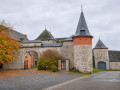
A hike in the Condroz region, starting from the small village of Foy-Notre-Dame on a rolling plateau with pleasant trails, including the Chemin des Pèlerins with its shrines.
Fairytale castle and hermitage against a backdrop of Lesse and Romans
 9.32 mi
+1,224 ft
-1,234 ft
5h 20
Moderate
Departure from Houyet (Province de Namur)
Starting from the beautiful Château de Vêves, set off to explore the meanders of the Lesse and visit the magnificent villages of Furfooz and Celles (selected as among the most beautiful villages in Wallonia).
The Lesse and the castle trails
 9.89 mi
+984 ft
-981 ft
5h 25
Moderate
Departure from Houyet (Province de Namur)
Between Gendron, Furfooz and Chaleux, this hike plunges into the heart of the Lesse valley, between limestone cliffs, deep forests and villages steeped in history. The river has carved out spectacular rocks such as the Roche du Curé and the Aiguilles de Chaleux, offering superb views.
The route passes through unspoilt woods, rich in flora and fauna, and runs alongside the Lesse and the Forges stream, a reminder of the local industrial past. Perched castles, including Walzin and Vêves, and the Roman remains of Furfooz complete this landscape where nature and heritage complement each other.
Long circular loop of the Lesse ladders
 11.75 mi
+1,194 ft
-1,188 ft
6h 25
Moderate
Departure from Dinant (Province de Namur)
Starting from Gendron-Celles station, this is a beautiful hike, mostly along the water's edge, mainly on paths and trails, with a few sections on roads when crossing villages.
On the first part, mainly between points (3) and (4), ladders and steps allow you to stay as close as possible to the Lesse, and the second part, between points (4) and (10), offers a different way to discover the Lesse, which has remained very wild, and breathtaking views.
This route is a combination of various local routes andGR® trails that run along the lower Lesse.
The circular can easily be split up to reduce the distance or avoid certain difficulties; see the practical information.
An excellent walk to prepare for more technical hikes.
Please note: with regard to accessibility, please read the practical information carefully before setting off.
Walzin, Chaleux and the ancient Roman camp
 8.82 mi
+1,004 ft
-994 ft
4h 55
Moderate
Departure from Dinant (Province de Namur)
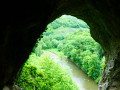
Starting from the small car park at the end of Pont-à-Lesse, this walk takes you on a journey of discovery, covering less than 15 km, to some of the most interesting sites in the Lesse Valley just before it joins the Meuse at Anseremme: Walzin Castle perched on its rock overlooking the river, the Aiguilles de Chaleux, part of the Furfooz Nature Reserve and the ruins of the Roman Camp (please note: there’s an admission charge!), the pretty village of Furfooz, and the Ferme de Sûre, which overlooks the agricultural plateau.And for those who are unaware, the Lesse has another sinkhole apart from the Gouffre de Belvaux and its resurgence at Han-sur-Lesse. There is a partial sinkhole at Furfooz, slightly downstream from Gendron Gare, with a resurgence after the Aiguilles de Chaleux. The ‘Trou qui Fume’ is situated directly above the underground course and sometimes emits steam in winter when there is a marked difference between the temperature inside (the cave) and outside (frost).
A walk in Anseremme
 9.83 mi
+1,201 ft
-1,178 ft
5h 35
Moderate
Departure from Dinant (Province de Namur)
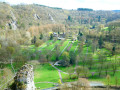
Anseremme is all about the Meuse and the Lesse... whether you choose one or the other, or both, the trip is usually very pleasant. It’s best done at midday on a lovely sunny day when the Lesse isn’t overrun by thousands of kayakers... The route offers some stunning panoramic views from the heights over Pont-à-Lesse and Chaleux, from the banks of the Lesse over Walzin Castle, or across the countryside around Dréhance and Hordenne. The Chawia ravine or gorge is very pretty!
Dinant, martyred town, August 1914
 8.64 mi
+814 ft
-794 ft
4h 40
Moderate
Departure from Dinant (Province de Namur)
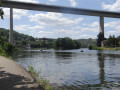
Dinant, daughter of the Meuse, with its citadel, collegiate church, Rocher Bayard, river boats, and home of Adolphe Sax and Father Pire (Nobel Peace Prize winner). Dinant and its bloodstained banks in August 1914. Caught in a pincer movement between the Imperial Army and the French Army, it paid a heavy price for this situation. 674 civilians were massacred by the German Imperial Army. The route is a memorial route of this historical episode, which I invite you to discover.
Between the Meuse and Lesse rivers in Anseremme
 11.52 mi
+640 ft
-623 ft
5h 50
Moderate
Departure from Dinant (Province de Namur)
This long circular route takes you on a journey of discovery along the Meuse and Lesse rivers in one of the most beautiful parts of their course, with impressive rocks and splendid castles. Mainly wooded but also a little rural on the heights of Falmignoul, it does not present any major difficulties and is ideal for families.
For more walks, use our search engine .
The GPS track and description are the property of this route's author. Please do not copy them without permission.

