Circular route between Saint-Jean-de-Rebervilliers and Châteauneuf-en-Thymerais

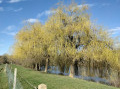
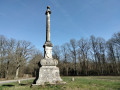
A circular route starting from Saint-Jean-de-Rebervilliers. Largely through woodland, it leads to Châteauneuf-en-Thymerais. After setting off through the forest, the route crosses the Rond de France, where a beautiful stone column stands, locally known as the ‘pyramid’. After passing through the town centre, the return route takes you back through the forest, past the Château du Jaglu and then the Église Saint-Jean, ending near the pretty pond with its pleasantly landscaped surroundings.

Details

91568274
Creation:
Last update:
Last review:
  • Walking
    Activity: Walking
  • ↔
    Distance: 11.24 km
  • ◔
    Average duration: 3h 20 
  • ▲
    Difficulty: Moderate

  • ⚐
    Back to start: Yes
  • ↗
    Ascent: + 38 m
  • ↘
    Descent: - 38 m

  • ▲
    Highest point: 215 m
  • ▼
    Lowest point: 176 m

Description of the walk

Start from the Town Hall in Saint-Jean-de-Rebervilliers via the D928, 4 km north of Châteauneuf-en-Thymerais. Parking along Rue de la Mairie.

Yellow and red markings

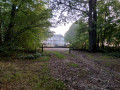
(S/E) From the junction with the Grand Rue (public space – wash house – picnic table – children’s play area), follow the path to the right along the edge of the pond. Reach the D928. Cross it carefully at the pedestrian crossing and follow the path almost directly opposite that leads into the forest. Continue to Rond de St-Jean, the junction with the Route forestière de Belle Croix, where you leave the GRP® Vallées de la Blaise et de l'Avre.

No signposting

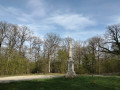
(1) Follow the path on the left to the Rond de France (pyramid).

(2) Take the third exit on the right, heading due west along the path that leads to the edge of the forest. Take the winding bridle path on the left, staying close to the edge of the forest, and continue to the D323.

(3) Cross it carefully and turn left onto the path that climbs towards the Rond de Brouvilliers. (Picnic tables)

(4) Follow the Route Royale to the right (this long, stony track crosses the entire forest from north to south and forms its backbone).

(5) After about 500 m, leave it and take the path on the left (between plots 72 and 73).

(6) After about 200 m, turn onto a well-marked path on the ground leading off to the right. Follow it for a long way until you reach the edge of the forest at the corner of Rue de la Grande Noue.

(7) Follow this street straight ahead along the industrial estate, cross Rue Albert Thomas and continue to Rue Émile Vivier, passing near the wayside shrine, where you will rejoin the GRP®.

Yellow and red markings

(8) Turn right onto Rue Émile Vivier (D928) then Rue Maurice Violette until you reach Place du Marché.

(9) Pass to the right of the town hall via the passageway that joins Rue Hubert Latham (D939). Follow it to the right for 100 m, then turn left into Rue de l’Église, leaving the GRP®.

No signposting

Continue to the church (open to visitors).

(10) Retrace your steps and turn right onto Rue du Pont de la Vierge, then left onto Ruelle Piquet, which leads back to Boulevard Jean Jaurès (D928), and left at the junction in front of the town hall.

(9) Cross at the traffic lights and turn right onto Rue Jean Moulin. At the small car park, cross at the pedestrian crossing and take Rue Drouaise on the left. Turn left into Rue de La Petite Friche.

(11) Opposite the secondary school, turn right onto Rue du Chemin de Fer (D140) until you reach the junction at the end of the swimming pool car park. Turn left onto Chemin du Calvaire (D140), running alongside the car park, and continue to the large junction (D928); keep to the right and follow the road to the entrance of the large Jaglu forest lane.

Yellow and red markings

(8) Turn right onto it and you’ll reach the Rond du Calvaire (picnic tables).

(12) Follow the gravel road straight ahead to the Château du Jaglu.

(13) In front of the castle, turn left, follow the small road and then, at the bend, leave the GRP® to continue straight ahead on the path.

(14) About a hundred metres before the D928, take the bridle path on the right at the edge of the woods, which runs almost to the D928.

(15) Follow the D138 to the right, then take the first path on the left. Walk past the church of Saint-Jean. (Enter via the cemetery to see its façade). Continue along Rue de l’Église. At the crossroads, head straight on to the town hall to return to the starting point. (S/E)

Waypoints

  1. S/E : km 0 - alt. 177 m - Saint-Jean-de-Rebervilliers Town Hall
  2. 1 : km 0.49 - alt. 177 m - Rond de Saint-Jean
  3. 2 : km 1.22 - alt. 186 m - Rond de France (Forêt de Châteauneuf)
  4. 3 : km 2.89 - alt. 186 m - Crossing the D323
  5. 4 : km 3.29 - alt. 196 m - Rond de Brouvilliers
  6. 5 : km 3.62 - alt. 195 m - Path between plots 72 and 73
  7. 6 : km 3.84 - alt. 197 m - Junction
  8. 7 : km 4.94 - alt. 201 m - Rue de la Grande Noue
  9. 8 : km 5.32 - alt. 204 m - Rue Emile Vivier
  10. 9 : km 5.89 - alt. 213 m - Châteauneuf-en-Thymerais Town Hall
  11. 10 : km 6.05 - alt. 215 m - Église Notre-Dame (Châteauneuf-en-Thymerais)
  12. 11 : km 6.91 - alt. 209 m - Secondary school
  13. 12 : km 7.67 - alt. 199 m - Rond du Calvaire (Forêt de Châteauneuf)
  14. 13 : km 8.64 - alt. 193 m - Château du Jaglu
  15. 14 : km 9.29 - alt. 191 m - Horse riding track 100 m before the D928
  16. 15 : km 10.33 - alt. 184 m - D138 road
  17. S/E : km 11.24 - alt. 177 m - Saint-Jean-de-Rebervilliers Town Hall

Notes

Please wear waterproof footwear. Forest paths can be very wet.

During the hunting season, check the hunting calendar for the Châteauneuf-en-Thymerais state-owned forest on the website of the Comité Départemental de la Randonnée Pédestre 28 https://eure-et-loir.ffrandonnee.fr/. No hunting takes place on Sundays and public holidays in the state-owned forest.

The resumption of construction work on the Châteauneuf Western Bypass is scheduled indefinitely. Work is currently suspended. This route may be affected when work resumes. Please exercise caution if you unexpectedly encounter a construction site. The GRP® has been temporarily modified in anticipation of the resumption of works from the south of Châteauneuf to Saint-Jean-de-Rebervilliers. Its route will be updated as works progress.

Worth a visit

The Rond de France pyramid(2) marks the boundaries of the municipalities of Châteauneuf-en-Thymerais, Saint-Maixme-Hauterive and Saint-Jean-de-Rebervilliers. The forest is home to two 18th-century ‘pyramids’ at Les Ronds de France and Les Ronds du Roi. These structures are thought to have served as boundary markers and rallying points for hunts under the Ancien Régime. Roe deer, stags and does are abundant here, and hunting is still practised.

Châteauneuf-en-Thymerais , asmall town of almost 3,000 inhabitants, owes its name to the replacement in 1059 of the nearby castle of Thimert—first captured by William the Conqueror and then razed by the King of France—with a new fortress. Until recently, it was the administrative centre of the canton. The new administrative division has attached it to the canton of St-Lubin-des Joncherets.

The town hall (9) is an irregular polygonal building opening to the west. The style is Neoclassical: a series of semicircular arches forming a porch onto Rue Jean Moulin, a sculpted pediment, a bell tower with a double dome, and a clock taken from the old market halls. On the former market square, the building features a curved façade with four bays of openings surmounted by a dormer window framed by volutes.

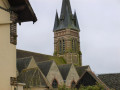
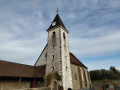
Church of Notre-Dame de Pasme in Châteauneuf-en-Thymerais ( 10)Having survived the destruction of the fortress in 1591 , the castle chapel became a parish church. It was an important regional place of pilgrimage. This form of worship, widespread in Italy, was established in the Thymerais region by a lord of Châteauneuf from the branch of the Princes of Mantua.

From 1200 onwards,the Thymerais formed a single, large fiefdom centred on Châteauneuf-en-Thymerais. The castellany of Châteauneuf-en-Thymerais extended over an area roughly bounded by the Avre to the north and the Eure to the south and east.

The Château du Jaglu. The Manoir de Jaglu, near Bigeonette in Saint-Sauveur-Marville, belonged to the d’Épinay Saint-Luc family. It was partly destroyed during the Revolution and then rebuilt from 1844 onwards.

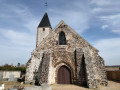
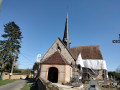
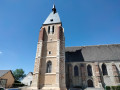
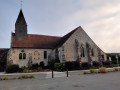
The church of Saint-Jean-de Rebervilliers. The lower part of the present-day church was, in the 12th century, a small priory that was dependent on the nearby Abbey of Saint-Vincent.

Based on online sources.

Other walks in the area

For more walks, use our search engine .

The GPS track and description are the property of this route's author. Please do not copy them without permission.