Country:

 City:
City:


Start from the Ahüzki inn, just above the Col de Burdin Olatzé, which links Soule (Mauléon-Licharre) and Lower Navarre (Saint-Jean-Pied-de-Port) via the RD 117. Park at the pass and walk up to the inn.
(S/E) Head to the inn, then go round it to the right. Ignore a path veering off to the left as you come out of the bend.
(1) The actual start of the circular route. Follow the small road uphill to the second bend.
(2) Leave this road for the path heading left towards the spring. After tasting the water, walk past the fountain, skirting the trough at its base. Pass under a small shrub—one of the few you’ll see at the start of the route—before setting off along a very faint track.
Regular markings, made using small yellow-marked stakes, ensure you stay on track. Keep a close eye on them. Continue along this track until you pass under a rocky outcrop that cuts across the pasture.
A hawthorn tree, standing completely alone on the hilltop marking the boundary of the next valley, signals the start of the descent.
(3) As you approach it, turn left and descend the ridge of the hillock until you reach a copse. Pass to the right of it. Be careful: as you go round the copse, the path is unclear, the slope is steep, and the ground may be slippery.
Once you have passed the small copse, veer right to finish crossing the pasture and reach a track. Turn right onto this track to reach the Lexarregibela sheepfold.
(4) Pass between the shepherd’s hut and the sheepfold, and follow the bottom of the valley until you reach the forest. Pass a series of sinkholes, some wetter than others, until you reach the largest one, which is also the lowest. As you descend, the terrain closes in and the woodland thickens. Once you reach the last sinkhole, the path seems to disappear.
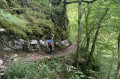
(5) Look out for the small stakes, marked in yellow, which climb the opposite slope, slightly to the right. As soon as you reach a small plateau, the path becomes more visible again, although the vegetation tends to close in. You will soon reach a steep slope, dominated by beech trees, where the path winds its way down.
Stay alert to follow them, as the wooded environment and infrequent use make it easy to lose your way. Rely on the well-established markings. On the descent, ignore the forest track you cross. Shortly afterwards, the woods thin out as the Eltzarre plateau comes into view. Descend to the track that runs alongside it.
(6) Turn left to climb back up the plateau. Strange, this flatness in such a mountainous setting! After entering the beech forest again, look for the entrance to a chasm on the left of the track, where a rope has been left in place. Descent reserved for experts!
(7) After the chasm, the track continues its gentle ascent, crossing a clearing and curving to the left. As the terrain closes in and a jumble of large boulders seems to block the way, you reach an overgrown clearing at a place called Erbinea.
(8) Pass through the clearing, then continue up the track, which is easy but a little monotonous, until you emerge from the forest. You come back to the pastures and soon the Istaurdi sheepfold comes into view.
(9) Pass the sheepfold, leaving the track on your left that leads to the first sheepfold you passed at the start of the route. Continue uphill, then reach the first hairpin bend.
(10) Leave the track, heading slightly uphill to the left to go round the wooded bottom of the ravine. Several parallel tracks wind through the pasture. Once again, take care not to lose sight of the marker posts, which are sometimes quite inconspicuous. Cut across a valley on the left, then continue along the ravine, which narrows as you climb. Climb up to Col Inharpu and the road that runs through it.
(11) Follow the road to the left, gradually moving away from it. The path then runs a few dozen metres above the road, initially following a rocky ledge. Afterwards, the slope becomes steeper and the track runs along a ledge above the drop. Take care on this section!
Above the inn, rejoin the road leading up to the fountain.
(1) Turn right and follow the road back to the cars (S/E).

 Visorando Member
 Easy
Easy 
 Local authority