Country:

 City:
City:



Please note: I’m quoting here a comment from a Visorande user who isn’t very used to hiking in the wilderness:
“If you fancy getting lost this summer amongst the ferns and ticks, this walk is for you.
The route is impossible to follow; the ferns hide any trace of a path. The signposting is virtually invisible in summer.”
Although very close to the town – and therefore frequented by people more accustomed to pedestrianised streets than to hiking trails – we are here in the mountains, in the low mountains to be precise. If you stray from the marked path, you risk finding yourself above dangerous cliffs (marked in bold black lines on the map).
The scene is set!
From Lourdes town centre, head for the slopes of the Béout by following signs for ‘la Cité Saint-Pierre’, ‘Padre Pio Auditorium’ or ‘Village des jeunes’. Park either near the entrance to the Cité Saint-Pierre or in one of the complex’s car parks (provided the security staff agree to let you in, particularly in the low season).
(S/E) Enter the site via the tarmac-surfaced local road that runs through it. Head quickly up towards the higher ground, passing two large accommodation blocks on your right (the Saint-Vincent-de-Paul and Ozanam Pavilions) and another large building on your left (marked ‘Bureau des guides’ and ‘Accueil’).
Continue uphill. You will then pass a series of three further accommodation blocks on your right (labelled “Sainte-Anne”, “Saint-Martin” and “Saint-Jacques”). Continue the ascent, still on a small tarmac road running alongside the edge of a woodland on the left, bordered by a rustic stone wall and meadows on the right. Pass a two-storey barn on the hillside and continue along the road, still within the grounds of the “Cité Saint-Pierre” complex, towards Mouniquet Farm.
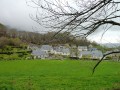
(1) At the 526-metre mark, there is a small car park on the right and a wooden sign reading “Béout” (photo).
Do not continue towards the farm buildings on the left (Mouniquet farm), which are private property under a tenancy agreement.
Follow the sign and go through a zigzagging livestock gate. At this point, you leave the estate’s grounds.
As has been the case since the start of the route, you will now follow a circular route with no signposting whatsoever. Take care not to stray from the clearly marked paths or the occasional faint tracks. Immediately after the gate, turn left along the wire fence, heading up the embankment. A path then climbs to the right for a few dozen metres across a meadow. Stay on the right-hand side of the hillside; do not cut across the meadows.
When you reach a small ‘pla’ (a clearing), which may or may not have been mown depending on the season, take a sharp left to pass upstream of a short hedge of trees with a low stone wall at its base. There isn’t always a clearly marked path (especially at the start of the summer season, when it hasn’t yet been used).
Do not attempt to go round the small hollow of Turoun Esplat on the right. Make your way to its modest summit at 633 m above Mouniquet and head roughly south. At the end of this new ‘pla’, at the 620-metre mark, the slope becomes very steep.
However, continue along this path to the right towards the cross at the summit of Béout. This takes you away from the western cliffs.
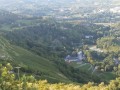
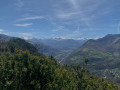
(2) You reach the summit at 791 m. From up there, you can see the town of Lourdes and its surroundings, the Arboucau valley and the Soum d’Ech to the west, the Batsurguère valley to the south-west, the main range of the Pyrenees in the distance to the south, and its ‘big brother’ and rival, the Pic du Jer (948 m), with its funicular railway.
We then continue the route towards the viewpoint by the old cable car station and the radio communications mast, which comes into direct view.
The path descends through the ferns. Following the ridge, you pass by a first isolated rock outcrop, clearly visible from a distance (photo), then at the 765-metre mark you reach a group of two outcrops (photo), including the famous ‘Mysterious Rock’, marked on the IGN map. These granite boulders, whilst all the other rocks here are limestone, have long been a source of mystery, hence the name ‘Mystérieux’. Today we know that they were carried here by glaciers and probably originate from Cauterets or Gavarnie. They are classified as ‘erratic boulders’.
The final stretch of the route via the small pass of Béout, between the Grand Béout (the cross) and the Petit Béout (the antenna), is rather rugged, winding through sharp limestone pavement and dense, low-lying vegetation (photo).
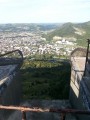
(3) It takes 1 hour 15 minutes to reach the viewpoint from the start (for keen walkers; allow 1 hour 30 minutes to 1 hour 45 minutes if taking breaks). The view over Lourdes and the surrounding area is very interesting. The place has an air of mystery as it lies virtually abandoned after a glorious past.”
We are facing the Pic du Jer, which stole the limelight from the Béout in the late 1980s. Indeed, the Béout cable car, which had become obsolete and was too costly to renovate, was taken out of service in 1986. However, until 2000, the cable car’s two cabins remained suspended from their cable until the installations were dismantled.
For its part, the Pic du Jer funicular, built in 1900, has seen more than a century of operation and undergone two renovations that have successfully preserved the historic character of the installation. Its operators developed other activities at the summit, which have helped to make it a major tourist attraction in L’Heure-de-Lard to this day.
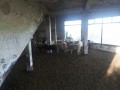
On our viewing platform and in the premises of the old station – exposed to the elements and left to fall into disrepair – sheep have made the area their own.
There is a curious atmosphere here, as at all sites from the industrial era that people have abandoned, yet without removing the remnants of the past.
Continuing south-east, you soon come across a badly rusted sign, on which you can still make out the word ‘Gouffre’ alongside an arrow, and a steel handrail, embedded several metres into the rock.
This path leads, a few hundred metres further down, to the “Gouffre de Lourdes” and the cave’s former technical and visitor facilities.
Return via the rear of the buildings and head back to the first electricity pylon at the start of the descent, to the north-east. This marks the start of a fairly well-marked path, although it is very steep and quite slippery.
NB: as the section that follows is very little used, the path may be overgrown with ferns (particularly in summer). You can also choose to return via the path you took on the way there (in which case, head back via (2), then (1), then (S/E).
(4) Reach a small ‘plain’. Head straight left, even if the ferns are particularly tall depending on the season. Take a chimney where you’ll need to ‘use your hands’. Further down, join a well-marked path heading north-east. This path quickly winds its way between rocky outcrops where you’ll need to use your hands. A short, safe descent through the wooded gap.
(5) At the bottom of the path, you’ll reach an open plateau (the Lourdes Trial Club grounds).
Immediately turn left onto the small, well-marked path through the undergrowth.
Then continue left along the track which leads to a gate that you can easily walk through.
(6) You’ll reach the start of the tarmac path, near the uninhabited Doucet farm, at the top of the hamlet of La Citoyenne, and then the starting point in Milhas (S/E).




 Visorando Member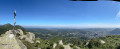
 Moderate

 Easy
Easy