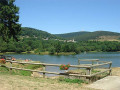
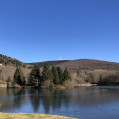
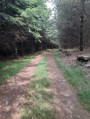
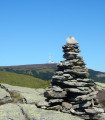
Circular route through the Nore forests via the Pic de Nore.

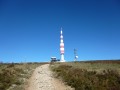
A circular route through the Nore National Forest, passing through the Nore gate and the Pic de Nore, also known as the little Ventoux for its climate and its red and white telecommunications tower. The climb through the conifer and beech forests is gentle, but the descent to Pradelles-Cabardès is steep! In winter, it is possible to do all or part of the route on snowshoes, depending on snow conditions. Be careful, there is a ford to cross!

Details

90993396
Creation:
Last update:
Last review:
  • Walking
    Activity: Walking
  • ↔
    Distance: 18.11 km
  • ◔
    Average duration: 6h 40 
  • ▲
    Difficulty: Moderate

  • ⚐
    Back to start: Yes
  • ↗
    Ascent: + 520 m
  • ↘
    Descent: - 519 m

  • ▲
    Highest point: 1,209 m
  • ▼
    Lowest point: 804 m

Description of the walk

There is an unmarked car park at the start of the forest track at the RD112-RD9 crossroads. You can also park in the village of Pradelles and start the hike from there.

(S/E) Start by taking the carriage road that climbs northwards, with a view of the Roc de Nouret. The path (a forest road) climbs and passes through the heart of the planted forests with a few recently cut plots. Continue for about 2 km until you reach the junction with a track on the right coming from Pradelles (sign).

(1) Continue straight ahead. The rest of the route is flat, leading to a crossroads with numerous paths.

(2) Continue straight ahead on a forest track that hardly climbs at all, leaving a wide path that climbs up on your right, and begin a gentle descent before a wide right-hand bend that joins a slight hairpin bend where the Rieu Cros crosses the track via an underground structure.

(3) The track climbs up the other bank, moving away from the stream, and 200 m after a right-hand bend, you will reach a fork.

(4) Take the dirt track on the left, which descends. Follow it to the Ruisseau de Combe Escure.

(5) As the footbridge is in ruins, you will need to wade across the stream. Depending on the season, the water may be calf-deep. Continue on the other bank, climbing up a hairpin bend.

(6) At the top of the path, turn right and continue uphill on the wide dirt track with a left-hand bend. At a T-junction, turn left and after 100 m you will reach a more passable forest track with a hairpin bend at this junction.

(7) Take this track to the right uphill and join the Croix des Vaissières, which marks an intersection.

(8) Continue straight ahead on a slight descent and rejoin the Route de Forestière de Roquetaillade coming from the left. Continue straight ahead on a steady, easy climb up the mountainside until you reach the shared route of the GR®36 and GR®7.

(9) Turn right onto another track, then 20 to 30 metres further on, leave this track and turn left onto the GR®36-GR®7 path, which climbs through the undergrowth to a crossroads.

(10) Turn left onto a section that descends slightly before climbing again for the final section that leads to the Portail de Nore.

(11) Continue either on the GR®36 or, with caution, on the RD87, which has very little traffic (see practical information for the reason why I chose to take the road) and reach the Pic de Nore, which is visible from the Portal.

(12) Go to the orientation table and retrace your steps to take the GR®36 on the right, which descends. Cross the road twice within 250 metres and continue downhill over the rocks. Cross the Roquo d'Astié, a pile of boulders. Continue downhill, which becomes steeper with some slippery sections on exposed rock. After a wide bend to the right, the slope levels out and the path crosses the Arnette via a rocky bridge. Continue left towards the village of Pradelles-Cabardès.

(13) At the fork where the path splits in two, take the upper path on the right. The next fork leads to the same point, but the left path is the most direct: it follows the Chemin des Combes, which becomes Rue des Barris and leads to Place de la Tour (lodge on the right).

(14) Continue straight on along Grand Rue and, after the last houses, follow the road downhill alongside the cemetery. It leads to the D112.

(15) Take this road carefully to the right (towards Mazamet on the road signs). Leave the village and, after a slight bend to the right, turn right onto a path. Follow it along the edge of a wood and then a field to the car park (S/E).

Waypoints

  1. S/E : km 0 - alt. 805 m - Unimproved car park, start of the forest track.
  2. 1 : km 1.66 - alt. 866 m - Les Bayours
  3. 2 : km 2.8 - alt. 867 m - Crossroads
  4. 3 : km 3.76 - alt. 823 m - Rieu Cros
  5. 4 : km 4.26 - alt. 840 m - Fork
  6. 5 : km 4.8 - alt. 807 m - Combe Escure stream
  7. 6 : km 5.24 - alt. 855 m - Fork in the road
  8. 7 : km 5.61 - alt. 892 m - Forest track
  9. 8 : km 5.97 - alt. 914 m - Croix des Vaissières
  10. 9 : km 8.55 - alt. 977 m - Junction of GR®36 and GR®7
  11. 10 : km 11.01 - alt. 1,132 m - Forestière des Loups trail
  12. 11 : km 12.17 - alt. 1,150 m - Nore Gate
  13. 12 : km 13.81 - alt. 1,209 m - Pic de Nore
  14. 13 : km 16.42 - alt. 837 m - Fork - Arnette (rivière)
  15. 14 : km 16.85 - alt. 837 m - Place de la Tour
  16. 15 : km 17.18 - alt. 821 m - D112
  17. S/E : km 18.11 - alt. 806 m - Unimproved car park, start of the forest track.

Notes

There is no drinking water on the route except in Pradelles, but that is at the very end of the hike.

From (9) to (14): red and white markings (well signposted) of the GR®36, shared with the GR®7 from (9) to (12).

Shorter alternative: the Chemin des Vaissières allows you to go directly from (8) to (10), but the climb is steeper.

The descent to Pradelles is a little technical with lots of stones and exposed rocks. Snowmelt and runoff water flow along this path for much of the descent, particularly at the start up to Roquo d'Astié: walking poles and waterproof shoes are recommended.

The hike can be done entirely or partially on snowshoes, depending on weather conditions. In summer, the undergrowth and streams provide welcome coolness.

Weather: the Montagne Noire has a unique climate. The weather can change quickly; on the ridge (from the Portail de Nore to the peak), the wind can blow very strongly (especially the tramontane) and can make the temperature feel much lower (especially in winter), especially as the forest has provided shelter beforehand. You need to be properly equipped: bring gloves, a hat and an extra layer in your bag. Snow is becoming less and less common (in terms of frequency and duration), but its absence on the southern slope does not mean that it will be the same on the northern slope, which this route takes. On this slope, snow is generally present between 900 m and 1000 m altitude if the summit of Pic de Nore is snow-covered. Snowdrifts can be found on the summit.

Weather conditions on 30/01/2026: there was patchy snow on the forest track between (9) and (10) with some melting and it was possible to walk without difficulty in hiking boots. After (10), I found snow at an altitude of around 1050 m. I put on my snowshoes (that's why I came) and the snow cover quickly exceeded 30 cm (snow up to mid-calf). A vehicle had the bright idea of driving on the GR®36 between (11) and (12), making it impassable (ruts, mud), so I took the road, which was clear on this section. The GR® option is preferable. I put my snowshoes back on at thesecond crossing of the RD87.

Worth a visit

View of the Roc de Nouret.

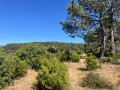
Crossing the Nore forests.

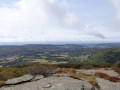
Pic de Nore and its panoramic view of the Pyrenees if the horizon is clear.

Always be cautious and plan ahead when you're outdoors. Visorando and the author of this route cannot be held responsible for any accidents occurring on this route.

The GR® and PR® markings are the intellectual property of the Fédération Française de Randonnée Pédestre.

Other walks in the area

For more walks, use our search engine .

The GPS track and description are the property of this route's author. Please do not copy them without permission.