Belvédère des Deux Lacs from Le Brey

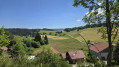
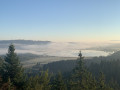
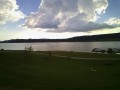
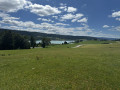
This varied route has a special charm, taking in very different environments: lakes, marshes, peat bogs, rivers, meadows and forests. The highlight is the Belvédère des Deux Lacs, which offers a unique view of the Lac de Remoray National Nature Reserve and its natural environments.

Details

64039356
Creation:
Last update:
Last review:
  • Walking
    Activity: Walking
  • ↔
    Distance: 5.23 km
  • ◔
    Average duration: 1h 45 
  • ▲
    Difficulty: Easy

  • ⚐
    Back to start: Yes
  • ↗
    Ascent: + 126 m
  • ↘
    Descent: - 125 m

  • ▲
    Highest point: 963 m
  • ▼
    Lowest point: 866 m

Photos

Description of the walk

Car park behind the town hall in the hamlet of Le Brey.

Yellow-blue signposts

(S/E) Go down the village via Rue Principale, below the D437 (large farms). Cross a road (wash house) and continue opposite along the street that leaves the hamlet, then skirt the D437 and join Rue du Fuverat, which leads to an industrial estate.

(1) Take the small grassy path that climbs up opposite, turn right to follow the craft area, then descend to the left to enter a sparse forest, which is more shaded. Cross the Ruisseau du Lhaut via a wooden footbridge and continue on to a forest road (Forêt Domaniale du massif du Mont-Sainte-Marie). Head downhill to the left.

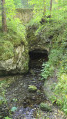
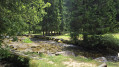
(2) Don't miss the opportunity to take a detour down a tiny, barely visible path on the left to see the Capucins spring, which emerges from a hole on the right and is a picturesque and refreshing place to stop (on the IGN map, the spring appears to be further on, but this is not the case). Return to the Lhaut bridge. Cross the D437 with caution, go up it on the left for about ten metres, then turn right.

(3) At the junction with a farm track, climb up the embankment and take the path that climbs up and overlooks the road. Climb gradually through the forest to reach the Remoray road. Take it on the left without joining the D437.

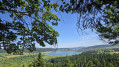
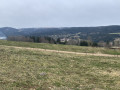
(4) Walk along the car park to reach the Route Forestière Marcel Goux, and climb this road on the right for 100 m, then take a steep path on the left (picnic table). Turn left again to reach the Belvédère des Deux Lacs. In the foreground is Lac de Remoray and its ring of peat bogs, classified as a National Nature Reserve, and in the background is Lac de Saint-Point, one of the largest natural lakes in France.

(5) With your back to the viewpoint, return via a path to the south, through the forest, which crosses a pasture to join a road below the hamlet of Le Brey.

(6) Go up the road on the right towards Les Bretilles.

(7) Descend to the left (viewpoint) along a farm track lined with low walls covered in ash trees. Cross the D437 with caution and return to the starting point (S/E).
Waypoints

  1. S/E : km 0 - alt. 910 m - Breux Town Hall car park
  2. 1 : km 0.8 - alt. 911 m - Crafts area
  3. 2 : km 2.08 - alt. 875 m - Source des Capucins
  4. 3 : km 2.49 - alt. 867 m - Path overlooking the road
  5. 4 : km 3.02 - alt. 881 m - Car park on the D437
  6. 5 : km 3.5 - alt. 939 m - Belvédère des Deux Lacs
  7. 6 : km 4.76 - alt. 920 m - Les Bretilles
  8. 7 : km 4.88 - alt. 932 m - Fork in the road to the left
  9. S/E : km 5.23 - alt. 911 m - Breux Town Hall car park

Notes

The route is mostly exposed to the sun. Avoid in hot weather.

Picnic table near the car park at the Belvédère des Deux Lacs (5), in the shade but without a view.
Several benches in the shade at the Belvédère des Deux Lacs, with a magnificent view, are ideal for a break or a picnic.

Worth a visit

Belvédère des Deux Lacs: in the foreground of this viewpoint is Lake Remoray and its crown of peat bogs, classified as a National Nature Reserve since 1980; and in the background, Lake Saint-Point, one of the largest natural lakes in France. A true sanctuary of biodiversity, the Lac de Remoray Reserve is home to remarkable flora and fauna, particularly associated with wetlands: common snipe, water rail, superb carnation, meadow primrose, copper-coloured bistort, white-fronted snipe, etc.

Source des Capucins: at the beginning of the century, the municipality of Frasne had a gallery built to capture water (Fournier). Traces of the construction remain in the form of a dry stone wall. It is a permanent spring with a siphon 15 m from the entrance. The siphon is partially blocked by debris from the road that passes just above it. The flooded gallery was recognised on 16 June 1974 by the Groupe Lémanique de Plongée Souterraine (Lake Geneva Cave Diving Group) at a depth of 43 m and less than 10 m below ground level. The spring is still active today, and the water flows clear, even during medium floods.

Other walks in the area

For more walks, use our search engine .

The GPS track and description are the property of this route's author. Please do not copy them without permission.