Date of your route : Sep 06, 2026
Reliability of the description : Not used / Not applicable
Ease of following the route : ★★★★☆ Good
Route interest : ★★★★★ Very good
Very busy route : No
I stand by the‘Very good’ rating I gave your route, Karcheryves. But that is without relinquishing my right to offer you a firm rebuke. Others (Maminouxe, Demonfra, Nine 68, User 8197954, etc.) have done so before me, but I hadn’t noticed.
Towards the end of the route (7 to 1), there is a steep climb – which you must surely be aware of but have omitted – even though you mentioned the initial climb in section S/E. Yet that climb alone should have been enough, without anything else, to deter walkers with pushchairs right from the start… Whereas between points 7 and 1, once you’ve reached this climb, there’s no turning back.
In good faith, one does not choose the ‘Balade au Col de Fouchy’ on Visorando lightly, but relies solely on the information provided in the description: the header, the basic details, the reviews, not forgetting to examine the map at full zoom. Yet in your header, you’ve opted for dubious humour rather than any other warning to the public, other than the ‘oddballs’ with pushchairs… (and why not those wearing flip-flops or gladiator sandals?).
These warnings are, however, essential for safety reasons; they are useful, for example, depending on one’s state of health, to (real) families and to the elderly – even those in good shape – far more so than to Sunday dabblers!
Below, I’d like to show you how only a tedious, excessively thorough examination could have warned me, whereas you yourselves could have done so – if not in the introduction, then at least in point 7, where it was essential!
HERE IT IS:
I have no doubt that the map representations of Visorando walks aim to piece together extracts from IGN maps as carefully as possible. Here and there, from one extract to the next, the contour lines do not always ‘match’ perfectly, but according to these representations, to within plus or minus 5 metres, the elevation profile is reliable.
As for estimating distances (paths and routes): the window in the bottom left-hand corner representing ‘100 metres’ varies depending on the map’s zoom level. This estimate remains approximate but is nonetheless a fair approximation. However, dear Pythagoras, it is necessarily horizontal, and its actual length in three dimensions is therefore slightly greater.
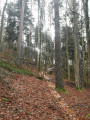
Bearing this in mind: the route from point 7 to point 1 corresponds to a path running from approx. 590 m to 667 m in two sections: the first a pleasant long descent, the second an ascent. It is this latter section that interests me: according to the map, it begins – let’s try to be precise – at 555 m and ends at point 1, which is said to be at 667 m, representing a 112-metre elevation gain.
On my screen now: the distance from 555 to 667 is 110 mm. And in the window at the bottom left, ‘100 m’ = 26 mm. Based on this data, the 110 mm corresponds to 110/26, or 4.23 times 100 metres. But these 423 metres are the horizontal length of the path. According to Pythagoras, 4232 + 1122 = 437.58 metres. The actual length of the climb is therefore approximately 438 m.
So, what is the gradient percentage for a 438-metre path climbing to an altitude of 112 metres?
Gradient = (438/112) × 100 = 25.6. The path therefore has an average gradient ofapproximately 25.6 per cent.
This corresponds to an incline of approximately 14.4°.
Of course, there’s the ‘adventure’… Of course, I could have carried out the tedious calculation above before setting off…
I urge you, Karcheryves, to amend your listing no. 19017345 as a matter of urgency: we found this surprise only… moderately enjoyable; and, following other unexpected features of the terrain – irregularities that sometimes required sustained attention – it completely spoiled the genuine pleasure of the ‘Walk to the Col de Fouchy’.
Machine-translated



 Country:

 City:
City:




 Visorando Member

 Difficult
 Tourist office
 Easy
Easy