Country:

 City:
City:


Access to the starting point: After passing the road that climbs to the right to Grand Soulage, the road turns left just after the junction that leads to Hermuzière. Park on the left next to the wooden waste sorting bins.
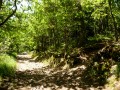
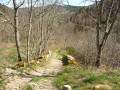
(S/E) Take the Affortis trail that climbs opposite the road. The gentle climb up this rarely used road takes you to the Boirayon buildings. As you approach the buildings, the road continues to the right (dead end), and a grassy path leads to the buildings. Continue straight ahead as if you were going to these buildings until you see a path leading off to the left.
(1) Littered with fallen trees (but some have been cut away), it crosses a stream after a descent through the undergrowth. After the stream, it climbs back up to the hamlet of Gonnet along a path that gradually widens.
You will see the Rocher de Mahun, below which lies the hamlet of Gonnet.
(2) When you reach the tarmac road, cross it and walk past the houses on the right. Climb a little further and take the wide grassy path on the left that overlooks the houses of Gonnet (yellow and white markings). This path seems to be the old mule track leading from the Rhône valley to Le Puy-en-Velay, which is very pleasant and gently sloping. You will soon pass by a ruin that appears to be very old, judging by the style of the windows (with lintels) in the large section of wall and the vaulted ceiling of the small building that are still standing.
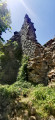
::3: :You will arrive at the Mahun rock, where you can see the two walls of the ruins of the medieval castle of Mahun at the top on your right. The IGN map locates the castle ruins at the hamlet, but in fact they are above the rock. Continue along the path, passing through a beech forest of young trees and then a pine forest to reach La Celle.
(4) When you reach the crossroads at La Celle, take the forest road on the left. After passing a clearing where you can take a pleasant break, take the path that climbs up to the right.
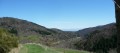
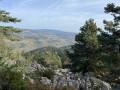
(5) After a few metres, another path branches off to the right. Ignore it and continue straight ahead (red and yellow markings). Continue until you descend to the Col de la Supyère. Don't forget to take in the landscape, which offers a beautiful view of the beginning of the Monts d'Ardèche. When you reach the forest road, take it to the right, then climb the more pleasant path that branches off to the left (red and yellow markings). On the mountain side, this path has a small wall to prevent it from collapsing. Watch out for roots protruding from the ground (which have been damaged by quad bikes).
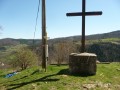
(6) You will arrive at the Croix du Knoll crossroads (on your left). Take the path to the left of the cross and then, immediately afterwards, the middle path (marked yellow and white), which descends very steeply and is very loose, having been badly damaged by motorised vehicles (motocross bikes and quad bikes).
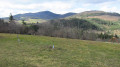
(7) You will arrive at a beautiful wide road lined with a superb old mossy wall. Take it on the right. From there, you will have a panoramic view of the Pays d'Ay and the Vercors mountain range.
A few hundred metres further down, the road ends at a wide track. Cross it to see the start of the path that descends to Mialier, still marked in yellow and white. The path becomes grassier and more pleasant, and may even be crossed by a stream.
When you reach the Ferme d'en Haut de Mialier, cross the forest road that leads to it and take the path opposite, below along the road, which descends towards La Grangette and Le Crouzet. You will pass through the middle of a ruin that borders the path with a low wall on each side. The path continues to descend through the undergrowth until it reaches a tarmac road.
(7) Take the tarmac road on the right to arrive a few metres further on at an intersection where you will see a calvary with a silver cross on your right (shown on the IGN map).
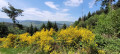
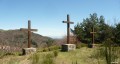
(8) Follow the direction of the Croix du Bosc by taking the beautiful grassy path that climbs to the right and passes above the Grangette farm. You will pass a large wooden cross leaning against the fence of the meadow on your right as you reach the top. Then, after passing through the broom, you will arrive at the three crosses (commemorating the 1929 mission) which are not marked on the IGN map. From here, you have a beautiful view of Saint-Symphorien-de-Mahun and the Vercors hills.
Pass these calvaries and take the path on the left that you will soon come to. Descend to the La Furgonne road, ignoring the path on your left and taking care when you cross the path, which is half grassy and half muddy in wet weather (very slippery). Take this beautiful grassy road on the left; it will quickly become a narrower path. You will finally arrive at a place called "La Croix de Bosc" (without a cross, incidentally!) after crossing the tarmac road. Be careful, as the arrival on the road is sudden and it is not possible to see approaching cars from the path.
(9) Pass the hiking signposts and take the tarmac road that runs below Saint-Symphorien-de-Mahun. Cross a stream via a bridge that leads you opposite the hamlet. Go up the road to the calvary, which marks the start of the path leading to Veyrines (yellow and white markings).
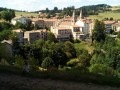
This is a wide, grassy path with a steep incline (which can be very slippery in wet weather) from which you can see the hamlet of Veyrines and its medieval church. You will come to another tarmac road, which you should cross to pick up the path opposite. You will soon reach the road leading to Veyrine. Take this road on the left. Follow it and ignore a road that goes to the right.
(10) Then, when you reach the junction with the D480 leading to Saint-Symphorien-de-Mahun, continue straight ahead (turn right) to return to your vehicle (S/E).





 Visorando Member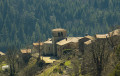

 Difficult