Around Douvres-la-Délivrande

This pleasant semi-urban walk starts in Douvres-la-Délivrande and takes you to Plumetot and Cresserons. In addition to the peace and charm of the surrounding countryside, you will discover a rich and varied architectural heritage, including the British military cemetery and the Basilica of Notre-Dame-de-la-Délivrande.

Details

15192370
Creation:
Last update:
Last review:
  • Walking
    Activity: Walking
  • ↔
    Distance: 10.25 km
  • ◔
    Average duration: 3h 00 
  • ▲
    Difficulty: Moderate

  • ⚐
    Back to start: Yes
  • ↗
    Ascent: + 31 m
  • ↘
    Descent: - 31 m

  • ▲
    Highest point: 56 m
  • ▼
    Lowest point: 19 m

Photos

Description of the walk

Parking is available in the car park of Saint-Rémi Church, Rue Abbé Bellée, between Rue d'Anguerny and Rue du Presbytère.

(S/E) With your back to Saint-Rémi Church, walk up the pavement on the left to Rue d'Anguerny, then turn left to the pedestrian crossing. Cross the street carefully and, a few steps further on the left, take Rue Abbé Bellée. Follow it to the end.

(1) Turn left onto Rue des Noyers, take the second street on the right and walk up Rue de Maître Colleville until you reach Route de Caen (D 7). Keep to the right to reach the traffic lights and the pedestrian crossing, cross Route de Caen (D 7) carefully and head towards the British military cemetery. Keep left towards Rue de la Fossette, then turn right towards the cemetery entrance gate.

(2) Go through the gate and enter the British military cemetery, cross it and exit through the gate onto Rue des Fossettes. Turn right, follow Rue des Fossettes to the end, then turn right onto Rue Alfred Kastler and follow it to the end. Turn left, follow Rue Jean Perrin to the end and cross the roundabout.

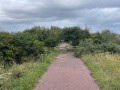
(3) Take the dirt track opposite and follow it for about 700 metres until you reach a crossroads. Cross the D221 road carefully and continue along Bout des Hue for about 200 metres until you reach the first house on the left in the village. Turn right onto the grassy path (Chemin de la Descente de Dieu), follow it for about 600 m, negotiate the left-hand bend and continue to the intersection. Cross Bout Basset, turn left and then immediately right onto the first path.

(4) Follow the dirt track (Chemin du Bas Cachy), cross Chemin du Maréchal at the crossroads and continue straight ahead until you reach the bend. Take the left-hand bend and follow Chemin de Poupinel to the village of Plumetot. Turn left onto Bout aux Charrières (D 222), stay on the left-hand pavement and head towards the church and town hall. Go around Saint-Samson Church on the left, cross Bout Basset and head towards the town hall and the Polish Air Force memorial. Turn right to pass between the town hall and the church, follow Bout de la Burbulence (D 222) on the left-hand pavement, then take the left-hand side road at the exit of the village. Enter the town of Cresserons, continue to a large crossroads, cross it on the left and pass Avenue du Clos du Four.

(5) Cross Rue de Plumetot (D 222) carefully, then take the dirt track that branches off diagonally. Follow the path to the left at both intersections and continue on the left, passing Saint-Jacques Church and the cemetery on your left, and continue to the crossroads. Turn left after the public garden to reach the pedestrian crossing and cross Rue de Caen (D 221) carefully. Turn right towards the bakery and cross Rue de la Charrière. Turn left and follow this street for about 500 metres until you reach a major road (Rue de la Délivrande - D 35). At the last house, use the pedestrian crossing, cross Rue de la Charrière and continue left on the cycle and footpath that runs alongside Rue de la Délivrande (D 35). Continue for about 600 m until you reach the commercial buildings.

(6) Go around the commercial buildings on the left, cross Rue des Hautes Devises using the pedestrian crossing. Continue on the cycle path running alongside Rue de Bourgogne on the right, pass the retirement home on the left and continue to the next crossroads. At the secondary school, turn right onto Rue de l'Arbalète and follow it almost to the end. After the last house on the right, use the pedestrian crossing to cross Rue de l'Arbalète and continue to the right until you reach Rue du Bout Varin (D 35).

(7) Turn left onto Rue du Bout Varin (D 35), stay on the left-hand pavement and head towards the basilica until you reach the large crossroads with Rue de la Basilique (D 83). Keep left until you reach the traffic lights, use the pedestrian crossing to cross Rue de la Basilique (D 83) and continue along Rue du Bout Varin until you reach the basilica. Go around the basilica on the left to reach Rue du Général de Gaulle.

(8) Turn left onto this street, continue to the pharmacy with its very original façade, cross Rue du Général de Gaulle and follow it to the end on the right-hand pavement. At the fork, cross Rue du Chemin du Bord, turn left and continue to the roundabout. Turn right, pass under the buildings, cross Place des Marronniers and go around the post office and nearby buildings on the right, then continue to Voie des Alliés. Use the pedestrian crossing to cross safely, then continue opposite on Promenade Thomas de Douvre for about 600 metres until you reach Rue de la Fontaine.

(9) Cross this street, turn right and, about 20 metres further on, take the path that cuts diagonally across the meadow and goes up to the corner of the Baronnie car park. Go around the two Baronnie buildings on the right, then cross the gardens to the exit leading to Rue de la Poterie. Cross this street, turn left and walk about 50 metres to the first path on the right.

(10) Turn right onto Promenade Thomas de Douvre, go through the gate and walk about 200 metres. At the intersection, turn left and go up Chemin du Val. At the top of the intersection, turn left towards the water tower and follow the Anguerny à la Délivrande road for about 300 metres. At the end of the road, cross and turn left into Rue de la Poterie, leaving Rue d'Anguerny behind and continuing to the second street on the right.

(11) Turn right onto Rue du Presbytère and follow it to Saint-Rémi Church and Rue Abbé Bellée. Turn right onto this street and continue to the car park (S/E).

Waypoints

  1. S/E : km 0 - alt. 28 m - Rue Abbé Bellée next to Saint-Rémi Church
  2. 1 : km 0.13 - alt. 31 m - Rue des Noyers
  3. 2 : km 0.5 - alt. 31 m - Cimetière militaire britannique (Douvres-la-Délivrande)
  4. 3 : km 1.69 - alt. 44 m - Path continuing on from Rue Jean Perrin
  5. 4 : km 3.29 - alt. 51 m - Chemin du Bas Cachy
  6. 5 : km 4.76 - alt. 29 m - Crossroads of Rue de Plumetot and Avenue du Clos du Four
  7. 6 : km 6.26 - alt. 31 m - Commercial area on the RD 35 at the entrance to Douvres
  8. 7 : km 7.21 - alt. 20 m - Rue du Bout Varin (D 35)
  9. 8 : km 7.5 - alt. 22 m - Rue du Général de Gaulle - Basilique de Notre-Dame-de-la-Délivrande (Douvres-la-Délivrande)
  10. 9 : km 8.78 - alt. 23 m - Rue de la Fontaine
  11. 10 : km 9.17 - alt. 27 m - Thomas de Douvre Walk
  12. 11 : km 10.06 - alt. 31 m - Rue du Presbytère
  13. S/E : km 10.25 - alt. 28 m - Rue Abbé Bellée next to the church of Saint-Rémi

Worth a visit

The Church of Saint-Rémi in Douvres-la-Délivrande
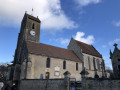
The church, dedicated to Saint Remi and Saint Laurent, is located not far from the Barony, in the town centre. The oldest part appears to be the bell tower, probably built in the 12th and 13th centuries and listed as a historic monument. The choir was built in Gothic style and dates from the late 14th to early 15th century. The entire monument has suffered the ravages of time, and the southern part has had to be rebuilt several times.

The British military cemetery in Douvres-la-Délivrande
The bodies of 1,123 soldiers lie in this British military cemetery in Douvres-la-Délivrande. Among the graves are 923 British, 11 Canadian, 3 Australian, 1 Polish, 180 German and 1 unidentified soldier. The presence of this cemetery in this location can be explained above all by the fierce fighting and the defence of the nearby radar station by entrenched German soldiers. It is also here that the soldiers who took part in the capture of Caen were buried.

The Church of Saint-Samson in Plumetot
The building dates from the 13th century and between the 12th and 18th centuries according to the Heritage Foundation website. Fragments of opus spicatum give the building a Romanesque character. The choir and a chapel date from the 14th century. The vaults feature 15th-16th century decorations. Others date the choir to the 13th century. The altarpiece was installed in the 17th century and a plaster vault in the 18th century. The clock was installed on the bell tower in 1891. Major restoration work was carried out on the building in the 1960s. The building was listed as a historic monument on 16 May 1927. At the beginning of the 21st century, structural problems made further work necessary.

The Polish Air Force Memorial in Plumetot
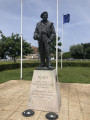
This monument, unveiled as part of the75th anniversary of D-Day, commemorates the return of the Polish Air Force to the European continent and the role of Polish airmen in the Normandy campaign and the liberation of France. The131st Polish Wing, comprising the 302nd "City of Poznan", 308th "City of Krakow" and 317th "City of Vilnius" squadrons, was based at the B10 airfield in the fields of Plumetot. From 3 August to 6 September 1944, these were the first units of the Polish Air Force to have a base in France. By the end of the war, approximately 19,000 airmen were serving in the Polish Air Force, providing 15 squadrons to support the Allied effort in the West - the largest contribution of any country under German occupation.

The Church of Saint James in Cresserons
Saint James Church in Cresserons was originally built in the 12th century. All that remains today is the eastern façade from the Romanesque period and part of the walls. The church was in ruins in the 16th century, so it was extensively restored around 1610. The bell tower wall above the façade dates from 1727. The choir and transept date from the 19th century, between 1830 and 1870, and were built by Monsieur Desclais, who served the parish. The walls were raised at the same time, with the foundations possibly dating back to the 12th century. In 1989, the western façade was renovated and the bell tower reinforced. The following year, two stained-glass windows for the chapel and the north façade were installed, created by Sylvie Liégeois.

The Basilica of Notre-Dame-de-la-Délivrande
The Basilica is one of the oldest pilgrimage sites in Normandy dedicated to the Virgin Mary, with origins dating back to the Gallo-Roman period. This pilgrimage is attributed to Regnobert, Bishop of Bayeux in the 7th century. It was honoured twice by Louis XI and by Saint Thérèse of Lisieux. In the mid-12th century, a Black Madonna was found, but it was destroyed during the Wars of Religion and replaced by the current statue in 1580.
Two buildings preceded the current basilica, first a chapel destroyed by the Vikings, then a second one built around 1150 on the site where the Black Madonna was discovered, of which only two Romanesque semicircular arches decorated with zigzags and crenellated frets remain. Construction of the Basilica of Our Lady of Deliverance began in 1853. Leo XIII elevated it to the status of minor basilica in 1895, and it was consecrated on 22 August 1895. Stained glass windows were installed in 1881 but destroyed during the D-Day landings. In 1885, carved oak stalls and marble paving were installed in the sanctuary. The grand organ was inaugurated in 1886. The building is in the Norman Neo-Gothic style. The architect was Jacques-Eugène Barthélémy and the master builder was René Lalique.

The Lesage pharmacy in Douvres-la-Délivrande
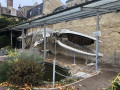
The building was constructed for the pharmacist and mayor of the commune, Georges Lesage, by the Caen architect François Rouvray in 19012. The ironwork was made by Adolphe Marie, a craftsman from Creully. During his terms of office in the first half of the 20th century, and as a pharmacist until 1948, Mayor Lesage undertook numerous investment projects. The building's façades and roofs, as well as its interior décor, were listed as historic monuments by a decree dated 7 April 1975. The owner, dissatisfied with the protection procedure, appealed to the Caen Administrative Court on the grounds of abuse of power, but his appeal was dismissed in June 1979, as the building was considered to be "the last vestige of a very distinctive architectural style characteristic of the early 20th century" and "a complete testimony to an era when the region was not particularly rich in the arts".
The monument is built of limestone in an eclectic style with Art Nouveau elements. The Art Nouveau style is very rarely found in the Calvados department. The building is a classic bourgeois construction from the early 20th century, but it features some very typical Art Nouveau elements, such as the roof tiles and ironwork. The entrance to the building is modest in comparison to the size of the display window. The building retains floral tiling, typical furniture elements and an ironwork balustrade. The polychrome stained glass windows in the entrance canopy no longer exist, but other interior stained glass windows have been preserved.

The Barony of Douvres-la-Délivrande
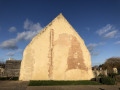
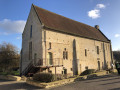
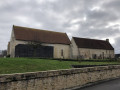
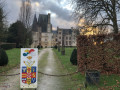
The lodgings of the Barony of Douvres-la-Délivrande are a former seigneury of the Bishopric of Bayeux. The current remains include a manor house, whose restoration was completed in 2012, a barn, and the faint remains of an ancient Saint-Symphorien Chapel. The buildings are a rare example of a preserved medieval civil structure.

Reviews and comments

4.5 / 5
Based on 8 reviews

Reliability of the description
4.5 / 5
Ease of following the route
4.5 / 5
Route interest
4.5 / 5
Nork
Nork

Overall rating : 4 / 5

Date of your route : Dec 08, 2025
Reliability of the description : ★★★★☆ Good
Ease of following the route : ★★★★☆ Good
Route interest : ★★★★☆ Good
Very busy route : No

The beginning isn't very interesting.
The route continues in a very pleasant way between countryside and villages, despite the rainy weather.
The basilica is worth visiting.
Thank you.

Machine-translated

User 23588337

Overall rating : 4.7 / 5

Date of your route : Jun 30, 2025
Reliability of the description : ★★★★★ Very good
Ease of following the route : ★★★★★ Very good
Route interest : ★★★★☆ Good
Very busy route : No

A pleasant hike between the countryside and the city, easy to follow, I visited the basilica, which has a rich history and houses
a black Madonna that the parishioners honour by making clothes for her, which can be seen in a collection. Not far away, I spotted a building
belonging to a congregation for which Mr Lalique designed the stained glass windows of their chapel.

Machine-translated

pucci
pucci

Overall rating : 5 / 5

Date of your route : Jun 06, 2025
Reliability of the description : ★★★★★ Very good
Ease of following the route : ★★★★★ Very good
Route interest : ★★★★★ Very good
Very busy route : No

The section through the industrial area after the cemetery isn't very interesting, but after that it's very nice.

Machine-translated

ClaudeG14
ClaudeG14

Overall rating : 4 / 5

Date of your route : Mar 10, 2025
Reliability of the description : ★★★★☆ Good
Ease of following the route : ★★★★☆ Good
Route interest : ★★★★☆ Good
Very busy route : No

A good city-countryside outing

Machine-translated

rothranv
rothranv

Overall rating : 4.3 / 5

Date of your route : Feb 11, 2025
Reliability of the description : ★★★★☆ Good
Ease of following the route : ★★★★☆ Good
Route interest : ★★★★★ Very good
Very busy route : No

Good hike, countryside and town, decent paths. Dover the Deliverer with its history, superb pharmacy façade.
I recommend this hike 5/5.

Machine-translated

Vivrenature19
Vivrenature19

Overall rating : 5 / 5

Date of your route : Sep 20, 2024
Reliability of the description : ★★★★★ Very good
Ease of following the route : ★★★★★ Very good
Route interest : ★★★★★ Very good
Very busy route : No

The route was tracked on the phone without any problems.
The time allowed is sufficient to visit and look around.
This route allows you to discover this town in a different way, between its narrow streets, buildings of different styles, green spaces and religious buildings in the towns we passed through.
Thank you.

Machine-translated

mamiliane
mamiliane

Overall rating : 4.7 / 5

Date of your route : May 08, 2023
Reliability of the description : ★★★★★ Very good
Ease of following the route : ★★★★★ Very good
Route interest : ★★★★☆ Good
Very busy route : No

A real discovery of Dover, between neighbourhoods with beautiful houses, craft areas and quiet paths in the surrounding countryside.

Machine-translated

MERE VEILLE
MERE VEILLE

Overall rating : 4.3 / 5

Date of your route : Feb 26, 2022
Reliability of the description : ★★★★☆ Good
Ease of following the route : ★★★★☆ Good
Route interest : ★★★★★ Very good
Very busy route : No

It's not too far from our home, so we were able to discover Dover in a way we hadn't before.

Machine-translated

Other walks in the area

For more walks, use our search engine .

The GPS track and description are the property of this route's author. Please do not copy them without permission.