Circular route via Luc-sur-Mer

Enjoy the charms of Luc-sur-Mer, which will reveal its maritime and rural attractions to you.

Details

17419774
Creation:
Last update:
Last review:
  • Walking
    Activity: Walking
  • ↔
    Distance: 4.72 mi
  • ◔
    Average duration: 2h 15 
  • ▲
    Difficulty: Easy

  • ⚐
    Back to start: Yes
  • ↗
    Ascent: + 56 ft
  • ↘
    Descent: - 56 ft

  • ▲
    Highest point: 82 ft
  • ▼
    Lowest point: 13 ft
  • ⚐ Country: France
  • ⚐ City: Luc-sur-Mer (14530)
  • ⚑
    Start/End: N 49.321399° / W 0.357338°
  • ❏
    IGN map(s): Ref. 1612OT
  • Hour-by-hour weather

Photos

Description of the walk

Parking is available in the seaside car park on Rue Guynemer (D514), between the sailing school and the casino.

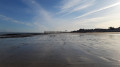
(S/E) Facing the sea, turn right, cross the car park to the casino building and take the steps on the left which lead down alongside the building to the seafront promenade. At the bottom, turn right and follow the seafront promenade for about 300 m until you reach the beach clock facing Rue de la Mer. Turn right, cross Rue Guynemer
(D 514) to take Rue de la Mer opposite and follow it to Luc-sur-Mer Town Hall.

(1) Opposite the town hall, carefully cross Rue de la Mer, go under the entrance archway at number 45, turn left to pass in front of the whale skeleton, then cross the municipal park until you reach Rue Camille Blaisot on the other side. Leave the park, cross the street carefully and turn left onto Rue Camille Blaisot heading north. Continue straight ahead into Rue Abbé Tolmer; at the pedestrian crossing, cross Rue du Docteur Charcot (D514) and continue straight ahead to the seafront promenade.

(2) Turn right and follow the seafront promenade until you reach the bends near the pier. Pass the bends and continue along the seafront promenade for about 600 m until you reach its end.

(3) Turn right into Rue du Corps de Garde and continue to Route de Lion (D514). At the pedestrian crossing, cross Route de Lion (D514), take Rue du Goulet opposite and follow it across the fields for about 800 m until you reach some buildings and Rue du Point du Jour (D84).

(4) Cross this road (D84) with extreme caution and continue straight ahead along Rue Jules Flambard until you reach the next junction near some agricultural sheds. Turn right onto Chemin des Delles and follow it until you reach Rue de Cresserons (D222). Turn right, follow the street for about a hundred metres, then carefully cross Rue de Cresserons (D222). Take Rue Auguste Langlois and follow it until you reach Place de la Croix and Rue Abbé Vengeon (D83) on the right.

(5) At the bakery, turn left onto Place de la Croix without crossing the road, then follow the D83 along the left-hand pavement for about 300 m until you pass the church and reach the pedestrian crossing opposite the cemetery wall. Use the pedestrian crossing to cross Rue de l’Église, then turn left to continue along the D83 on the right-hand pavement. Walk for about 400 m until you reach the corner of Rue du Château d’Eau. Use the pedestrian crossing to cross the D83, then turn right to continue following the D83 on the left-hand pavement, then the cycle path that runs alongside it. Follow the cycle path for about 600 m until you reach the houses and the car park on the opposite side of the road at the entrance to Mont-Notre-Dame. Use the pedestrian crossing to cross the D83 and return to the right-hand pavement.

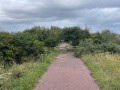
(6) At the start of Rue du Père Saulet, turn sharply right heading north. Cross the car park, go through the barrier and follow the tarmac footpath running alongside the La Capricieuse stream for about 1.5 km until you reach Rue de la Fontaine. Turn left and walk along this street on the left-hand side for about ten metres.

(7) Cross Rue Maximilien Pichon (D84) at the pedestrian crossing and continue along the path opposite. Walk for a good hundred metres and, at the fork, turn left onto the tarmac footpath that runs alongside the Capricieuse stream. Follow the path for about 900 m until you reach Avenue Lecuyer, just past the campsite.

(8) Cross Avenue Lecuyer very carefully and continue left until you reach the traffic lights and Rue Guynemer (D514). Cross Rue Guynemer (D514) at the pedestrian crossing and take the seafront promenade opposite, which turns right towards the sailing school and the casino. Follow the seafront promenade for about 100 metres until, after the sailing school building, you reach the steps leading up to the right towards the car park. Climb the steps and, at the top, turn left to reach the car park (S/E).


Waypoints

  1. S/E : mi 0 - alt. 26 ft - Seaside car park between the Casino and the Swimming Pool
  2. 1 : mi 0.37 - alt. 39 ft - Luc-sur-Mer Town Hall - Parc de la Baleine
  3. 2 : mi 0.71 - alt. 20 ft - Seafront
  4. 3 : mi 1.21 - alt. 20 ft - End of the seafront
  5. 4 : mi 1.76 - alt. 39 ft - Rue du Point du Jour (D84)
  6. 5 : mi 2.26 - alt. 46 ft - Rue Abbé Vengeon (D83)
  7. 6 : mi 3.09 - alt. 56 ft - Chemin de la Capricieuse at the entrance to La Délivrande
  8. 7 : mi 3.96 - alt. 23 ft - Rue de la Fontaine (D84)
  9. 8 : mi 4.57 - alt. 23 ft - Avenue Lecuyer
  10. S/E : mi 4.72 - alt. 26 ft - Seaside car park between the Casino and the Swimming Pool

Worth a visit

Saint-Quentin Church
11th century and 1873–1877
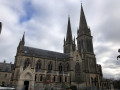
A church has stood on this site since the first half of the 11th century. Only the bell tower remains of the Romanesque church. The base dates from the 11th century and may predate the church itself. A second level, dating from the 13th century, is Gothic. The crowning element and its crenellated parapet were added in the 16th century. Obscene figures are carved on the corbels of the tower. The old church, under the patronage of Fécamp Abbey, was secretly demolished in 1873 to make way for this building, for which no other site could be found. This new church was built to designs by Abbé Vengeon in a Neo-Byzantine style. A calvary stands at the entrance to the churchyard: its double-sided cross, depicting Christ on one side and the Virgin Mary on the other, with a base dated 1662, was crafted in the Renaissance style.
The renovation of the church (and the chapel) was undertaken by Father Hébert in 1956. The Mutin-Cavaillé-Coll organ was inaugurated in 1957 and the Master Marcel Dupré gave a recital there on 8 August 1958. A new altar replaced the old one, and the pulpit was removed.
This pulpit was found by chance a few kilometres from the village. The town hall was contacted recently and the technical services will attempt to piece the puzzle back together. As for the cross in the churchyard, which had been vandalised and repaired twice, it has been restored and re-erected at the rear of the church.

"Bathers’ Chapel"
This chapel, situated in the former hamlet of Petit Enfer, is known by the name of Notre-Dame de Bonne Espérance.
It was destroyed during the Hundred Years’ War by the English. Around 1860, Father Vengeon, the parish priest, decided to rebuild a chapel partly using his own fortune and – according to tradition – to raise funds in England, which was responsible for the destruction of this building. After many setbacks, he managed to have the money raised transported by bisquines and to have the chapel rebuilt as we know it today on Rue de la Mer.
The chapel was renovated and inaugurated on 24 July 1958. The blessing was performed by the Abbot of Mondaye. The altar, made of Berchères stone, is the work of Jean Ransart; the wrought-iron grille of the gallery is by Jacques Briand; and the stained-glass windows (1956–1957) are by the master glassmaker Gérard Lardeur. The oak sculpture of the Virgin Mary, carved by Lydia Luzanovski, was blessed on 4 August 1959 in the presence of the artist.

Menhir
Of this badly damaged menhir, owned by the Société Préhistorique Française, only the base remains. It is situated in a place formerly known as ‘Delle de la Pierre’ in Luc-sur-Mer, at the junction of Rue du Menhir and Rue Maginot.
In 1930, the archaeologist Edmond Hue wrote: “At an unknown time, the menhir was broken almost at ground level, as evidenced by the large areas of fractured rock visible on the upper edge of the north face and on the western ridge. Some forty years ago, ill-intentioned farmers attempted to destroy what remained of the megalith using explosives… There are no legends or customs associated with it. However, the inhabitants had, by tradition, respected what remained of this ancient monument; it took the mindset of people from outside the region (the Horzains) to conceive of its destruction… By a most gracious vote, for which I am sincerely grateful, the council has agreed to protect the ‘Pierre de Luc’, which is now placed under the guardianship of the local people.” The explanatory plaque that had been placed on the menhir has now disappeared.

Maison de la Baleine
During the night of 14–15 January 1885, a 40-tonne, 19-metre-long whale beached itself on the shores of the Côte de Nacre at Luc-sur-Mer at a place known as “Brèche du Moulin”. The Luc-sur-Mer Marine Laboratory took charge of its examination, dissection and preservation, whilst thousands of visitors arrived by train at Luc station to see it!
Its skeleton is now on display in the Municipal Park, attracting many visitors.
To make the visit more appealing and culturally enriching, a Whale House was designed and built for individuals and groups (this museum is run by the association known as “the Brotherhood of the Knights of the Whale”).

View of the Basilica of Douvres-la-Délivrande.
Next to the D-Day beaches stand the two spires of the neo-Gothic basilica built in the 19th century.
Elevated to the status of a basilica in 1872, the building replaces the ancient chapel which, since the 12th century, had attracted thousands of pilgrims every year. The chapel itself had been erected on the site of a Marian shrine, the origins of which are attributed to Saint Regnobert, Bishop of Bayeux in the 7th century. He had replaced the statue of the mother goddess Demeter with that of a Black Madonna.
The Norman invasions of the 9th century led to the statue’s disappearance; according to legend, it was miraculously rediscovered a century later by a sheep in a field.
During the Wars of Religion, the statue was destroyed and a few years later, in 1572, a new statue of the Black Madonna was placed in the sanctuary. It has been venerated there ever since under the title of "Virgo Liberatrix", the Virgin who liberates.
Pilgrims come to entrust to Mary their lives and those of their loved ones, their plans, their sufferings and their thanksgiving.
It was before this statue that Saint John Eudes came in 1643 to entrust to Mary the foundation of the Congregation of Jesus and Mary (the Eudists). Saint Thérèse of the Child Jesus also came here to pray. Two beautiful statues at the entrance to the choir recall the visits of these saints, just as the many small statues surrounding the Black Madonna speak to the universality of the pilgrims: beggars, sailors, mothers, the sick, teachers, dignitaries…
As an anecdote, every new bishop of Bayeux and Lisieux, before being installed in his cathedral, comes to preside over a celebration in the sanctuary, laying his crosier at the feet of Our Lady of Deliverance.

Reviews and comments

4.1 / 5
Based on 7 reviews

Reliability of the description
4.3 / 5
Ease of following the route
4.3 / 5
Route interest
3.6 / 5
Lynel61
Lynel61

Overall rating : 4 / 5

Date of your route : Sep 01, 2025
Reliability of the description : ★★★★☆ Good
Ease of following the route : ★★★★☆ Good
Route interest : ★★★★☆ Good
Very busy route : No

Discovering sites in Luke.

Machine-translated

Pl Carrillo
Pl Carrillo

Overall rating : 4.7 / 5

Date of your route : Jan 13, 2025
Reliability of the description : ★★★★★ Very good
Ease of following the route : ★★★★★ Very good
Route interest : ★★★★☆ Good
Very busy route : No

Some lovely discoveries in old Luc

Machine-translated

POTTIER Philippe
POTTIER Philippe

Overall rating : 3.7 / 5

Date of your route : Sep 09, 2023
Reliability of the description : ★★★★☆ Good
Ease of following the route : ★★★★☆ Good
Route interest : ★★★☆☆ Average
Very busy route : No

We enjoyed the cycle path, the Whale Garden and the seafront, but we didn’t like the flat part nearly as much.

Machine-translated

Marie-Christine78
Marie-Christine78

Overall rating : 4.7 / 5

Date of your route : Jul 10, 2023
Reliability of the description : ★★★★★ Very good
Ease of following the route : ★★★★★ Very good
Route interest : ★★★★☆ Good
Very busy route : No

Return via the very pleasant greenway

Machine-translated

eric.billaux
eric.billaux

Overall rating : 2 / 5

Date of your route : Oct 17, 2022
Reliability of the description : ★★☆☆☆ Disappointing
Ease of following the route : ★★☆☆☆ Disappointing
Route interest : ★★☆☆☆ Disappointing
Very busy route : No

Lack of explanation regarding the diagram

Machine-translated

eljoouri
eljoouri

Overall rating : 4.7 / 5

Date of your route : Sep 27, 2022
Reliability of the description : ★★★★★ Very good
Ease of following the route : ★★★★★ Very good
Route interest : ★★★★☆ Good
Very busy route : No

An easy walk to enjoy after a picnic by the sea, even on a gloomy day. A pleasant route combining land and sea.

Machine-translated

Jean-Paul BUTEAU
Jean-Paul BUTEAU

Hello Christine,
Thank you for taking the time to post your comment on the Luc-sur-Mer circular route; I was delighted to receive your positive feedback.

Machine-translated

Christine 14
Christine 14

Overall rating : 4.7 / 5

Date of your route : Jan 17, 2022
Reliability of the description : ★★★★★ Very good
Ease of following the route : ★★★★★ Very good
Route interest : ★★★★☆ Good
Very busy route : No

Very detailed description
A pleasant route.

Machine-translated

Other walks in the area

For more walks, use our search engine .

The GPS track and description are the property of this route's author. Please do not copy them without permission.