


Refine your search for walks in Arènes de Lutèce
Arènes de Lutèce walks


 Le Quartier Latin and Sainte-Geneviève Mountain
 Visorando Member
 3.78 mi
 +131 ft
 -164 ft
 1h 50
1h 50
 Easy
Easy
 Departure from Paris
Le Quartier Latin is a labyrinth of streets, each as important as the next, as there is a strong history behind. The Sainte-Geneviève Mountain is home to several prestigious schools, and the presence of numerous students adds to the atmosphere of this magnificent suburb.
From Porte Dauphine to Bercy
 10.25 mi
+105 ft
-138 ft
4h 50
10.25 mi
+105 ft
-138 ft
4h 50
 Average
Departure from Paris
Average
Departure from Paris
A walk through Paris exploring the Left Bank and its quartiers.
Saint-Germain-des-Prés and Montagne Sainte-Geneviève
 3.84 mi
+79 ft
-105 ft
1h 50
Easy
Departure from Paris
3.84 mi
+79 ft
-105 ft
1h 50
Easy
Departure from Paris
A journey into the medieval and even Gallo-Roman past of Paris, following in the footsteps of Sainte-Geneviève, whose namesake hill we climb, whose ancient sarcophagus can be seen in the church of Saint-Étienne-du-Mont, and whose statue can be seen in the Jardin du Luxembourg and on the Pont de la Tournelle. Among other sights, the itinerary follows a section of the old city wall built by Philippe Auguste and crosses the Arènes de Lutèce.
From Paris to Bry-sur-Marne via the Bois de Vincennes and along the Marne
 Association / Club / Walk leader
 15.57 mi
+177 ft
-154 ft
7h 20
15.57 mi
+177 ft
-154 ft
7h 20
 Difficult
Departure from Paris
Difficult
Departure from Paris
In the eastern suburbs of Paris, along the route taken by Saint Columbanus, we find all the signs of the Columbanian influence that shaped our countryside and landscapes.
The first part of our 26km route through the Île-de-France region is flat, allowing us to take the time to visit the jewels revealed by the churches of Paris, as well as the towns that witnessed the birth of the monasteries that punctuate the route.
A route through the heart of Paris
 22.13 mi
+312 ft
-312 ft
5 days
Easy
Departure from Paris
22.13 mi
+312 ft
-312 ft
5 days
Easy
Departure from Paris
This route, comprising just five stages, all accessible by public transport, offers an exploration of the capital’s city centre and a journey back in time to the city’s Gallo-Roman foundations.
From Châtelet to Austerlitz
 4.21 mi
+138 ft
-135 ft
2h 05
Easy
Departure from Paris
4.21 mi
+138 ft
-135 ft
2h 05
Easy
Departure from Paris
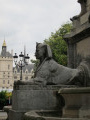
A walk between Châtelet and Austerlitz, along picturesque streets rich in Parisian history with many points of interest: gardens, monuments, building facades, etc. Depending on your pace and curiosity, the route can take between two and four hours.
Walks near Arènes de Lutèce
Green spaces in Paris’s 5th arrondissement
 4.70 mi
+177 ft
-157 ft
2h 20
Easy
Departure from Paris
4.70 mi
+177 ft
-157 ft
2h 20
Easy
Departure from Paris
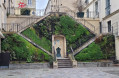
Just like Paris’s oldest arrondissement, the gardens of the fifth evoke the past: the Cluny Medieval Garden, Square Viviani, where the capital’s oldest tree, the famous black locust, has watched Paris transform for over 400 years; the Arènes de Lutèce or the Jardin des Plantes, the Royal Garden of Medicinal Plants. A tour through bustling neighbourhoods, blending bookshops, student cafés and ancient alleyways in an authentic, timeless atmosphere that embodies the intellectual soul of Paris.
From the Pont d’Austerlitz to the Port de Javel along the banks of the Seine
 5.22 mi
+10 ft
-30 ft
2h 25
Easy
Departure from Paris
5.22 mi
+10 ft
-30 ft
2h 25
Easy
Departure from Paris
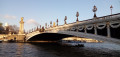
An urban route that allows you to enjoy the fully pedestrianised left bank of the Seine in Paris! You walk pleasantly along the river and pass by some of the capital’s most famous landmarks: Île Saint-Louis, Île de la Cité and Notre-Dame Cathedral, Pont Neuf, the Louvre Museum, the Musée d’Orsay, the Grand Palais and the Eiffel Tower.
Adjust your route according to the water levels of the Seine: see the practical information section.
The Bestiary of Bastille, Popincourt and République
 5.64 mi
+43 ft
-39 ft
2h 40
Easy
Departure from Paris
5.64 mi
+43 ft
-39 ft
2h 40
Easy
Departure from Paris
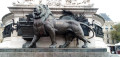
A south-to-north walk through the 12th, 11th and 10th arrondissements of Paris, in search of depictions of animals. The Port de l’Arsenal and several narrow passages add a picturesque touch to this route.
Paris Pont d'Austerlitz - Massy
 14.65 mi
+361 ft
-180 ft
7h 05
Difficult
Departure from Paris
14.65 mi
+361 ft
-180 ft
7h 05
Difficult
Departure from Paris
First stage of the Grand Tour of Île-de-France via the GR® 11, starting from the former confluence of the Bièvre and the Seine at the Pont d'Austerlitz in Paris, to the Massy-Palaiseau station in Essonne. It consists of climbing up the lower part of the Bièvre valley, where the river flows mainly underground but is sometimes exposed to the open air following rehabilitation programmes.
Grand tour of Île-de-France in 34 stages on the GR®11
 528.35 mi
+22,037 ft
-22,156 ft
34 days
Difficult
Departure from Paris
528.35 mi
+22,037 ft
-22,156 ft
34 days
Difficult
Departure from Paris
This marked GR® route around the Île-de-France region (with a few forays into neighbouring departments and regions) complements its "little brother", the GR®1, by forming a circular route around Paris, generally with a slightly larger radius.
It follows the same overall pattern: first, a radial section starting from Paris (more precisely from the Pont d'Austerlitz, near the former confluence of the Bièvre and the Seine), going up the entire Bièvre valley, then continuing to Villiers-Saint-Frédéric, in the Yvelines. From there, it is a circular route that loops around the Île-de-France region, close to its borders with neighbouring regions.
The route passes through beautiful regions, often untouched by intensive urbanisation, regional nature parks and other protected natural areas, and takes in some architectural wonders.
Retrace Bourvil and Gabin’s walk through Paris
6.11 mi
+269 ft
-59 ft
3h 05
Easy
Departure from Paris
Retrace the steps of Bourvil and Jean Gabin in Claude Autant-Lara’s film. Of course, all this remains rather imaginary, as very little of the film was shot on location. But there is still the route from Rue Poliveau to Rue Lepic and the pleasure of strolling through the streets of Paris. There is one more filming location that lies too far off the main route: 158 Boulevard Hausmann, now the Jacquemart-André Museum, where the scenes of the arrival at the Kommandantur were filmed.
The Philippe Auguste enclosure and the covered passages of the Sentier
 4.71 mi
+26 ft
-23 ft
2h 10
Easy
Departure from Paris
4.71 mi
+26 ft
-23 ft
2h 10
Easy
Departure from Paris
This route on the right bank of the Seine takes us on a journey from medieval times to Art Nouveau. First, we discover the most important remains of Philippe Auguste's city walls and former mansions. We then wind our way through the Sentier district to explore several of its covered passages.
This walk is best done during the week, as the covered passages are closed on certain days.
The Passages of Paris
7.51 mi
+75 ft
-16 ft
3h 30
Average
Departure from Paris
In Paris, the term ‘passages’ refers to covered walkways through which one goes from one street to another by passing through one or more buildings, and which are intended solely for pedestrians. The shops there are splendid, well-stocked, but somewhat expensive. In bad weather, like the Palais-Royal, they serve as promenades and meeting places. They are generally lit by gas.
From the Île de la Cité to the Porte de Versailles
 3.65 mi
+43 ft
-30 ft
1h 45
Easy
Departure from Paris
3.65 mi
+43 ft
-30 ft
1h 45
Easy
Departure from Paris
From the heart of the capital to its outskirts, this urban walk takes you through the Latin Quarter before following the entire length of Paris’s longest street, Rue de Vaugirard. Along the way, you’ll come across Notre-Dame Cathedral (currently undergoing restoration), the Palais du Luxembourg and several churches dating from various periods.
From Île de la Cité to Porte de Pantin
 6.26 mi
+79 ft
-23 ft
2h 55
Average
Departure from Paris
6.26 mi
+79 ft
-23 ft
2h 55
Average
Departure from Paris
From the heart to the outskirts of the capital, this urban route first takes you through the Marais district, dotted with mansions. Then, under the sign of water, you walk along the Canal Saint-Martin and then the Bassin de la Villette. The route ends at the entrance to the Parc de La Villette.