Country:
 City:
City:


If you’re coming from Le Castellet, head towards “Le Brulat” (D26) and carry on towards Sainte-Anne du Castellet, then take the D246 on the left just before the village. Go through the village, take the Chemin du Moulin towards the Caday neighbourhood, then the Chemin Fontaine de Marc. At a three-way junction, carry on straight ahead along the now unpaved track for about 200 metres, until you pass below a farmhouse and come to a dirt track. At this point, turn left and park on the lay-by below.
If you are coming from the Marseille road via Camp du Castellet, enter Sainte-Anne via the D87 and, after an ‘S’-bend, at a wayside shrine, turn right onto the Chemin du Moulin, then follow the instructions above.
(S/E) Take the path that continues on from the Chemin Fontaine de Marc.
From there, follow the route described in the Perrye83 walk, right up to where it approaches the Roche Redonne.
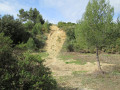
(1) Note the presence of a very well-preserved paved slanting street over a stretch of a few dozen metres. During this part of the route, you can also see, top right, the hills erroneously labelled “Roche Redonne” on the IGN map: in fact, the Roche Redonne is the one we will be visiting further on, starting from our point 3 (near point 3 of the Perrye83 walk).
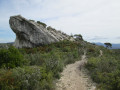
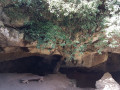
(2) At an elevation of approximately 355, you’ll see a faint path leading towards the eastern face of the rock. Take this path and you’ll soon find yourself at the foot of the cliff, where a series of rock shelters—known as ‘baumes’ in Provence—begins.
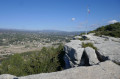
(3) After walking for about 200 metres beneath the rock shelters, you emerge at the bottom of the slope that forms the western face of the Roche Redonne. You can climb this slope to the summit of the rock to take in a magnificent 360° panorama.
Take the path heading west and follow the route described by Perrye83.
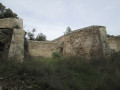
(4) Instead of continuing along the main dirt track, take a dirt path that branches off diagonally to the right and, after 50 m, passes close to the ruins of Camp de Penon – a heavily dilapidated building and a well covered with a wire mesh.
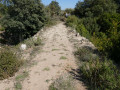
Carry on along the track, which is initially earthy then rocky, and stay on the ridge: on three occasions, you’ll pass a path on your right and always take the left-hand route. It is along this stretch that you’ll see an abundance of fossilised burrows of Cretaceous sandworms. About 1.7 km after Camp de Penon, you’ll come across a straight track.
(5) Turn left, heading east, for 450 metres before crossing a stream and catching a glimpse, on the right, of the site of the Roman bridge at Le Cannet.
(6) Turn right onto a path which, after 150 metres, crosses a track. Turn right again to reach the Roman bridge after 150 metres.
(7) Return to the track heading north-east and, after 450 metres, you’ll pass the ruins of the Caday horse post station, which is well worth a stop. Continue for 100 metres and you’ll come to the Chemin de la Font de Marc; take this on the left to return to the car park (S/E).





 Visorando Member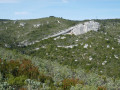


 Easy
Easy 

 Difficult