Country:

 City:
City:



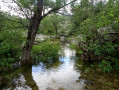
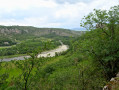
After Joyeuse, head south, continue on the D104, then turn left at the first major crossroads towards "Les Gras de Perret". Drive through the village of Les Gras de Perret, then the hamlet of Guilhaumon and continue to the houses in the hamlet of Tourneuse. There are places to park your car, but on private land, so please ask the locals. Otherwise, there are one or two spaces just before the water reservoir (do not block access).
(S/E) Continue along the wide path for about 400 metres until you reach a fork with a wide path on the right. To help you find your way, a wooden hunting blind has recently been built 20 metres from the crossroads on the left, and there is another older one about a hundred metres away.
(1) Take this path, which is wide at first and runs through a meadow, but quickly becomes a more wooded trail. Curiously, it is not fully marked on IGN maps, yet it is obvious. It is marked on the ground with red dots on stones. Continue along this path south-southwest. After a short climb, you will notice what looks like a karstic cave on your left. This is a double underground cistern, which is immediately accessible. Go and see it, and notice how it has been vaulted to keep it cool and prevent too much evaporation. Continue for about half an hour until you reach a crossroads. Note that the path on the right is marked with yellow and white signs and the one you have just left is marked with a yellow and white cross (see the hike "A short tour of the Gras de Perret", for which the route is the same).
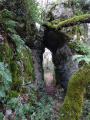
(2) Continue straight ahead and then very quickly take the path on the right (towards Reméjadou). Yellow-white markers. The path crosses a limestone chaos and an extraordinary mossy forest worthy of fairy tales. Do not stray from the path, as the karst terrain is very uneven (there are many holes). After climbing up to a clearing, the trail leaves the wide path and turns left between some rocks. Continue along this path until you reach the "Reméjadou" signpost.
(3) Turn left towards Bourbouillet. The path heads south-east then quickly turns north-east between rocks. Keep an eye out for a path on the left marked with a cross (less than 100 metres from the crossroads). Take this path with great care. It stops abruptly in front of a pile of rocks behind which there is nothing. A 30-metre deep chasm. Note the piton used by cavers to abseil down, and note or listen for the river flowing at the bottom. Return to the path and continue (to the left). Cross another section of forest, then the path slopes southwards and leaves the forest. Join a wide path bordered by a high fence.
(4) Make a return trip to the Bourbouillet resurgence: continue along the main path heading south, which descends. At the bottom, you will find a field on your right with a wide track, blocked by a removable fence, just before a ford. Take this track north-west to the end - you will almost turn around - (close the fence). You will find the resurgence site at the bottom of the valley 200 metres away. It is a beautiful spot with some shade for picnics. Return to the fence to continue.
Continue right on the wide path heading south. After 200m (a sharp right turn followed by an uphill section), you will find a wide path on your right at a right angle (close the fence) that climbs slightly.
(5) Take this path (close the gate) for 350 m (white and yellow markers). It is lined with a small power line suspended from telegraph poles. Just where this path branches off slightly to the right, look for a faint track that goes off at a right angle to your left (landmark: it is just opposite an electricity pole (two feet away), the next one of which, a little further on, is marked with a clearly visible white and yellow marker). A cairn had also been piled up at the start of the track (but may have been destroyed by wild animals, etc.).
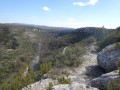
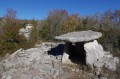
(6) Make a round trip to the dolmens: turn left and take this track straight ahead, heading south. It descends towards the bed of the Ruisseau de Fontgraze, which you can see. Leave two other tracks on the right and left. After 300 metres, the track seems to stop and turn sharply left. Ignore it and head slightly right into the scree, which you cross diagonally to reach a bench of sharp limestone pavement overlooking the stream bed, just opposite the road you can see ahead. The first dolmen is there, on your right. Two others are located 150 m away, taking a left heading south from the first dolmen on the lapiaz plateau, descending towards the river (in the direction of the cracks).
After this visit, return to the intersection with the main road lined with a high fence.
(4) Take the wide north-northeast path opposite, which starts by going downhill, following the high fence on your right. Continue until you reach the "Espéluche" hiking sign.
(7) Turn right (short climb) towards Joyeuse. At the top of the climb, the path turns right at a right angle. Ignore the narrower path that continues straight ahead along the fence. Turn left and continue along this path until you reach a fork (Saint-Alban-Auriolles on the right). Continue straight ahead towards "Joyeuse". The road runs alongside a low wall and then descends, turning slightly to the left. Join a road coming from your left. You will arrive at the signpost "Falaises de Lunel".
(8) The path becomes a wide forest track and then a forest road.
(9) Take this forest road on the left, which runs alongside and overlooks the La Beaume river. You will return to the junction of the loop.
(1) Follow the same route back to the car park (S/E).





 Visorando Member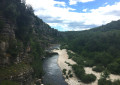
 Difficult
 Easy
Easy