


 Country:

 City:
City:


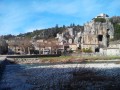
Access: Coming from the D104 (the former Aubenas–Alès national road), take the D315 towards Labeaume. The hamlet of Chapias, on the plateau, is recognisable by its tower. Before the hamlet, after the mission cross, a large area on the left with rubbish bins offers plenty of parking spaces.
(S/E) From the car park, set off along the road towards the hamlet of Chapias (white-and-yellow markings). In the hamlet (150m from the start), a wooden sign on the right points to “Rocher des Curés” (a 500m round trip).
(1) After the chapel, leave the marked path after about fifty metres and continue along the edge of the field towards some rock formations with holes in them.
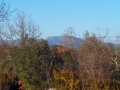
(2) The Rocher des Curés offers a view towards a high point that may once have served as a pulpit for preaching. Return to the road and continue to the right.
(3) Walk past the Chapias Tower. After 100 metres, at a well, take the signposted road to the left. Then continue along the Chemin de Chapias until you reach the road just before Linsolas. Follow the white-and-yellow markings to the left. After about 500 metres, when the road bends to the left, take the signposted path to the right.
(4) Cross the tarmac road and take the signposted path opposite, to the left of a private gate. Continue to follow the signposts straight ahead until you reach the tarmac road. Turn right towards Chamontin.
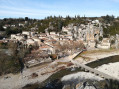
(5) At the signpost, continue along the road following the signposts, passing by the cemetery, heading down towards the church and then onto the square, before the submersible bridge over the Baume.
You’ll reach the hiking signpost at the bridge at the entrance to the square after passing the ‘Faïsses’ signpost. A visit to the village is definitely worth it.
(6) At the signpost, head towards Saint-Alban-Auriolles, cross the bridge over the Baume and then continue along the path uphill.
(7) At the signpost, take the signposted path leading uphill to the right towards the Alphonse Daudet Museum. There are hairpin bends at either end.
(8) Where the path joins the road, turn left (the hiking signpost is on the other side), heading towards Saint-Alban-Auriolles via the museum. Take the Impasse des Fraysses on the right, then the signposted path on the left as the road curves to the right.
Follow the signposted path carefully – it does not appear on the IGN map (the one shown on the map is closed). When you reach the tarmac road, turn right.
Follow the road (Chemin de La Vignasse), passing the museum. Continue along the road, following the signposts. On the descent, take the road on the left, Chemin de Bousseyron. Pass the church at Auriolles. Cross the D208 and take the road opposite (Chemin du Béal).
(9) At the signpost, take the track on the left towards Ruoms. Follow the signposted track straight on through the vineyards and orchards for approximately 1.4 km. Ignore the first track on the left, then turn left towards the D208. Join the departmental road.
(10) Turn right and continue along the road for about 900 metres. Cross the Baume via a narrow bridge, head towards the hamlet of Peyroche, then turn left and walk through the hamlet.
(11) At the signpost, head towards Labeaume on the left. Follow the signposted path.
(12) At the signpost, go straight on towards Chapias. Following the signposts, you’ll reach the D245. Take the departmental road to the right and, after 150 metres, at the bend, take the path on the left.
At the end of the track, take the tarmac road to the left, which quickly becomes a track again, heading towards the dolmens.
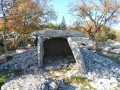
At the information board for the “Ranc de Figère” site, leave the track to discover two dolmens notable for their size (ranc = rock in Occitan).
Return to the track and, at the bend to the right, take the path on the left (signposted).
Continue along the white-and-yellow signposted path through the heath. You’ll cross several paths; the markings are clearly visible and you should always go straight on.
(13) At the signpost, carry on straight on towards Rosières and Chapias. Continue to follow the markings. After 350m, you’ll come across another track; go straight on, slightly uphill, and continue until you reach the D315 (with the Croix de Cavagnac on your left)
(14) At the cross, turn right onto the departmental road. A pyramid made from stones found on the ground commemorates the clearing work carried out by local residents to cultivate strips of land (faisses). Continue along the road
(15) At the mast (with the mission cross nearby), take the road on the left to return to the starting car park (S/E).

 Visorando Member
 Difficult

 Easy
Easy 
