


Terre Valserine Tourisme

 Tourist office
 Premium user
- 71 rue de la République, Bellegarde-sur-Valserine, 01200 VALSERHONE
- Tel:04 50 48 48 68
- Website: https://www.terrevalserhone-tourisme.fr/
Sign up:
Published route(s)
 The Retord Sud mountain pasture
 4.93 mi
 +394 ft
 -371 ft
 2h 35
 Easy
 Departure from Châtillon-en-Michaille (Ain)
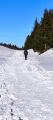
Explore the vast expanses of the Retord Plateau. Along the way, you will see a few typical farms, traces of life in an immaculate and unspoilt place.
The Cirque des Avalanches
 7.48 mi
+1,831 ft
-1,834 ft
5h 00
 Moderate
Departure from Champfromier (Ain)
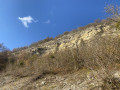
After leaving the village of Champfromier and all its amenities, walk through pastures and forest paths. The highlight of this circular: the magnificent panorama from Les Avalanches over the Jura mountains.
The botanical trail at Châtillon-en-Michaille (Valserhône)
 3.07 mi
+778 ft
-768 ft
2h 05
Easy
Departure from Châtillon-en-Michaille (Ain)
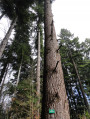
During this walk, discover the arboretum established in 1920. As well as local trees such as birches, hornbeams and spruces, it features exotic species including Lebanese cedars and red oaks… There are around twenty different species, all catalogued and labelled.
The banks of the Rhône between Arlod and Génissiat
 8.16 mi
+997 ft
-984 ft
4h 35
Moderate
Departure from Bellegarde-sur-Valserine (Ain)
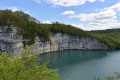
This trail allows you to explore the riverbanks, which tell a story through fishing, geology and industry. Halfway along, take a break at the magnificent shaded viewpoint.
Le Dragon Sous Roche
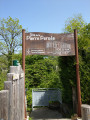 2.71 mi
+830 ft
-830 ft
2h 00
Easy
Departure from Champfromier (Ain)
This route takes you to the banks of the Valserine and transports you back in time: ancient stone bridges, a power station with an unusual history and a customs guard's hut. A mysterious and bucolic trail.
La Namphée
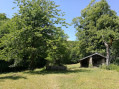 2.65 mi
+636 ft
-630 ft
1h 45
Easy
Departure from Champfromier (Ain)
This route takes you down into the Valserine Valley, between the villages of Montanges and Champfromier. Woodland, meadows and fresh air await you!
Tour of the viewpoints in Giron
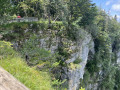 7.98 mi
+981 ft
-958 ft
4h 30
Moderate
Departure from Giron (Ain)
In a typical Jura setting, this loop offers exceptional panoramic views, such as the Roche Fauconnière.
The Saint-Pierre to Chanay trail
2.19 mi
+656 ft
-656 ft
1h 35
Easy
Departure from Chanay (Ain)
The paths you’ll be following are in the southern part of the Jura, known as La Michaille. Perhaps, if you’re quiet enough and with a bit of luck, you might spot some of the many animals that inhabit our mountains.
The Charcoal Burners’ Trail starting from Chanay
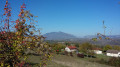 5.55 mi
+1,460 ft
-1,460 ft
3h 50
Moderate
Departure from Chanay (Ain)
Charcoal burners produced charcoal in the mountains by piling wood into heaps which were then set alight. Part of the wood was consumed as it burned, consuming oxygen, whilst the heat from the wood transformed the rest into charcoal. This process was carried out directly in the forest, as close as possible to the source of the wood. The forests of La Michaille, like many other French forests, supplied this charcoal, which was used until the mid-20th century for heating and cooking.