


naucelle

 Tourist office
PRO  Premium user
 Sign up:
Published route(s)
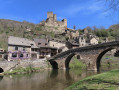
 Exploring the Ségala on foot: Towards Belcastel
 6.62 mi
 +1,283 ft
 -1,306 ft
 4h 10
 Moderate
 Departure from Colombiès (Aveyron)
Set in the heart of the Ségala’s rich agricultural landscape, the village of Colombies still boasts beautiful medieval houses, some dating back to the 15th century. This village has retained a certain harmony even in its official buildings, such as the town hall and its porch. Its Romanesque-style church, built in 1880, stands in the centre of a small square near a landscaped fountain.
This walk, marked with yellow signposts, will take you to one of the Most Beautiful Villages in France, Belcastel.
Exploring the Ségala on foot: Discovering a rich local heritage
7.16 mi
+1,214 ft
-1,184 ft
4h 20
Moderate
Departure from Manhac (Aveyron)
Travellers at the turn of the century who took the royal road from Rodez to Toulouse, between the two coaching inns at La Primaube and Baraqueville (Baraque de Fraysse), crossed an almost deserted plateau covered in moorland and chestnut groves.Only the riverbanks and the valley slopes were cultivated. The region was plagued by famine. It was the land of the ‘black bellies’; their diet consisted mainly of rye bread and chestnuts.The arrival of the railway in 1902 made it possible to bring in lime to improve these acidic soils. Rye disappeared, replaced by crops of wheat, potatoes and maize, which enabled the establishment of high-quality cattle farming.This agricultural revolution reshaped the region and led to the creation of two new towns, Baraqueville and La Primaube.
Exploring the Ségala on foot: The Lakes Trail
 6.29 mi
+614 ft
-614 ft
3h 25
Moderate
Departure from Baraqueville (Aveyron)
This is the land of white water and a thousand springs that feed numerous streams and small lakes further downstream. A short detour at the town’s main crossroads allows you to see three spires: since 1997, they have stood at the centre of the crossroads where Baraqueville was founded, clearly marking the place the town intends to retain at the heart of the Ségala, that of the main hub for events and interaction. The three spikes symbolise the Ségala’s past and give way between them to the three roads of the crossroads, which, when viewed from above, form the spokes of a turning wheel.
Le Ségala on foot: The ancient mills trail
 4.42 mi
+558 ft
-584 ft
2h 30
 Easy
Departure from Gramond (Aveyron)
Gathered around its church, Gramond is a village rich in history. The valley is wild along the Lézert with a view of Boussac that will amaze you.
The Ségala: the Marsende Stream
3.37 mi
+548 ft
-535 ft
2h 00
Easy
Departure from Boussac (Aveyron)
A walk through the ‘Land of 100 Valleys’, following a secret and unspoilt valley,
In the heart of the village of Boussac, with its traditional houses, stands a remarkable church, originally built in the 13th century and subsequently fortified by its inhabitants during the 14th and 15th centuries to protect the local population from the English invasion. Battlements, arrow slits and machicolations still bear witness today to the building’s defensive purpose.
Le Ségala: Castelpers and Roc de Miramont
 6.96 mi
+1,375 ft
-1,378 ft
4h 25
Moderate
Departure from Saint-Just-sur-Viaur (Aveyron)
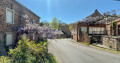
This walk is situated at the confluence of three valleys and between two picturesque villages, Saint-Just and Castelpers.The site of Castelpers is an ancient fortified settlement, mentioned in the Book of Miracles of Sainte-Foy de Conques. It has become a very popular destination. Of this former seigneury and barony belonging to the Castelpers family (13th to 17th centuries), all that remains on the rock is the pre-Romanesque chapel known as Notre-Dame du Roc.This small sanctuary overlooks the Giffou Gorges from a height of 150 metres and houses a statue of the Virgin Mary crushing three black snakes.The Chapel of Saint-Jean de Castelpers (2 km away), nestled amidst the woods, was originally a small abbey which became a flourishing priory until the end of the Crusades.