Country:

 City:
City:


Park in the cemetery car park, located at 22 Chemin de Chautard.
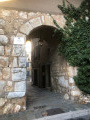
(S/E) Take Rue du Château d'Eau towards Saint-Césaire Church. Go around the building on the right and, facing the entrance, go under the medieval gate called Porte de la Tour. As you pass through, take a look at the church clock: following an earthquake, the clock hands fell to the ground. The technician responsible for putting the hands back in place made some mistakes.
(1) Take the path on the right to reach Rue Saint Férréol, through the old houses of the town. Continue along Chemin des Moulins and join Route de la Siagne (D105) at a hairpin bend.
White and red GR® markings
(2) Take the path on the left downhill at marker 20a, following the direction of Pont des Tuves.
No markings
(3) Turn left at this crossroads marked by a cairn. The descent into the valley is mainly wooded with several species of trees, including many laurels. Once at the bottom, cross the 1-metre-wide concrete footbridge over the Siagne river: be careful, there is no parapet. Continue for about ten metres until you reach the trail junction: you are now in the Var department .
Yellow markings.
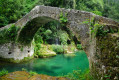
(4) Turn right onto the path that crosses a dense wooded area. After the ruins of the Siagne paper mill, continue to the magnificent stone Pont de Rey bridge.
(5) Turn left onto the paved slanting street, following the sign for "Villages perchés de Haute Siagne" (Haute Siagne hilltop villages), at a marker without a number. The waters of the Siagne are turbulent and accompany us throughout our journey.
(6) At the crossroads, continue straight ahead on the uphill path and you will come to a fork in the path marked by a cairn.
No signposts
(7) Turn left onto this descending path (not mapped on IGN, but present on OSM) which winds through the dense forest and joins a crossroads of paths in the valley. Take the right-hand path to immediately return to the crossroads before the footbridge.
Yellow markings.
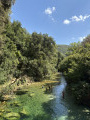
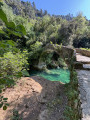
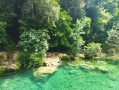
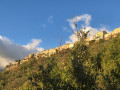
(4) Continue right on the relatively flat path along the beautiful green Siagne River. The village of Saint-Cézaire-sur-Siagne appears at the top of the forest. After passing a small beach on the river, follow the sign on the left for "Pont des Tuves 100 m". Less than 100 m further on, admire this magnificent restored bridge and the wetland environment that unfolds before you. This Pont des Tuves bridge is called Pont des Gabres on the Saint-Cézaire side and Pont des Tuves on the Var side.
No markings
(8Return to the fork and follow the sign on the left for "Route des Gorges de la Siagne". After a few metres, which are quite steep, the path turns into a very pleasant carriageway along the Siagne, which resembles a lake.
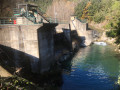
(9) Turn left to walk along the fence of the Siagne dam and continue on the track between the Siagne and the canal, which at this point passes through a 3-metre-high concrete tunnel and is therefore not visible.
(10) Leave the track and take a beautiful path on the left, which sometimes overlooks the Siagne. The waters are tempting, but a sign warns that it is dangerous and forbidden to venture into the riverbed.
(11) Turn right, then left about 50 metres further on. At the next bend, continue straight ahead on a long, relatively flat path, which is sometimes densely vegetated. You will come to a fork at Ubac de Tournon.
(12) Take the path on the right and follow it straight ahead. Further on, it becomes a track. You will reach a point where a landowner has privatised the path.
(13) Turn right at the gate, walk for about 300 metres, then turn left onto the path leading down to the RD562 (Route de Grasse).
(14) Cross it carefully, then turn left and follow the edge of the road. Cross the bridge, stay on the pavement, and arrive at marker 24 on the other side of the road.
Yellow markings.
(15) Cross it carefully and follow the signs for Chapelle Saint-Saturnin. After a short hill, take the path opposite, at the house. At the tarmac road (Chemin des Veyans), marker 15 indicates a left turn, keeping towards the Chapelle Saint-Saturnin. Pass the fountain and follow the road marked as a dead end.
No signposting
(16) Leave Chemin de Veyans at this bend in the road and turn left to follow the path that starts at a stone wall. This path runs alongside terraced olive groves and joins a track.
GR® white and red markings.
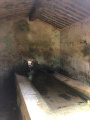
(17) Continue along this track, which winds through the forest. When you reach the Veyans wash house, keep to the right and follow the signs to the chapel. Pass the Tuves building, which is still in good condition, and you will come to a fork in the road.
(18) Continue to follow the GR® marked trail, reach the fork in the trail that leads to the Saint-Saturnin Chapel, and turn left to reach the building.
(19) Return to the fork and continue the route to the left, following the sign for "St-Cézaire-GR®510". At the next crossroads (marker 6), continue to the left, keeping towards Saint-Cézaire. Shortly before reaching the canal, cross a wooden footbridge: take care if it is wet.
(20) Cross the canal bridge and continue to a trail junction.
(21) Continue straight ahead until you reach the three-way junction of tag 9.
(22) Keep to the right to follow the path that leads to the village. This path is a beautifully paved slanting street, and the steps, designed over 200 years ago, are almost regular. The village comes into view in the last few metres.
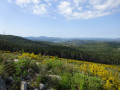
(23) You reach it via a small square where marker 10 is located: this spot offers a view of the valley. At this point, take the stairs leading to Rue de l'Égalité. Turn right to reach the car park (S/E).


 Visorando Member
 Easy
Easy