


Refine your search for walks in Vancé
Vancé walks


 La Tussonne from Vancé
 Tourism professional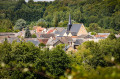
 4.15 mi
 +318 ft
 -295 ft
 2h 10
2h 10
 Easy
Easy
 Departure from Vancé (Sarthe)
Situated in the south-west of the Calais plateau, which is cut by steep-sided valleys, the village is divided by watercourses belonging to the Braye basin; the two main ones are the Charmançon and the Tusson. Its origins may date back to the Gallo-Roman period, but its history becomes clearer in the Middle Ages thanks to the discovery of coins. In the early19th century, following significant population growth, Vancé became home to a large number of craftsmen. In 1810, the village was home to thirteen weavers and twelve building tradespeople: four stonemasons, one bricklayer, one carpenter, three joiners, three shingle cutters and numerous other craftsmen catering to everyday needs.
La Redonne
 8.53 mi
+351 ft
-367 ft
4h 15
8.53 mi
+351 ft
-367 ft
4h 15
 Moderate
Departure from La Chapelle-Huon (Sarthe)
Moderate
Departure from La Chapelle-Huon (Sarthe)
La Chapelle-Huon developed gradually from the Middle Ages onwards. Saint-André Church is a Romanesque building (11th–12th century) with a Renaissance seigneurial chapel added later. The current bell tower was built in 2000 as part of the building’s general restoration. On this occasion, contemporary stained-glass windows were added to enhance the interior. Saint-Gervais-de-Vic likely has very ancient origins. The place name ‘Vic’, from the Latin vicus, meaning village, may refer to the Gallo-Roman period. Iron slag and pottery shards, discovered during work on the railway line, are also evidence of an ancient presence. Admire the15th- and16th-century Manoir de la Béchuère, the Redonne stream and the beautiful wooded countryside.
A map and full description of the route are available in the Perche Sarthois Hiking Guide (50 routes). On sale at Perche Sarthois tourist offices for €10.
Courdemanche and its Saint-Fraimbault Chapel
 Visorando Member
 8.88 mi
+554 ft
-584 ft
4h 35
Moderate
Departure from Courdemanche (Sarthe) (Sarthe)
8.88 mi
+554 ft
-584 ft
4h 35
Moderate
Departure from Courdemanche (Sarthe) (Sarthe)
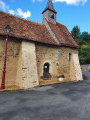
A hike through two valleys. It passes through the hamlet of Saint-Fraimbault and its restored chapel.
The Jewel of Courtanvaux
 4.41 mi
+305 ft
-322 ft
2h 20
Easy
Departure from Bessé-sur-Braye (Sarthe)
4.41 mi
+305 ft
-322 ft
2h 20
Easy
Departure from Bessé-sur-Braye (Sarthe)
Bessé dates back to the Middle Ages. At that time, the parish comprised numerous fiefdoms, including Courtanvaux, a parish seigneury elevated to a marquisate in 1609. The village developed particularly from the18th century onwards thanks to the establishment of pre-industrial sites, as evidenced by the cotton mill set up by Elie Savatier in 1735 (on the site of a former linen weaving mill) or the paper mill established at La Roche in 1824. The latter has since become the town’s main industrial site.
Over hill and dale to Courtanvaux
3.93 mi
+177 ft
-190 ft
2h 00
Easy
Departure from Bessé-sur-Braye (Sarthe)
The Braye, celebrated in song by Ronsard, meets the Loir here. Whilst Bessé-sur-Braye is best known to locals for its thriving paper industry, this village in the Calais region is also home to a Renaissance gem, the Château de Courtanvaux, which is said to have hosted Henry IV. Its large wooded park is open to the public all year round, and serves as the starting point for this walk, which also takes you through lovely countryside along a small tarmac road.
Between Tuffeau and Grès Roussard
 7.53 mi
+289 ft
-279 ft
3h 45
Moderate
Departure from Sainte-Osmane (Sarthe)
7.53 mi
+289 ft
-279 ft
3h 45
Moderate
Departure from Sainte-Osmane (Sarthe)
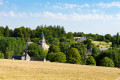
Val-d’Étangson is a new commune formed in 2019 from the merger of the communes of Évaillé and Sainte-Osmane. Dedicated to an Irish princess who became a hermit in Brittany in the7th century, the church, extensively remodelled around 1540, features a beautiful Renaissance porch with classical decorations. By undertaking the interior restoration of the building themselves, the residents have revived the tradition of the ‘fabrique’ – an assembly of parishioners responsible, under the Ancien Régime, for the building’s upkeep. In 1841, the local landscape was mainly characterised by small farmsteads, sometimes grouped into hamlets such as La Chauvière, and a few large estates, such as Rateau or a dairy farm.
Along the banks of the Tusson towards Val-d'Etangson
 7.85 mi
+308 ft
-315 ft
3h 55
Moderate
Departure from Évaillé (Sarthe)
7.85 mi
+308 ft
-315 ft
3h 55
Moderate
Departure from Évaillé (Sarthe)
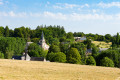
Val-d’Étangson is a new commune formed in 2019 from the merger of the communes of Évaillé and Sainte-Osmane. Possibly first mentioned as early as the9th century, the village on the banks of the Tusson consisted in 1829 of nothing more than the church, the18th-century presbytery with its courtyard and garden, and around fifteen houses. It expanded after 1840, no doubt linked to the opening of the road connecting the two sub-prefectures of La Flèche and Saint-Calais (now the D13).
The Étangsort Valley towards Tresson
 8.68 mi
+348 ft
-351 ft
4h 20
Moderate
Departure from Tresson (Sarthe)
8.68 mi
+348 ft
-351 ft
4h 20
Moderate
Departure from Tresson (Sarthe)
The origins of the settlement of Tresson are very ancient, as evidenced by a dolmen situated not far from Les Basses Poches. Furthermore, the territory of Tresson is crossed by the Via Turniacensis, near which a large agricultural estate is recorded in 572. This villa was donated by Bishop Domnole to Saint-Vincent Abbey, which established a priory in Tresson. This combination of factors led to the development of the present-day village in the Étangsort valley.
In the eye of the Saint-Jean Fountain
 9.14 mi
+354 ft
-344 ft
4h 30
Moderate
Departure from Montaillé (Sarthe)
9.14 mi
+354 ft
-344 ft
4h 30
Moderate
Departure from Montaillé (Sarthe)
Montaillé has developed around two centres: the village centre, built up around the church, and La Brenaille, a cluster of hamlets and farms to the north of the village. The site of La Brenaille appears to have been inhabited since ancient times, whilst the village centre seems to have been settled during the Gallo-Roman period, as evidenced by the route of an ancient road between Le Mans and Orléans. ‘Montaillé’ likely derives from a contraction of the Latin ‘montem’, meaning mountain or high ground, and the name ‘Alhierus’, a Germanic name that may have referred to the landowner following the barbarian invasions ofthe 5th century. As the name suggests, the land is situated on high ground and is close to a stream, the Pibeau, and a spring, the Fontaine Saint Jean-Baptiste.
On the Via Turniacensis in Maisoncelles
 5.48 mi
+82 ft
-82 ft
2h 35
Easy
Departure from Maisoncelles (Sarthe) (Sarthe)
5.48 mi
+82 ft
-82 ft
2h 35
Easy
Departure from Maisoncelles (Sarthe) (Sarthe)
The village of Maisoncelles, described as a ‘street village’, has developed linearly along the road linking Bouloire to Tresson and Écorpain, running perpendicular to the Ruisseau de l’Étangsort. Although difficult to date precisely, the imposing Church of Notre-Dame, possibly dating back to the Romanesque period, is undoubtedly the oldest building in the village. You can, however, see typical rural features from theThird Republic, such as the public pump at the foot of the church. Heading towards the cemetery, you will see on the right the old communal washhouse, recently converted to welcome walkers, and further up, a former school recognisable by its two-storey structure and brick window frames.
The Calaisienne Loop
 9.62 mi
+318 ft
-305 ft
4h 40
Moderate
Departure from Saint-Calais (Sarthe)
9.62 mi
+318 ft
-305 ft
4h 40
Moderate
Departure from Saint-Calais (Sarthe)
The evolution of Saint-Calais is evident in its town planning, which developed in the Middle Ages on either side of the Anille. On the right bank, the former abbey site founded inthe 6th century is still visible in the two tall gables of the current resource centre. During the Revolution, it gave way to another administrative centre with imposing buildings and the straight streets typical ofthe 19th century. On the left bank, on the hillside between the river and the castle founded inthe 11th century to rival the powerful abbey, you can easily make out the medieval quarter, which was built around the axis of the Grande Rue on an irregular and densely packed grid of plots.
Route of photography from Conflans-sur-Anille
 14.34 mi
+617 ft
-600 ft
7h 10
14.34 mi
+617 ft
-600 ft
7h 10
 Difficult
Departure from Conflans-sur-Anille (Sarthe)
Difficult
Departure from Conflans-sur-Anille (Sarthe)
Situated on a small spur at the confluence of the Anille and Roulecrotte rivers, the village, first mentioned in the 13th century, retains several old houses, including the town hall, a former presbytery built in the 15th century. The church, rebuilt around 1780, features a beautiful collection of murals painted around 1860 using potassium silicate (a new technique for the time).
The ‘Route des Cormiers’
 10.01 mi
+541 ft
-512 ft
5h 05
Moderate
Departure from Conflans-sur-Anille (Sarthe)
10.01 mi
+541 ft
-512 ft
5h 05
Moderate
Departure from Conflans-sur-Anille (Sarthe)
Setting off from this village-street with its rich architectural heritage, head along the ancient sunken paths, sections (1) to (6) ofthe GR®® 235, lined with a variety of trees – oaks, service trees, serviceberries, wild pear trees and so on – offering walkers an enchanting, shaded route. These paths, in the heart of the rolling countryside of the Perche Sarthois, are linked by a network of quiet country lanes, offering stunning 180° panoramic views from the higher points.
Les Sapins des Pauvres
 11.37 mi
+302 ft
-289 ft
5h 30
Moderate
Departure from Saint-Mars-de-Locquenay (Sarthe)
11.37 mi
+302 ft
-289 ft
5h 30
Moderate
Departure from Saint-Mars-de-Locquenay (Sarthe)
The name adopted at the time of the merger refers to the location of the two villages situated in the valley at the confluence of the Arche and Hune streams. The area has been inhabited since ancient times, as evidenced by the dolmen on the border with Tresson, dating from the Neolithic period, and the ancient road – the Via Turniacensis – linking Le Mans to Blois; passing through Volnay and Saint-Mars-de-Locquenay before heading towards the Loir Valley. This facilitated the development of large agricultural estates, explaining the presence of numerous fiefdoms in medieval times, of which few traces remain (Champion, Pois, Le Grand Yvay, Mèleve, Sargilet), with the exception of La Chesnaye, which incorporated most of them during the Modern Era (16th–18th centuries).
In the footsteps of Gohan in Bouloire
 10.05 mi
+486 ft
-509 ft
5h 05
Moderate
Departure from Bouloire (Sarthe)
10.05 mi
+486 ft
-509 ft
5h 05
Moderate
Departure from Bouloire (Sarthe)
Bouloire is nestled in the heart of a vast, hilly agricultural region crossed by the Dué and Tortue rivers. Human presence along the ancient road between Le Mans and Orléans is attested to by a coin dating back to the Merovingian period. Its name comes either from a Celtic place name meaning "fortification" or from an etymology meaning "between two coasts ". The town centre is rich in ancient architectural heritage. The Church of Saint-Georges, destroyed by a fire that ravaged the village in 1680, bears the coat of arms of Marshal Guillaume Testu de Balincourt, who enabled its reconstruction. The town's coat of arms is also linked to this figure.
On the edge of the woods from Volnay
 13.34 mi
+502 ft
-492 ft
6h 35
Difficult
Departure from Volnay (Sarthe) (Sarthe)
13.34 mi
+502 ft
-492 ft
6h 35
Difficult
Departure from Volnay (Sarthe) (Sarthe)
The name Val-de-la-Hune, adopted at the time of the merger, refers to the location of the two villages situated in the valley at the confluence of the Ruisseau de l’Arche and the Hune. The area has been inhabited since ancient times, as evidenced by the dolmen on the border with Tresson, dating from the Neolithic period, and the ancient road, the Via Turniacensis, linking Le Mans to Blois; passing through Volnay and Saint-Mars-de-Locquenay before heading towards the Loir Valley. This facilitated the development of large agricultural estates, explaining the presence of numerous fiefdoms in medieval times, of which few remains are left (Champion, Pois, Le Grand Yvay, Mélève, Sargilet), with the exception of La Chesnaye, which incorporated most of them during the Modern Era (16th–18th centuries).