Country:
 City:
City:


Start at Lourmel metro station (line 8). Take exit 1 onto Rue de Lourmel.
(S/E) As you exit the metro station, turn right to cross Avenue Félix Faure at the traffic lights. On the other side, turn right then left into Rue de Lourmel (note the two large carved lion heads on the façade of the bank on the corner). At the next junction, turn left into Rue Vasco de Gama. At the next junction (traffic lights), turn left into Rue Lecourbe. Pass Villa Thoréton on your left and you will soon reach the entrance to Vaugirard Cemetery.
The route inside the cemetery is a guide only and can be adapted in various ways. In the description below, the names appearing on the graves may be highlighted for three different reasons:
1) Graves of notable figures, in which case a lower-case letter in brackets refers to a short entry in the “Places to see” section, where names are listed in the order they appear on the route.
2) Particularly original monuments.
3) Useful landmarks on the ground.
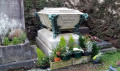
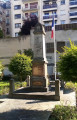
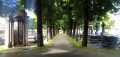
(1) Enter the cemetery and walk straight along the Main Aisle until you reach a water feature dominated by the Attenni family monument, adorned with medallions and a statue of a mourner (this monument was created by the former firm Attenni Frères, based in the 15th arrondissement). Continue straight along this path and note, on the left-hand side, the grave of Adolphe Chérioux (a).
(2) With your back to this grave, take the cemented path opposite, which soon turns grassy. Shortly afterwards, turn left onto another path and pass between a grave adorned with a statue of a praying monk and the bust of Ernest Berger (b). At a junction at the corner of Germaine Gilbert’s grave, turn right onto a grassy path. Note, on the right-hand side, the statue of an angel that seems to be watching over the Fisch family grave.
At the T-junction, turn right, passing between the graves of the Olivier and Bony families. After about 40 metres, turn right. Pass once more by the foot of the grave with the praying monk and rejoin the Main Aisle opposite the grave of Adolphe Chérioux.
(2) Follow the path to the right. On the left, just past the Buezac couple’s grave, you will find a communal grave for the Jesuit community of Grenelle, including Cardinals Henri de Lubac (c) and Jean Daniélou (d). Continue along the path and note, on the left-hand side, the Boyer family grave, including Jean-Baptiste Boyer (e), surmounted by a sculpture depicting a woman supporting a dying soldier, no doubt her son.
Just past another communal grave on the left, turn left onto a grassy path, leaving the Le Pape family grave on your right. Take the second path on the right, leaving the grave of Sarah Alizadeh, adorned with inscriptions in Persian, on your left. You will reach the grave of Michel Baroin (f), adorned with a modern sculpture. You will come to a junction with the Durand family grave on your left.
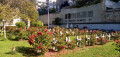
(3) Then turn right, pass the grave of Michèle Darty, cross the Main Aisle and proceed through a small open area (information panel on the military section). Then turn left and pass a chain to enter the military section, which contains the graves of soldiers who died during the First World War as well as those who died on overseas operations between 2000 and 2020. Follow the wide grassy path, passing an obelisk on your right – a memorial to the war dead and disabled veterans. Pass another chain, emerge onto a path and follow it to the left. At the end, turn left again onto the Main Path.
At the obelisk, turn right onto a path between the grave of Michèle Faudry and that of the Mouton family. Immediately take the first path on the left and, shortly afterwards, pass the grave of the Doumer family: Paul Doumer (left), Blanche Doumer née Richel (right) and two of their sons, André and René, who died in action during the First World War. Continue to a junction you passed earlier.
(3) Then turn right. Just before the end of the path, turn left between the Dop and Lecouteil graves and follow a grassy path. At a crossroads, first turn right then left and pass the Gélin family grave, which is adorned with an owl. When you reach the Guérin family grave on the right-hand side, turn left onto a grassy path.
Just after a grave topped with a crucified Christ, on the left-hand side, turn right onto a path lined with young trees. Pass by the foot of the Marius Plateau monument, which features a sculpture of a soldier’s head and at the base of which you can read his commendation in the Army Order. Return to the Attenni family monument and continue to the cemetery exit.
(1) Then follow Rue Lecourbe to the left. Take the first left (metal gate, cobbled pavement), pass under a porch and enter Villa Frédéric Mistral. At the end, go through a small gate on the right and pass under another archway. Go past a chain, emerge onto Rue Félix Faure and follow it to the left. At the end, cross Avenue Félix Faure at the pedestrian crossing on the left and follow it to the left. Walk along Square Rosalind Franklin and you will immediately come to the Lourmel metro station (S/E).
 Visorando Member

 Moderate