A visit to Auteuil Cemetery

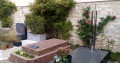
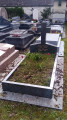
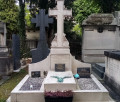
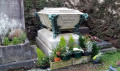
A very brief stroll through one of the oldest and smallest cemeteries in Paris, in a relatively peaceful setting. The graves of a few notable figures and some unusual monuments await.

Details

94747940
Creation:
Last update:
Last review:
  • Walking
    Activity: Walking
  • ↔
    Distance: 0.47 mi
  • ◔
    Average duration: 0h 15 
  • ▲
    Difficulty: Easy

  • ⚐
    Back to start: Yes
  • ↗
    Ascent: + 7 ft
  • ↘
    Descent: - 7 ft

  • ▲
    Highest point: 125 ft
  • ▼
    Lowest point: 118 ft
  • ⚐ Country: France
  • ⚐ City: Paris (75000)
  • ⚑
    Start/End: N 48.841849° / E 2.259236°
  • ❏
    IGN map(s): Ref. 2314OT
  • Hour-by-hour weather

Photos

Description of the walk

Start from Exelmans metro station (line 9). Take exit 3, Rue Claude Lorrain.

In the description below, the names appearing on the graves may be highlighted for three different reasons:
1) Graves of
notable figures, in which case a lower-case letter in brackets refers to a short entry in the ‘Places to see’ section, where names are listed in the order they appear on the route.
2) Particularly original monuments.
3) Useful landmarks in the area.

(S/E) On leaving the metro station, go straight ahead and turn immediately left into Rue Claude Lorrain. After about fifty metres, turn right and enter Auteuil Cemetery.

(1) Walk straight ahead along a gravel path and immediately note, on the right-hand side, the grave topped by a bust of Adolphe Yvon (a). Shortly afterwards, in the third row on the right, look out for the bust of Paul Dalloz (b) and his family’s grave. You will reach the chapel of the Gounod and Pigny families, which houses, amongst others, the grave of Charles Gounod (c).

At the corner of this chapel, turn right into a grassy path. Note, on the right-hand side, the grave of a chemical engineer, Louis Possoz, adorned with his bust and his instruments.

(2) At the end of the path, turn right to see, on the left-hand side, the tomb of Charles Leron-Levent, designed by the architect Hector Guimard (1867–1942), an icon of Art Nouveau, and adorned with a bronze medallion sculpted by Jeanne Itasse-Broquet (1865–1941). Return to the previous junction.

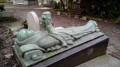
(2) Continue straight ahead. At the end of the path (on the right, a monument topped by a statue of a child holding a sprig of laurel), turn left and you will arrive at the foot of the imposing mausoleum of the Duke of Riaro Sforza.

(3) Turn right at the corner of the mausoleum, then right again at the next corner. You will immediately find, on the right-hand side, the chapel of Pierre-Alfred Chardon (d) and Amélie Lagache (e). Note on the left an imposing monument bearing the name of the Ternaux family.

Take the penultimate path on the left, at the corner of the Auzou tomb. Go straight on and, after a few dozen metres, note the tomb of Raoul Follereau (f) on the left.

At the end of the path, turn left twice and you will immediately find, on the left, the grave of Benjamin Thompson (g). Shortly afterwards, on the right-hand side, note the Burgart family grave, which houses Orane Demazis (h).

At the end, facing the Chardon-Lagache chapel seen earlier, turn right twice. Note on the left the grave of Adrien Legendre (i) and then that of Pierre Granier-Deferre (j).

At the end of the path, note the grave of Pierre Benoît (k) opposite. Then turn left twice and walk past the grave of Pierre Jean Georges Cabanis (l). Continue straight ahead until you reach the crossroads at the foot of the mausoleum of the Duke of Riaro Sforza.

(3) Then turn right and you will immediately reach the central crossroads where there is a bell.

(4) Turn right onto Avenue Transversale (not signposted). Continue straight ahead and note, on the left-hand side, the grave of Robert Élias (m). At the end, turn left and walk past a chapel flanked by two mourners.

At the end of the path, turn left and walk past the grave of Louis Roussel (n). At the Baton grave (large metal cross), turn left. At the T-junction, turn right and you will soon reach the junction with the bell.

(4) First turn right then left to take a narrow side path that starts at the foot of a grave bearing the inscription "Perpetual Concession 1854". Note on the left the grave of Abel Gance (o). Go straight ahead, pass between two chapels and arrive at a T-junction.

Turn left and note, on the left-hand side, the grave of a former soldier from the fighter aircraft group known as "Normandie-Niemen", which was formed by the Free French in 1942. At the end of the path, turn left.

(1) At the junction, turn right and leave the cemetery immediately. Follow Rue Claude Lorrain to the left and, at the end, turn right to reach the Exelmans metro station straight away (S/E).

Waypoints

  1. S/E : mi 0 - alt. 125 ft - Exelmans metro station
  2. 1 : mi 0.06 - alt. 121 ft - Avenue Transversale x Chemin du Nord
  3. 2 : mi 0.09 - alt. 121 ft - Chemin de Zimmermann x Chemin de l'Ouest
  4. 3 : mi 0.12 - alt. 121 ft - Crossroads of the South-West section
  5. 4 : mi 0.26 - alt. 121 ft - Crossroads of La Cloche
  6. S/E : mi 0.47 - alt. 125 ft - Exelmans metro station

Notes

A simple pair of trainers is sufficient for this short urban walk.

Inside the cemetery, water points are marked on the map and there are toilets on the left just after the Rue Claude Lorrain entrance. Bars and restaurants in the surrounding neighbourhood.

A detailed map is required (at the very least the one accompanying this description). It is recommended that you obtain the map provided by Paris City Hall, which indicates the locations of the graves of several notable figures.

Auteuil Cemetery opening hours:
- Opening: weekdays, 8.00 am; Saturdays, 8.30 am; Sundays and public holidays, 9.00 am.
- Closing: from 6 November to 15 March, 5.30 pm; from 16 March to 5 November, 6.00 pm.

Need we remind you that a cemetery is a place of contemplation, and that discreet and respectful behaviour is required?...

Walk undertaken by the author on 12 April 2026.

Worth a visit

Some facts about the history of Auteuil Cemetery:
The Auteuil Cemetery was established in 1800, when the commune of Auteuil was still independent (it was incorporated into Paris in 1860). The mayor at the time, Pierre Benoît, is also buried there. Covering an area of less than one hectare, it is one of the smallest cemeteries in Paris.

Graves of notable figures (non-exhaustive list) :
a - Adolphe Yvon (1817–1893) Painter, best known for his battle scenes.
b - Paul Dalloz (1829–1887) Journalist and publisher, son of Désiré Dalloz, to whom we owe the voluminous compendia of French law still in use today.
c - Charles Gounod (1818–1893) Composer, author of 12 operas, the most famous of which is Faust (including the ‘Air des bijoux’, well known to readers of The Adventures of Tintin), as well as religious music.
d - Pierre-Alfred Chardon (1807–1879) Founder, with his wife, of a retirement home in the neighbourhood, which later became a hospital.
e - Amélie Lagache (1811–1887) Founder, with her husband Pierre-Alfred Chardon, of a retirement home in the neighbourhood, which later became a hospital.
e - Anne-Catherine de Ligniville Helvétius (1722–1800) Woman of letters.
f - Raoul Follereau (1903–1977) Founder of a leprosy charity.
g - Benjamin Thompson (1753–1914) British physicist and chemist, known for his work in calorimetry and photometry and for his innovations in the field of industrial furnaces.
h - Orane Demazis, née Marie-Louise Burgart (1894–1991) Actress, appearing in several films by Marcel Pagnol, including the role of Fanny in the Marius/Fanny/César trilogy.
i - Adrien Legendre (1752–1833) Mathematician.
j - Pierre Granier-Deferre (1927–2007) Filmmaker.
k - Pierre Benoît (1741–1816) Mayor of the commune of Auteuil at the time the cemetery opened.
l - Pierre Jean Georges Cabanis (1757–1808) Physician, physiologist, philosopher.
m - Robert Élias (1821–1874) Sculptor.
n - Louis Roussel (1825–1897) Priest, founder of the Oeuvre des orphelins-apprentis d’Auteuil.
o - Abel Gance (1889–1981) Filmmaker and director of, amongst other works, historical films, including the famous *Napoleon* in 1927.
s - Hippolyte de Villemessant (1810–1879) Journalist, newspaper magnate, founder of the newspaper Le Figaro.

Sources: Paris City Hall and Wikipedia.

Other walks in the area

For more walks, use our search engine .

The GPS track and description are the property of this route's author. Please do not copy them without permission.