


 Country:

 City:
City:


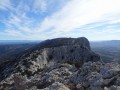
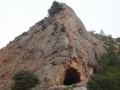
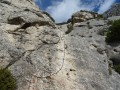
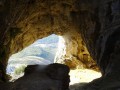
(____ WARNING__, risk of rockfalls on the yellow trail! Given the potentially dangerous nature of the remaining rock face, a municipal order has been issued by the Mayor of Saint-Antonin-sur-Bayon, formally prohibiting access to the trail until further notice.__)
Access: coming from Beaureceuil or Le Tholonet, drive through Saint-Antonin-sur-Bayon via the D17.
Park in the car park known as ‘Les 2 Aiguilles’, 500m to the right after the Maison de Sainte-Victoire, on the outskirts of Saint-Antonin-sur-Bayon.
(S/E) At the car park, facing Sainte-Victoire, cross the D17 road. Immediately on a large flat rock, there are several markings, including one indicating the start of the Black route on the right (marked ‘Garagaï’, fairly difficult).
Black route markers:
Then quickly pass the small picnic area. Ignore the next three paths branching off to the left. A few dozen metres further on, begin the climb towards the cliff face. 150m before the cliff face, cut across the Brown-marked trail by continuing straight ahead.
(1) Once at the foot of the cliff, you’ll come to the ‘Pied de l’Éléphant’ (Elephant’s Foot), where you’ll need to use your hands. After this short section, continue the climb; the markings head west. The black markings are quite difficult to see on the grey rocks, which have numerous dark patches. Take the time to look carefully and assess the terrain.
The route alternates between scree slopes, slabby or rocky sections and paths. A short exposed section, the Pas de l’Aiglon, allows you to bypass a sheer rock face before reaching the scree slope of the Garagaï. Once you reach this scree slope (where you’ll find wire mesh cages filled with stones), the black markings will soon meet the green markings (Forcioli).
Black and Green markings:
(2) After the stabilised section, the Black route joins the Green route of the Forcioli. The path heads back towards the middle of the scree slope where steel stakes have been driven into the ground to stabilise the path. Climb up the scree to cross large rock slabs and a series of ledges.
Cross a narrow, somewhat exposed ledge near the Petit Garagaï (which is now on your right, slightly below). The Grand Garagaï is directly ahead (to the west). Emerge at the foot of the Grotte aux Hirondelles. Cross it to reach the ridge. The climb is made tricky by the weathered and worn rocks. Take care if the ground is wet.
White/red markings,GR®®9:
(3) Exit the cave, on the north face of Sainte-Victoire. Turn left onto the ridge path via theGR®®9(red/white markings). Turn left again to reach the Croix de Provence. From the Croix de Provence, head back down theGR®®9to enter the Prieuré de la Sainte-Victoire.
Leave the priory and head left to continue the descent on theGR®®9.
Blue markings:
About 200m further down, at a junction, leave theGR®® and continue the descent following the blue markings (Imoucha path).
(4) On the descent, cross the small, inconspicuous path (partly hidden by vegetation) on the left coming from the Yellow trail. A tiny cairn marks its entrance. Continue straight down the path. Blue markings.
Red markings:
(5) At the first junction on the left with the Red route (Pas du Moine), continue left. A large cairn marks the start of the descent. Follow the continuous Red route. The descent is quite demanding and treacherous; you must watch your step. There are sections over fairly steep rock slabs at the start. You will reach the Pas du Berger, which you must climb down.
(6) You’ll emerge to the left of the Fork in the Road marked by a large cairn. On the second descent, you’ll approach from the right. Continue the descent along the Red route. Cross a few rocky slabs at the Pas des Dinosaures. Then cross a small area with orchards and olive trees before reaching the Cézanne refuge.
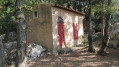
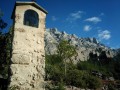
(7) Behind the Cézanne refuge, take a few steps up to the threshing floor of the old hamlet of Le Trou. To the right of the threshing floor stands the Rocher du Trou with its wayside cross.
White/RedGR®®653Amarkings and Brown markings:
Continue straight on along theGR®®653A. Red/white and brown markings. The path heads east at the foot of the cliffs.
(8) After 1 km on the brown-marked path, turn left.
Green markings:
A small rock with a green marker marks the start of the Forcioli path. Take this path, which climbs steeply until it reaches the foot of the cliff. Follow the cliff for about 30m to the Ecaille de Tortue passage, which is a slab resting against the cliff and slightly detached from it. The right-hand side is easier to access (good holds) and less exposed than the left-hand side.
At the top of the boulder, the route heads left before climbing up a chimney. At the top of this chimney, take the left (west) route along the cliff face. The path then climbs up slabs to emerge at the foot of a second ledge to be crossed. This second section is on very smooth limestone, which makes it tricky.
After a series of small ledges (slabs or boulders), you’ll reach the first scree slope.
Follow the green markings and leave the scree slope to the right to climb up a chimney, reaching a slab and then a small ridge. Cross a large sloping slab to join the black route at the patch of vegetation. The green markings are frequent and clearly visible on the ascent.
Black and Green markings:
(2) You’ll reach the section shared by the Black and Green trails below the Garagaï scree slope.
Emerge once again at the foot of the Grotte aux Hirondelles. Cross this to reach the ridge.
White/Red markings,GR®®9
(3) Leave the cave, then turn left again onto the ridge path via theGR®®9(Red/White markings).
This time, pass below the Croix de Provence and go round the Prieuré de la Sainte-Victoire.
Blue markings:
About 200m further down, at a junction, leave theGR®® and continue the descent following the blue markings (Imoucha path).
(4) Cross the small, inconspicuous path on the left coming from the Yellow trail for a second time. A tiny cairn marks its entrance. Continue straight on along the path. Blue markings.
(5) Pass the Pas du Moine and continue straight down the Blue trail to the Pas de l’Escalette.
Red dot markings:
(9) Continue to the left, following the red dot markings. Begin the descent by following these markings.
(6) You will emerge on the right-hand side of the Fork in the road marked by a large cairn. Continue the descent along the red route to reach the Cézanne refuge.
Yellow markings: (__Warning: route closed (see warning above)__)
(7) Behind the refuge, follow the yellow markings (on the tree trunk in the middle) heading towards the north-facing rock face amidst typical heath vegetation. A first rocky outcrop requires the use of your hands.
(10) Next comes the Pas de la Savonnette, a smooth slab that is crossed with the aid of an 8m chain. The passage remains challenging. The chain has several unaligned anchor points. An alternative route (dotted yellow markings) allows you to bypass this obstacle to the left.
Next, go round a pillar to reach the foot of a wide couloir (view of the Croix de Provence). The ascent alternates between steep sections and easier ones. The path becomes increasingly rocky and at times quite vertical, bordering on rock climbing. Many sections require you to make good use of your hands. Reach the ridge at Baù Cézanne.
No signposting:
(11) Head east to join the Imoucha path (blue route) at point (4).
White/red markings,GR®®9:
(4) Turn right, then head up to the Priory via theGR®®9, and continue to Garagaï.
(3) Continue along the ridges via theGR®®9for approximately 2.2 km. The terrain remains challenging, as the route crosses sharp limestone pavement.
Green markings:
(12) A discreet cairn with a green marker marks the entrance to the gap and the path leading back down.
Two green markers in the gap indicate the direction to follow. Take the path on the right, which descends steeply.
The descent from the Pas du Clapier is quite challenging; in less than a kilometre, you’ll reach the Brown-marked path that runs along the massif from east to west. Several short ledges must be negotiated during the descent, through gaps or faults. Good handholds make the descent safe. Green markings are present at regular intervals. You will reach the bottom (a large cairn marks the start of the Green markings).
Brown markings:
(13) Turn right onto the Brown-marked trail. You’ll arrive above La Marbrière (a former marble quarry). Take a short detour to visit this small quarry and the remaining blocks, then rejoin the Brown trail as it descends.
(14) Continue along this path to the right at the track junction.
No markings:
(15) At the next junction, after about 550m, continue along the small path to the left. Climb up to the Cheyenne cave. Continue downwards towards the south-west to reach the D17 county road. Turn right and follow it for 200m to return to the Deux Aiguilles car park (S/E).




 Visorando Member
 Very difficult
 Moderate
 Difficult
 Easy
Easy 
