07/11/2024: Hikes temporarily inaccessible: the black and green routes on Sainte-Victoire are closed by


 Country:

 City:
City:


Access: coming from Beaureceuil or Le Tholonet, drive through Saint-Antonin-sur-Bayon via the D17.
Park in the car park known as ‘Les 2 Aiguilles’, 500m to the right after the Maison de Sainte-Victoire, on the outskirts of Saint-Antonin-sur-Bayon.
(S/E) At the car park, facing Mont Sainte-Victoire, cross the D17 road. Immediately on a large flat rock, there are several signposts, including one indicating the start of the route to the climbing sites, marked by a Blue Triangle with a climber painted on it.
Take the path which then climbs due north towards the foot of the cliff. The track climbs through red earth. After 600m, cross the Brown Marked path and turn right onto it.
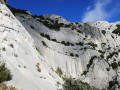
At the first junction, after about 170m, leave the Brown trail and continue to the left. Keep following the Blue Triangle markings. You will soon reach the cliff face and the numerous climbing routes, the names of which are marked in blue. Follow the path that runs along the cliff face heading west (left).
Continue to the “Rognures” sector, marked in blue on a rock, and carry on to the right of it. The path joins the base of two rocky gullies. The one on the left is easier to navigate and cross (the passage on the right requires a bit more dexterity).
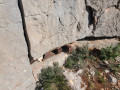
At the end of the gully, there is another ledge to cross, leading onto a limestone slab. Cross the overhanging slab. A transverse crack provides footholds.
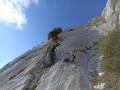
(1) Arrive at the foot of the "Pas de l'Oppidum". A long vertical then horizontal chain allows you to cross the slab. Continue the climb due north through boxwood and small scree slopes, following the cairned path. You will then quickly reach the Black-marked trail.
(2) At the junction with the "Black" trail, take the obvious scree slope opposite, which climbs straight north towards the "Pas du Chat". No markings. The slope is very steep. It is best to climb on the sides of the scree slope to find better grip and stability.
At the end of the scree slope, climb the slab using the vertical chain provided to cross the "Pas du Chat". Continue the ascent via another climb passing next to a tree, where you will find a second chain.
Reach the ridge quickly via a series of short, easy climbs.
(3) On the ridge, turn left towards the Croix de Provence via theGR®9. White/red markings.
(4) You will arrive in front of the Grotte aux Hirondelles. Black and green markings. Descend carefully (smooth, weathered rocks) and cross the cave. At the cave exit, pass by the Gouffre du Garagaï. Continue the descent following the black and green markings. Take care, as these are easier to spot on the ascent than on the descent.
Continue left (eastwards) on the black-marked path (the green “Forcioli” path branches off to the right).
(2) After 300m, cross the scree slope leading to the Pas du Chat again, and continue straight on along the path. Black markings. Follow the Black path eastwards for about 300m until you reach a large cairn with a black elbow-shaped mark painted on a rock.
(5) Climb straight north up the slope dotted with boxwood to reach a small pass at the top right, which provides access to the Vire des Cantilènes. It is advisable to climb through the fissures and ledges on the left-hand side rather than crossing to the right over the limestone slab. After this ledge, a well-marked path emerges, which is marked with cairns. Cross the Vire des Cantilènes from west to east, passing above the cliff. The traverse ends in a small, wooded and steep gully.
The exit from the gully leads to a large cairn and a promontory offering a beautiful view. Next, climb the slope to the left (north) via another rocky section, then continue the steep ascent to quickly reach the ridge.
(6) At the exit of the Cantilènes, continue to the right towards the east along the Saint Victoire ridge via theGR®9. White/red markings.
This descent is entirely off-trail and there are no markings.
(7) After about 450m, look for a small gap. No markings. Descend due south, hugging the rock face on your left. After 100m, a gap appears (with vegetation behind it); ignore this and continue the descent due south. Continue hugging the rocky ridge until it disappears at a sloping limestone slab.
On the very slight ledge at the end of the rocky ridge, turn left through the small crack. There is a small opening where you can abseil down using a rope (10m required) or use the crack to climb down the small ledge.
At the foot of the ledge, follow the overhanging limestone slab eastwards for a few metres, then turn right to reach the rocky outcrop to the south. Follow this downwards. You will emerge above a scree slope; descend this to reach the foot of the basin formed in the valley.
At the foot of the scree slope, turn left to rejoin the rocky face. Climb up and follow it through the sparse vegetation. Swing round to the other side and head straight eastwards. Pass the foot of the Garagaï des Raspinas; there is a cairn here.
Continue straight on, climbing up the ridge. You will find yourself above a scree slope. Enter it and descend to the bottom.
(8) You will emerge above La Marbrière. Then continue left (eastwards) on the brown-marked path. After 350m, you will arrive near the Pas du Clapier.
(9) At the foot of the Pas du Clapier, continue straight on along the brown-marked trail, still heading east.
(10) After 1.1 km on the path, look out for a small descending track branching off to the right. No markings. The route follows the bed of a dry stream in places. After a 350m descent, you’ll come out onto a wide track. Continue straight down. Then ignore the path on the left that appears shortly after 100m.
At the next fork after 350m, continue left onto the wide track, then after 150m turn left again (the D17 is nearby) onto the track suitable for vehicles. The terrain begins to climb slightly again. At the next fork, continue left and ignore all the small side tracks you encounter, staying on this wide track, which generally heads east. At the fork with two wide tracks, continue on the track on the right.
(11) After about 400m, you’ll come across a small path crossing the wide track. Take the path on the left, which climbs upwards. Red markings. Follow the red markings until you reach the Baudino Refuge. The path climbs all the way.
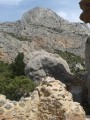
(12) At the Baudino Refuge, nestled on a small wooded plateau, look for the brown-marked path on the right. Go round the back of the refuge then cross a rocky section made up of huge limestone boulders. Cross a narrow “triangular” passage formed by two boulders.
After about 10 metres, a cairn-marked path starts on the left. Leave the brown-marked trail and head left. The slope rises quite steeply. Pass a large, clearly visible cairn, ideally situated on a rocky outcrop, and cross over to the other side (due north).
Once you reach the flat section of the path, follow it as it leads you to the upper part of a scree slope. To the left, just before the end of the Grand Couloir scree slope, the east-west-facing ledge appears.
This ascending ledge is equipped with a cable serving as a handrail. The exit from the ledge is followed by two short vertical sections with chains. After these sections, continue along the cairn-marked path through small scree and boxwood until you reach the ridge.
(13) Follow the ridge to the left (heading west) and try to stay as close to the cliff edge as possible without blindly following theGR®9, which runs further below, so as to fully enjoy the view. Cross the Plan de la Crau.
(14) After about 1.5 km, a discreet cairn with green markings indicates the entrance to the gap and the path leading down. Two green markers in the gap show the way forward. Take the path on the left, which descends steeply. Follow the green markings.
The descent from the Pas du Clapier is quite challenging; in less than a kilometre, you’ll reach the brown-marked path that runs along the massif from east to west. Several short ledges must be negotiated during the descent, through gaps or fissures. Good handholds make the descent safe. Green markings are present at regular intervals. Arrive at the bottom (a large cairn marks the start of the green markings).
(9) Turn right onto the Brown-marked trail. Arrive above La Marbrière.
(8) Continue the descent along the path. Brown markings. After 550m, continue along this path to the right at the track junction. At the next junction, after about 500m, take the small path on the left. Climb up to the Grotte du Cheyenne. Continue descending south-westwards to reach the D17 county road. Turn right and follow it for 200m to return to the Deux Aiguilles car park (S/E).




 You shouldn’t have provoked me.
 The chains are definitely there, phew!
 Visorando Member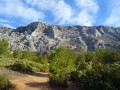

 Very difficult
 Moderate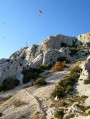
 Difficult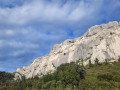
 Easy
Easy