Country:

 City:
City:


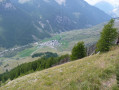
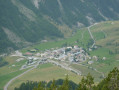
Heading up from Barcelonnette, shortly after La Condamine-Châtelard, turn right onto the Route du Col de Larche (D900) and drive to the village of Larche, halfway up the pass. Simply park in front of the church with the lovely name of Notre-Dame des Neiges: there are parallel parking spaces along the road.
(S/E) Head towards the pass, then take the second street on the left (Rue de la Clayette), passing a playground and the Tourist Office (which I believe also houses the post office). At the end of the street, at the bend opposite the La Rua chalet, continue along the track that heads into the valley of the stream visible on the right: red and white markings indicate that you are on the GR®.
Soon the track approaches the stream (Riou de Rouchouse) and runs alongside it.
(1) Just before a footbridge on the right, turn left at a post bearing four signs indicating, amongst other things: “Sentier de mémoire SES Costa de Beauregard” and “Tête Dure”. Follow: “Tête Dure”. Immediately after, turn right: it is also possible to take a left onto a side path which joins the main trail about 150 m further on.
Immediately after the junction, the path climbs quite steeply in numerous hairpin bends, gaining around 100 metres in altitude, passing notably near a captured spring (on the left).
(2) At the next signpost (a return route is possible to the left at Point d’Appui 1893), head north towards Tête Dure. The path is now relatively flat and almost level, gradually reaching the edge of the stream. Continue along this path marked in red and yellow (GRP®) and yellow (circular loop for Tête Dure).
(3) Close to the stream, where the valley narrows, there is a sign describing the Génie Dam. If you look around here, you should find the remains of this makeshift dam (see the sign) built to halt the enemy in June 1940.
After passing an old concrete structure bearing the two markers (Yellow and Yellow-Red), you’ll find a sign indicating: Support Point 2018, top left. Continue straight on towards: Col de Sautron – Col des Monges and Tête Dure.
(4) Pass very close to a roofless concrete hut, then not far from a hut in very good condition built sheltered by a huge rock (top left). Just after this, you come to a fork: left: Col de Sautron, right: Col des Monges – Tête Dure. Turn right. You are now on the left bank of the Rouchouse stream.
You are initially in a very rocky environment, then gradually the path enters the upper Rouchouse valley, a very open valley with a very gentle slope, where the torrent meanders freely in a wide, winding bed, and which foreshadows the very broad, undulating depression of the Montagnette that stretches between the Col des Monges and the Col de la Gypière, centred on Lac de la Montagnette.
(5) A post bearing three signs points to the Col des Monges on the left, and to the Col de la Gypière and Tête Dure on the right. Turn right to climb alongside a small stream.
(6) Just before a sheepfold with a corrugated iron roof, there is a post indicating Tête Dure to the right (the path opposite continues towards the Col de la Gypière). Turn right for a long, steep climb across numerous scree slopes, ending at the Col Rémy.
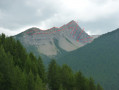
(7) At the pass, a signpost indicates: Col Rémy – 2,552 m, and the direction of Tête Dure. A moderate climb leads to the bare summit of Tête Dure, where you can enjoy a magnificent 360° view. An information panel recounts the history of the site, relating to the battles fought by Lieutenant Costa de Beauregard’s company in June 1940.
(8) Descend by taking the path southwards, which follows a long ridge bordering the Rémy valley and eventually joins a wide track near an antenna and its technical building.
(9) Turn right onto this lovely, balcony-like track heading towards Larche.
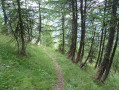
(10) After about 600 m, turn left onto a grassy path marked by a cylindrical post bearing a yellow marker. This path descends diagonally, initially running parallel to the track, then enters a larch forest. Within this forest, there are avalanche barriers, along which the path descends in numerous switchbacks. It then levels out heading north through a clearing, before winding downwards again to a series of ski lifts, along which it descends straight down to the cemetery, where it joins the road.
From the cemetery, take the road to the right to the car park in front of the church (S/E).




 Visorando Member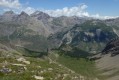
 Moderate
 Association / Club / Walk leader
 Very difficult