Country:
 City:
City:


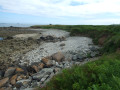
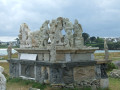
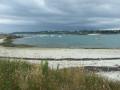
Park at the car park at the end of Grève Blanche. Note the modern granite statue “Amoco Cadiz” by Sylvie Berry (1992) on the dune.
GR® ®34, marked in white and red
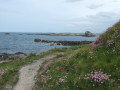
(S/E) Head north-northeast and join the coastal path along the Camping des Grèves. Walk along several pebble beaches. Pass several rocky headlands that have witnessed numerous shipwrecks, the most recent of which occurred in 1927. Arrive at Pointe An Dol Ven and note the modern statue by François Breton, “Den Mein”, the stone man (1998).
(1) Continue along the coastal path to reach the sea wall leading to the Penn Énez peninsula.
(2) Cross the causeway with the sea on your left. At the entrance to Penn Énez, which for a very long time was a site for drying, storing and burning seaweed, the sculptor François Breton has undertaken the erection of a modern calvary dedicated to maritime trades. Turn left, and take the time to admire this vast project currently under construction. Continue on to circle this peninsula. Near the harbour, note an old guardhouse which was later occupied by customs officers, then by seaweed harvesters.
(3) Pass Koréjou harbour and follow a small road westwards along the beach. You’ll come to a car park.
Yellow markings
(4) At the end of the car park, turn right onto the small road that crosses the hamlet of Trolouc’h and continue straight on until you reach a footpath.
(5) Turn right and head towards the site of the Saint-Michel Chapel, built in 1707 on the spot where Michel le Noblez, father of the Breton Missions, is said to have lived between 1607 and 1608. The oratory, rebuilt in 1891, preserves his memory.
(6) Leave the enclosure and follow the access road to the chapel on the right. At the first junction, first turn left then right and continue to the next junction (signposted Illis Kos).
(7) Turn right and arrive at the archaeological site. Between the 16th and 17th centuries, this parish was gradually buried by sand and abandoned. Recent excavations have uncovered the ruins of the church and, in particular, an impressive cemetery, a testament to medieval funerary art. Note a Gallic stele topped with a cross by the side of the road.
Continue along the road, which leads onto a track, and return to the car park where you started.
GR® ®34, marked in white and red
(S/E) Continue due west across the dune to a car park. Turn right towards Grève Blanche and then left onto the coastal path, continuing to a fork.
Yellow markings
(8) Leave theGR®® ®34 and turn left to continue along a small road. At the first houses in Penn ar Stéjou, turn right twice and continue to the Spins junction.
(9) Turn left and follow the small road until you see the sign for Liénen.
(10) Turn right onto this road. Before reaching another road near a roundabout, note the old, sculpted trees in a garden. Turn right and arrive at the Lost an Aod rest area, a mudflat popular with birds. Note a new sculpture, “Squale”, by Jean Gardet (1988).
GR® 34, marked in white and red
(11) Follow the road to the right, which runs along the edge of the cove before veering away due to houses encroaching on the coastal strip, and arrive at a small cross on a plinth on a slope to your right.
(12) Turn left and cross the hamlet of Kélerdut, where the old houses block the view of the sea. Return to the coast upon reaching Porz Grac’h, a former small fishing port and seaweed harvesting centre. Les Viviers Bretons, specialists in seafood platters, are based here.
(13) At the top of the slipway, take a path through the pebbles to rejoin the coastal path (viewpoint over the Île Vierge lighthouse) and continue to the large rock Bronn ar Roc’h (rock hillock), a large block of migmatite, a rock type intermediate between gneiss and granite. Turn right and head for the car park at Meledan Cove.
(14) Walk around this cove, with its slipway designed for hauling up the relatively abundant wreckage seaweed found here, and head left onto the coastal path. Pass through a gate and continue along the coastal path (another view of the Île Vierge lighthouse). Walk along the seashore and its pebble beaches. Note several large boulders of various shapes on the dune (one resembling a large hamburger). Continue to Pointe de Roc’h Pelguent and its large rock (a former barred headland). A beautiful viewpoint over the east coast, including the lovely Grève Blanche beach.
(15) Turn right onto the coastal path and arrive at a car park before the Porz Gwenn cove.
(16) Take the short stretch of road that goes round a property, turn left onto the path above the riprap (a patch of pyramidal orchids from June onwards) and arrive at the slipway of the small port of Porz Gwenn (white port).
(17) At the top of the slipway (to the left of a large house and nurseries, evidence of the dual livelihood of coastal farmers—farming, livestock rearing and seaweed harvesting all year round), take the coastal path that circles the Beg ar Spins peninsula. Pass the car park and continue along the path which leads back to Grève Blanche.
(8) Follow the route back the way you came to reach the car park at the end of Grève Blanche (S/E).


 Visorando Member

 Association / Club / Walk leader
 Difficult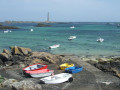
 Easy
Easy