Country:
 City:
City:


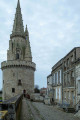
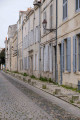
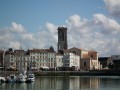
(S/E) From La Rochelle station, cross the forecourt and take Avenue du Général De Gaulle towards the city centre. Cross the square where the Ferris wheel is located, then head to Quai Valin, where most of the plot of Le Voyageur de la Toussaint takes place. Pass in front of the white and green lighthouse built into the quay in one of the houses lining it.
(1) Continue to the bridge and turn right onto Quai Louis Durand. Although this quay does not appear in the novel, it is undoubtedly the fictional Quai des Ursulines, where the Mauvoisin family home is located in Le Voyageur de la Toussaint. Cross the Canal de Marans via the Pont de la Ferté, then turn left onto Quai Maubec, then immediately right onto Rue Saint-Sauveur. Pass in front of the Église Saint-Sauveur, which is visible from the Mauvoisin family home. Continue along Rue Saint-Sauveur, turn right onto Rue de l'Hôtel de Ville, passing in front of the building recently rebuilt after the fire in 2013. On the square is the Brasserie de la Poste, formerly the Café de la Poste, under the statue of Mayor Jean Guitton, where many of Simon's heroes stopped for a glass of white wine.
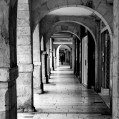
(2) Continue along the same route on the shopping street Rue Saint-Yon to the central market, with its brick hall topped by a metal dome. Passing in front of the market, continue along Rue du Pas du Minage, then turn left into Rue du Minage with its beautiful white stone arcades. On this street is the Maison des Ambassadeurs, a former hotel where Simenon began his discovery of La Rochelle in 1932. At the end of Rue du Minage, turn left onto Rue Chaudrier and arrive at Place de Verdun, formerly Place d'Armes, the city's central square.
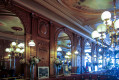
At No. 54 is the Café de la Paix, Simenon's favourite place in La Rochelle. The Art Nouveau-style café has remained unchanged for decades, just as Simenon frequented it in the 1930s, observing La Rochelle society and setting scenes from several of his novels there. You can even see a ring on the façade where Simenon is said to have tied his horse when he came to La Rochelle from Marsilly or Nieul.
(3) Continue down Rue Chaudrier and walk alongside Saint-Louis Cathedral. Continue along Rue du Palais. At No. 10 is the Palais de Justice, formerly a prison where Simenon witnessed the transfer of convicts in 1939 as a reporter. At No. 22 was a luthier where the killer in The Phantom of the Hatter bought the rope to strangle a victim, now a comic book shop.
(4) Before the Clock Tower, mentioned many times in the novels, turn right onto Rue Chef de Ville, then right again onto Rue de l'Escale, the most beautiful street in the city, which has remained unchanged with its round pebbles used as ballast on boats and imported from Quebec. It feels like stepping back one or two centuries in time. Walk up the street to Rue de l'Abreuvoir, where you will find the 17th-century Maison Nicolas Venette at No. 2, before the Orbigny Museum.
(5) Turn left onto Rue de l'Abreuvoir, then take the second left onto Rue de Réaumur. Pass No. 20, the mansion of the Dahl shipowners, which served as a model for the Donnadieu family, just before the Banque de France. Immediately afterwards, turn right onto Avenue Jean Guiton, which passes over Parc Charruyer and enters the chic neighbourhood of La Genette. Continue to Rue de la Pépinière and turn left. Join Rue Jeanne-d'Albret and turn left.
This street, emblematic of the neighbourhood, is lined with houses of varied architecture, some of them baroque. Pass No. 19, the Carel family villa, which is featured in The House of the Seven Girls, then No. 4, the Villa Agnès. Simenon lived in the Villa Agnès with his wife for a while in 1938, while waiting for his house in Nieul to be completed.
(6) Continue to the Mail, turning right and walking along the pavement. Continue to Avenue Coligny. Cross the Mail towards the sea to the Casino, at No. 37, the home of the notable Babin in Le Voyageur de la Toussaint. There you will find the restaurant Chez Coutanceau, which was formerly the Café La Pergola, where Simenon liked to eat. Take the Allée du Mail in the other direction, towards the sea. Continue to the Place du 8 Mai, then straight on to Avenue de la Monnaie. Turn right after the bridge onto Chemin des Remparts, then left onto Rue des Deux Moulins until you reach the Tour de la Lanterne. Climb up to Rue Sur les Murs with its shipowners' houses and views of the port and the sea, and continue towards the second tower, the Tour de la Lanterne.
(7) From the Tour de la Lanterne, head back down to the Old Port on the left and join Cours des Dames. Walk along the port via Quai Duperré, then Quai du Carénage. Take the small footbridge that leads to the Gabut district at the harbour master's office, leaving the Tour Saint-Nicolas on your right. Continue straight on Rue de l'Archimède, then turn left onto the aptly named Quai Georges Simenon, walking along the Bassin des Chalutiers. Reach Place de la Grande Roue and turn right onto Avenue du Général De Gaulle. Continue straight ahead to the station.
La Rochelle station, where Simenon was tasked in 1940 by the Belgian Embassy in Paris with organising the reception of his compatriots fleeing the German advance. He set up a temporary reception camp and canteen, working tirelessly to find work and shelter for the new arrivals (S/E).


 Association / Club / Walk leader
 Moderate
 Visorando Member