Country:

 City:
City:


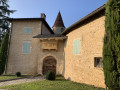
Park in the car park near the Maison des Associations.
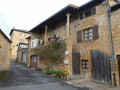
(S/E) Cross the square and walk up through the village via Rue de la Mairie. Turn right onto Chemin de Trézette (shopping centre) to reach the D70. Continue left for 150 metres until you reach Résidence Montclair. This former boarding school, built in the 18th century and renovated in the 19th century, features a section of wall with "fishbone" joints, a technique used to restore the wall's level.
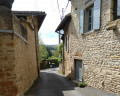
(1) Turn right to go down Chemin des Anges. This is a very old stone-paved road that descends towards the Saint-Bernard ford and has been converted into a botanical trail. The variety of trees found here is due in part to the presence of the parks of neighbouring châteaux. Below the path, on the right, is the Saint-Trys quarry, located at the intersection of several types of rock: oolitic limestone (Lucenay stone) and gryphaea limestone, which was quarried here.
Continue to the road and follow it straight ahead. Cross the hamlet of Le Gyre, leave Allée des Noyers on your right and continue along Chemin du Gyre for about 250 metres. After the green containers, turn right for about fifteen metres.
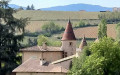
(2) Turn left onto Allée Turrin, towards the hamlet of Bel Air. At the left-hand bend, pass in front of the Château de Bel Air at no. 235. In 1632, it was owned by Philippe Turrin, an advisor to King Louis XIII and president of the salt granary. The tower housed a chapel and a spiral staircase in the centre of the main building.
Continue for about 100 metres.
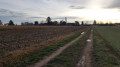
(3) At the small quarry, take the grassy path on the left that goes around it on the right, then turn left and walk along the field for 400 metres. Once you reach the farm, turn right and continue uphill along the same field, then at the crossroads of the grassy paths, continue straight ahead on a steep climb.
The east-southeast panorama offers a view of the southern extension (Dombes) of the Bresse collapse trench.
The north panorama offers an unobstructed view of the north of Pommiers and the Beaujolais wine-growing region.
Then keep right at the sign for "Si Pommiers m'était conté" (If Pommiers were told to me). Turn left (yellow arrow on the maple tree) between the houses and climb up to the D70, which you will follow on the left for about 300 m, taking care to watch out for traffic.
(4) Before the cellar, turn right onto a narrow path that climbs alongside the vineyards. At the tarmac road, turn left and then, 50 m further on, turn right at the sign for "Si Pommiers m'était conté". You will reach the Chapelle de Buisante, built in 1861. This is the highest point in Pommiers (357 m). Admire:
- the breathtaking 360° view (70 bell towers in sight!),
- émile Vilaplana's analemmatic sundial,
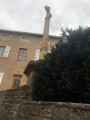
- the hail cannon. Measuring 4.20 m long, it fired rockets designed to divert or burst hail clouds, but in practice proved extremely dangerous. Destroyed during the storm of 1999, it was rebuilt in 2001 as a memorial.
(5) Follow the road to the left for about 150 metres. After the left-hand bend and the well, take the path on the right that descends through the vineyards towards Champs du Bois. Turn left onto the Forisant road and then, 10 metres further on, turn right, following the yellow and red signs. Continue downhill to the tarmac road (Chemin de Serveau).
Turn right onto this path towards Les Granges, then 200 m further on, turn left towards the picturesque hamlet of Le Cochet. At the T-junction, turn left onto Chemin des Granges and admire the Château des Tours on your right. It is referred to in history as Beauvais or Les Tours. Opposite is a curious chapel with a fireplace, as it was converted into a bread oven in the 19th century. Continue to Chemin de Parozet.
(6) Turn right. Leave Chemin du Plateau on your left, then at the next crossroads, turn left onto Chemin des Carrières. This is the name of the locality, which may come from the presence of the quarry, but also from "char", a place where carts passed through, as we are on an important road in the road network until the 19th century.
After 400 metres, continue along a stony path (signposted 'no vehicles') to La Cheville, then turn left up Chemin de la Cheville. Continue straight on to Lavoir Saint-Martin.
(7) Turn right onto Chemin de Saint-Martin. This is where Pré Saint-Martin and its spring were located, part of a network stretching from Neyra and the top of the village to La Galoche. In principle, people only rinsed their laundry here, as it was usually washed at home.
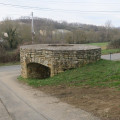
(8) At the Déo, turn left and walk back up to the village. On the way, notice the spring catchment on the right-hand side of the path, equipped with a hand pump. It is built of slabs of gryphaea stone.
Then head to the Maison des Associations (S/E).


 Visorando Member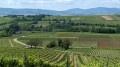

 Moderate
  Tourist office
 Difficult