


 Country:
 City:
City:



(S) The walk starts at Moulin Maïs, which was served by a private railway line. To follow this private line as closely as possible, take the road on the left. This road then becomes tarmac, following the exact route of the old private railway line. When you reach a roundabout, take the third exit to follow Rue François de Mahy.
You will then be walking alongside the old railway line that led to Moulin Maïs and ran through the houses now on your right. Continue along Rue Saint-Philippe until you reach the end of Rue François de Mahy. At the end of Rue Saint-Philippe, you will come to a roundabout; go straight on at this and at the next junction.
(1) After this junction, you’ll pass a basketball court. It’s located right next to a community centre. This is actually the former Saint-Louis railway station. From the former railway station, continue straight on along Rue Saint-Philippe.
(2) You’ll come to a fork in the road; go straight on, then straight on again at the next one. A little further to the left, at this point, the railway line used to split into two, with a private branch line continuing straight on to serve the Usine du Gol. You’ll then leave the historic railway line before rejoining it at a roundabout, where you should go straight on. Go under the A-road and turn right at the stop sign.
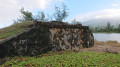
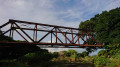
You will arrive at a bridge abutment, from where you can see the old bridge that allowed the train to cross the ravine and reach the Usine du Gol. It is possible to walk up the ravine to the bridge if the stream is not flowing. Following the route to the Usine du Gol is no longer possible and is dangerous due to traffic.
::3: Then return to the previous junction via the same route.
(2) Turn right onto Rue Lambert to follow the main route of the railway line. Continue straight ahead at the roundabout, pass under the main road and immediately turn right onto a concrete path. From here, you will rejoin the historic route of the railway line. Continue straight on along the road, then straight on again at the next junction onto Rue Valmy. This street follows the historic railway line route in its entirety. Continue straight on at every junction until you reach Étang du Gol.
(3) Describe the instructions from the waypoint here.
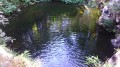
(4) The pond is at the end of the street. Just to the left, you can see the abutments of the railway bridge that once spanned the pond. Walk along the narrow strip of pebbles at the water’s edge to reach the abutment on the opposite side of Étang du Gol: however, this is impassable in heavy swell. Just by the other abutment is a wide track, which also follows the historic route of the railway line for several kilometres: follow this track. You will then reach a first car park; take the first track on the right. At this point, the train crossed the four-lane road and the Ravine Sèche via a bridge that was completely demolished to make way for the A10.
(5) Turn right at the end of the track onto a road until you reach the first orange-coloured building on your left: this is the former signalman’s house. The railway line used to cross the current road at this point. Then return to the previous bend and continue straight ahead.
At the junction, you can continue straight on to follow the historic route of the railway line as closely as possible, but this will be a round trip as you will find yourself behind the barbed wire when you emerge from the forest. Alternatively, turn right and then take the first track on the left, called Chemin des Rails. Turn again onto the first track on the left, which rejoins the old railway line at the bend for a few hundred metres before veering away and climbing up the slopes of Piton Rouge.
(6) It is right at the foot of this peak, and near a cliff on the left, that the abutments of an old iron railway bridge are located. The track runs as close as possible to the embankment on which the train used to run before veering away from it at the next bend. The construction of the four-lane road destroyed this section of the railway line, so you will need to take a long detour to the north. Keep left at every junction, staying on the track.
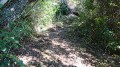
(7) Turn onto the first path on the left, which passes under the four-lane road. Turn immediately left onto the first path. Some sections of this path may not be visible at first glance: whatever happens, follow the footprints. The path is very sandy and leads to a track.
(8) The train used to follow the route of this current track. You can turn left to follow the track, and thus a longer section of the old railway line, but there are no notable remains left.
(9) Return to the previous junction.
(8) Head straight ahead and leave the historic railway line, which no longer exists due to urban development. You will cross the old line several times but do not follow it for several metres. Walk 100 to 200 metres and turn right onto Rue de la Gascogne to enter the Domaine Roche Carangue. Then immediately turn right at the first junction, continue straight on, then take the first left onto Avenue d’Aquitaine and the first right onto Rue d’Armorique. Pass an African baobab tree and turn right onto the first avenue (Avenue de la Louisiane), then left onto the next avenue (Avenue de Bretagne).
At the stop sign, keep right onto Rue Octave Benard, just past an old lime kiln. From here, follow the old historic railway line until the end of the stage. Just nearby, taking the second right, is Étang-Salé, which gave its name to the village. At the roundabout, continue straight on Rue Octave Benard to the tourist office, which is located in the former Étang-Salé railway station, whose sign is still visible (E).
This marks the end of the second stage and the starting point of the third.
 Visorando Member
 Easy
Easy 

 Difficult
