Country:

 City:
City:


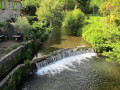
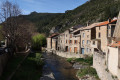
You reach Cabrespine via the D112. When you reach the right-angled bend, leave the departmental road and follow the sign for ‘Parking des Jardins’: please note that the sign is only visible if you’re coming from Villeneuve-Minervois, in which case you’ll need to turn into the narrow street on the right. If coming from Pradelles-Cabardès, however, you will need to negotiate the very tricky left-hand bend at the same point. In both cases, you should then pass the church situated higher up on the left, then turn right to cross the very narrow bridge over the Clamoux – vehicles cannot pass each other here. The car park is about a hundred metres further on, on the right.
Warning: the road markings you’ll encounter are old, faded and in some places almost completely worn away. They are in better condition on the return journey over the final few kilometres. However, numerous directional signs help with navigation at major junctions.
(S/E) Follow the road you arrived on for about fifty metres.
Yellow and Green + Yellow markings + directional signs
Turn right onto the uphill lane. The tarmac quickly gives way to a narrower, grassy path, which is initially almost flat before rising and veering to the left.
(1) Pass the ruins of the Costo Granié sheepfold, then continue climbing the stony path until, after a few hairpin bends, you reach a small, unnamed pass. Head straight ahead until you reach the signpost.
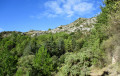
(2) Carry on to the left, then turn left again a few dozen metres further on, at the old wooden sign for the “Circular Route of the Pas de l’Aube”. Join a wide cross-country track and follow it to the left. Pass the lovely viewpoint at the hairpin bend to the right and carry on. After the start of a signposted path on the left (sign for “Circular Path of the Pas de l’Aube”), the slope becomes much steeper before you reach a wide, cross-country track suitable for vehicles.
(3) Turn left, negotiate the right-hand bend and walk to the junction with another track coming from the left.
No signposting
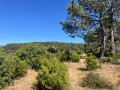
Take the hairpin bend and follow the track through a beautiful pine forest.
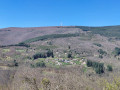
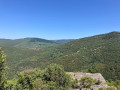
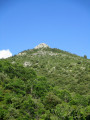
(4) Turn sharply right to begin a steady climb along the edge of the woodland on your right, whilst enjoying magnificent views to the left of the Pic de Nore. Reach the Col de las Aygos, which is very poorly marked, and veer left onto a less distinct track, heading towards the Roc du Tonnerre, whose exposed rocks can be seen at the very top. Once halfway up the slope (marker tape in June 2023), let a well-marked, almost flat path branch off to the left and continue the ascent to quickly reach the Roc du Tonnerre, marked by an imposing cairn.
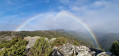
(5) Enjoy the 360° view, then continue on your way. Return to the path you left halfway up the slope and follow it to the right to climb the small hillock of La Vitarelle. After rounding another rocky outcrop and before reaching another imposing cairn clearly visible on the broad ridge, veer right onto a barely marked trail. With a forest track in sight to guide you, keep heading in that direction and join it at a bend marked ‘Col de la Vitarelle’ on a sign. Continue for about fifty metres to the left.
Yellow and Green + Yellow markings + directional signs
(6) Climb the slope on the left, then turn immediately left: the signposts are not well positioned at this point and may be misleading. The path begins a long, gently sloping switchback ascent, bends to the right and soon reaches a junction.
(7) Turn right uphill. The climb becomes much steeper as you emerge from the undergrowth and reach an unnamed pass with several directional signs.
No signposting
(8) Ignore the markings and begin the fairly steep climb leading to Mont Péril, where a fine cairn stands. Ignore two offshoots on the right and stay on course, then begin a descent leading to the junction with the marked track you left earlier, near a forest gate.
Yellow and Green + Yellow markings + directional signs
(9) Follow it, turning left, to reach the Cun de San Marti.
(10) Carry on straight ahead, negotiate a sharp bend to the right and continue for just under a hundred metres.
(11) Turn left onto the wide, shaded path that circles Mont Redon from the north through a beautiful woodland of beech and conifers.
(12) Leave this wide path and turn right onto a much narrower track signposted by a sign, beginning a steep descent punctuated by a few welcome hairpin bends. Pass a few farm buildings and continue to the right, following the signpost for “Castans”. You’ll come out onto a tarmac road; follow it to the left until you reach the nearby hamlet of Quintaine. Pass the few houses and then the recycling bins.
(13) Turn right, walk past the houses, then, at a tiny stone terrace on the left, take the small path on the left. It’s easy to miss this path if you’re not paying attention, as the “Circular Ruisseaux” sign is invisible when approaching from this direction! Further down, cross another tarmac road, head straight on opposite and reach the hamlet of Lafargue. Continue left along the road, pass the small wash house and reach a cul-de-sac, opposite a house.
(14) Cross the bridge over the Clamoux and head back up to the road. Cross the road to rejoin the path opposite, slightly to the right, which takes you straight to the delightful Notre-Dame de Pitié Chapel, with a bench and a picnic table in the shade in a very inviting spot. Carry on until you reach the road again, continue to the right and keep left at the Fork in the road by the restaurant, remembering to look up to the right to admire the beautiful church and Castans Town Hall.
(15) Just before reaching the first houses in Raïssac, take the ‘hidden’ path on the left, which descends very steeply before levelling out and rejoining the tarmac road as you pass a beautiful, well-restored building. Carry on straight ahead, skirting the houses of Bourdials higher up on the right: the IGN map is incorrect at this point and you must continue further along the road.
(16) Take the path on the left (signposted) which descends very steeply down the slope, crosses a road after a short, slightly tricky section, and continues on the other side: take care here, as it is not immediately obvious where the path resumes. The descent, which is once again very steep, leads to a track; follow this to the right for about twenty metres before turning left. Cross the bridge over the Clamoux and head back up to the houses at Thérondel Bas, which you should go round to the left to reach the tarmac road leading there. Follow this road until you reach a junction with another road.
(17) Follow it to the right for a few tens of metres, then rejoin the path on the left, which climbs quite steeply in a zigzag pattern to reach a junction on the shoulder of the Quiersboutou. Turn right and descend steeply. At the junction with a wider track (not shown on the IGN map), cross over and take the barely visible path opposite, which is fortunately signposted ‘Cabrespine via Serremijeanne’. Once on the tarmac road, turn left, then carry on straight ahead at the next junction, passing between two buildings.
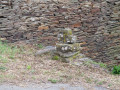
(18) At a very distinctive cross on the ground (see photo), turn left onto a path (overgrown with grass in early June 2023), pass between two buildings, then head into the steeply sloping undergrowth after crossing a very recently felled area that has not yet been fully cleared. You’ll emerge onto the Route de la Clamoux.
(19) Follow this road, turning left.
(20) Leave the road and take a narrow path on the right signposted ‘Cabrespine’. Cross the rickety footbridge over the Ruisseau de Belle Bruyère, rejoin the road for a few metres, then turn right onto the path which serves as a shortcut to avoid a hairpin bend. Further down, cross the road to rejoin the path opposite before meeting it one last time and following it to the hamlet of Laval.
(21) Cross the bridge and walk alongside the Clamoux on your left through a very pleasant, shaded setting. Pass the statue of the Virgin and Child and the benches provided there, then continue along the road to reach the narrow bridge you crossed at the start, as well as the car park (S/E).


 Visorando Member
 Moderate