Trassanel Route

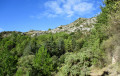
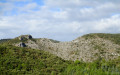
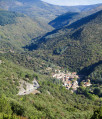
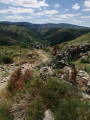
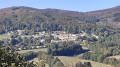
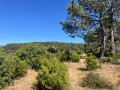
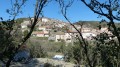
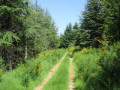
This hike in the Cabardès initially follows the ‘path of remembrance’ leading to the Grotte du Maquis de Trassanel, infamous for the number of Resistance fighters killed there by the occupying forces on 8 August 1944. On a lighter note, the route continues past the two remarkable viewpoints of Roc d’Agnel and Roc de l’Aigle before returning along the ridges, crossing a Natura 2000 protected area. A harmonious blend of history and unspoilt nature on the borders of the Montagne Noire and the Minervois. Several informative panels, rich in insights into the area’s geology and biosphere, are well worth a closer look.

Details

41711373
Creation:
Last update:
Last review:
  • Walking
    Activity: Walking
  • ↔
    Distance: 10.56 mi
  • ◔
    Average duration: 6h 45 
  • ▲
    Difficulty: Difficult

  • ⚐
    Back to start: Yes
  • ↗
    Ascent: + 2,142 ft
  • ↘
    Descent: - 2,139 ft

  • ▲
    Highest point: 2,411 ft
  • ▼
    Lowest point: 1,175 ft

Photos

Description of the walk

Park in the designated hikers’ car park at the entrance to Trassanel.

PR® yellow markings + Yellow Circle

(S/E) Head towards the village, pass the small church, then turn right following the wooden sign for “Grotte du Maquis”. Turn right at the bend and follow the stony path leading to a small pass where a memorial stone stands in memory of the Trassanel Maquis, marking the start of the trail followed by the Maquis fighters on 8 August 1944.

(1) Head down to the right along this narrow, stony path, which winds its way down through several tight bends to reach the hollow of the Ravin de Matte, then climbs gently up the other side. You will reach the Grotte du Maquis.

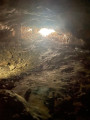
(2) This place of remembrance, marked by a commemorative plaque, is well worth a stop, if only to honour the memory of the fighters who took refuge here and perished. The cave is quite spacious and a head torch is needed to explore it fully and appreciate the various stalactites and stalagmites. In the first chamber, note the poignant wooden cross and the plaque marking the spot where a Maquis fighter fell, mortally wounded, and was taken in by a resident of Cabrespine.

Continue along the path, which turns right a few metres further on to begin a very steep descent into the Ravin d’Escoles before climbing even more steeply up the opposite slope: this section requires caution due to the gradient and the unstable, stony ground. Pass the entrance to the Coroluna cave and continue the climb to the ridge to reach a junction marked by a cairn.

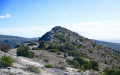
(3) Turn right onto a well-marked path leading to the foot of the Roc d’Agnel, where another cairn stands. The path continues straight ahead for about twenty metres, then comes to some rocks which you must climb using your hands to reach the summit: this short section requires caution.

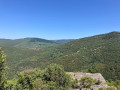
(4) Enjoy the magnificent 360° panorama, which includes a large part of the Pyrenees range to the south. Turn back, taking the same care when descending, then return to the cairn marking the junction.

(3) Head straight on and continue the descent. When you reach a junction where a sign points to a botanical trail on the right and the direction of Cabrespine, turn left. Continue on level ground, go through a fence, pass between two old sheepfolds and reach a three-way junction.

(5) Keep to the right, following the sign for “Roc de l’Aigle”. Keep to the right; a few metres further on, go through a second fence, then a third. Then take a right-hand bend, ignore the path on the left leading back to Trassanel, and arrive at a wooden chicane with an information sign marking the entrance to the Natura 2000 area.

(6) Pass through this barrier to begin a fairly steep climb and veer left before the 641m mark to follow the new marked route (IGN map incorrect). Then return to the original route and reach a junction marked by a new information sign and a marker post indicating Roc de l'Aigle to the right.

(7) Turn right, following the markings (IGN map incorrect), to reach another junction with numerous more or less ‘artistic’ cairns and another information sign. Continue right along the gentle ridge leading to the Roc de l’Aigle.

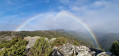
(8) Exceptional views over the Cabardès and its vineyards, the Carcassonne plain, the Corbières and the Ariège Pyrenees. Retrace your steps, pass the information sign and climb up to the right. The path soon takes a sharp 90° left-hand bend and joins the ridge at a small granite marker dated 1953. Turn right, cross the wooden barrier marking the exit from the Natura 2000 area and follow the wide path which curves to the left and leads to the junction with the GR®36.

(9) Continue straight ahead.

Very old, very rare and almost faded yellow + green + blue markings

(10) Turn left. Further on, let the track leading to the Moun Simel antennas branch off to the left and follow the wide path skirting Roquo Négro to the south. Keep going in the same direction until you reach a three-way junction.

(11) Continue left, go straight on at the junction and head towards the road leading to Fournes-Cabardès.

(12) When you see it, turn right onto a path between two fences, which leads further into a beautiful, very dense woodland and eventually comes out onto a track suitable for vehicles.

(13) Turn left. Go straight on at the inverted Fork in the road (signposted ‘Sentier de Cap Gros’ in the opposite direction), rejoin the tarmac and reach a crossroads by a beautiful stone cross.

Yellow PR® markings

Continue to the right towards Fournes-Cabardès and arrive at the junction in the centre of the village by a school bus stop.

(14) Turn left. Once in the bend, continue straight on along a dual-track path, which further on becomes a footpath. Go straight on and descend to cross the Ruisseau de la Ménetière (dry in October 2023), then follow it along the higher ground. You’ll reach a three-way junction: sign for “Sentier du Bosc Grand” in the opposite direction.

No signposting

(15) Turn left, keeping to the widest path. Descend into a wooded valley, then climb up the other side to emerge onto a tarmac road. Head left, then turn left at the junction, towards the Grotte de Limousis. Do not enter the site but take a steeply ascending path on the right, which then levels out before reaching a fork.

(16) Turn right towards Marmorières and come out onto a tarmac road before reaching the hamlet.

GR® red and white markings

Turn left. When the road begins to curve to the right, leave it and take the other tarmac road opposite, which is steeply sloping and signposted as a dead end. Continue to the end of the tarmac.

(17) Continue along the path in the same direction, ignoring a turn-off on the left at a ‘private property’ sign. Turn left at a right angle at the next three-way junction, follow a stream on your right at a higher level, cross it easily as it is dry (as of October 2023) and continue on the other bank.

(18) A tricky junction: look out for the signpost indicating you should leave the wide path you have been following and turn left onto a narrow, steep path. This levels out later and winds through lovely woodland before reaching the first houses of Trassanel. Keep to the right to return to the junction at the start, then turn right at the fountain and head back to the car park (S/E).


Waypoints

  1. S/E : mi 0 - alt. 1,444 ft - Hikers’ car park
  2. 1 : mi 0.61 - alt. 1,585 ft - Crossroads, memorial stone
  3. 2 : mi 1.15 - alt. 1,453 ft - Grotte et stèle du Maquis
  4. 3 : mi 1.56 - alt. 1,818 ft - Crossroads, cairn
  5. 4 : mi 1.75 - alt. 1,900 ft - Roc d'Agnel (585m)
  6. 5 : mi 2.35 - alt. 1,624 ft - Three-way junction, to the right
  7. 6 : mi 2.53 - alt. 1,693 ft - Entrance to the Natura 2000 area
  8. 7 : mi 2.97 - alt. 2,165 ft - Signpost, on the right
  9. 8 : mi 3.29 - alt. 2,201 ft - Roc de l'aigle (685m)
  10. 9 : mi 4.06 - alt. 2,336 ft - Junction with the GR®36
  11. 10 : mi 4.32 - alt. 2,411 ft - Crossroads, turn left
  12. 11 : mi 5.35 - alt. 2,287 ft - Three-way junction, to the left
  13. 12 : mi 6.2 - alt. 1,949 ft - Path on the right
  14. 13 : mi 6.68 - alt. 1,850 ft - Track, on the left. Passage near the - Menhir Couché de Peyregat
  15. 14 : mi 7.34 - alt. 1,677 ft - Fournes-Cabardès, bus stop
  16. 15 : mi 8.04 - alt. 1,283 ft - Sign for the Bosc Grand trail
  17. 16 : mi 8.91 - alt. 1,411 ft - Crossroads, turn right. Near the - Grotte de Limousis
  18. 17 : mi 9.41 - alt. 1,309 ft - End of the tarmac
  19. 18 : mi 10.06 - alt. 1,329 ft - Tricky junction, turn left
  20. S/E : mi 10.56 - alt. 1,447 ft - 43.344493,2.436026. Hikers’ car park

Notes

Warning

The IGN map is no longer up to date in several parts of this route where the marked trails are no longer signposted on the ground. This is particularly the case between (10) and (14): there are indeed old yellow, green and blue markings, but these are very rare and have mostly faded away. It is mentioned in the description for information purposes only, but you should not rely on it for navigation.

Between (6) and (7) the IGN route is no longer up to date, nor is it after (7) on the way to Roc de l'Aigle.

Grade

The hike is classified as difficult for the following reasons:

  • the section between (2) and (3) involves a very steep descent and ascent. The terrain is unstable on the descent.
  • The final section leading to the Roc d'Agnel is tricky: the rocks to be crossed require caution both on the ascent and the descent.
  • The section after the (15) has a very steep ascent before reaching the road.

Avoid this hike in strong winds – such as the Autan wind, amongst others. It is difficult to find shelter on the ridges.

Hiking boots are recommended due to the stony terrain. Walking poles will also be very useful. However, you will need to stow them away to climb Roc d'Agnel.

There is a fountain at the start in Trassanel: you can cool off there but not quench your thirst, as the water is marked as undrinkable.

Worth a visit

Always be cautious and plan ahead when you're outdoors. Visorando and the author of this route cannot be held responsible for any accidents occurring on this route.

The GR® and PR® markings are the intellectual property of the Fédération Française de Randonnée Pédestre.

Reviews and comments

4.8 / 5
Based on 3 reviews

Reliability of the description
5 / 5
Ease of following the route
4.5 / 5
Route interest
5 / 5
User 18520044

Overall rating : 4.7 / 5

Date of your route : Jan 15, 2026
Reliability of the description : ★★★★★ Very good
Ease of following the route : ★★★★☆ Good
Route interest : ★★★★★ Very good
Very busy route : No

Beautiful view of the Pyrenees when the weather is clear

Machine-translated

Clo31130
Clo31130

Overall rating : 5 / 5

Date of your route : Mar 30, 2025
Reliability of the description : ★★★★★ Very good
Ease of following the route : ★★★★★ Very good
Route interest : ★★★★★ Very good
Very busy route : No

There were eight of us on this walk on a sunny spring day following a few days of light rain. Everyone agreed it was a really pleasant walk; the route is very well signposted, and what’s more, we were walking there the day after a trail run
and all their markings were still in place.
It really is the perfect time of year for this hike; the trees haven’t yet grown all their leaves, which means you can enjoy views into the distance whilst still having a bit of shade.
It’s definitely a walk worth doing; it’s not difficult, though it might be a bit challenging for some with a 500m elevation gain.
There’s a lovely spot for a picnic just past the hamlet of Camp Bataillé in the meadow if you’re walking the route clockwise.
As for the Patou dogs, if you speak to them whilst keeping your walking sticks close to your body, they won’t bother you. One member of our group who was afraid of dogs got past without any trouble. Don’t use that as an excuse not to do this walk – it would be a real shame.
Don’t miss the detour to the castle, where the caretaker will give you a short guided tour amongst his goats, for a small voluntary contribution.

Machine-translated

madydou
madydou ★
• Edited:

Give credit where credit is due
Or rather, thanks to Jean-Jacques

Machine-translated

81randosergio
81randosergio

Overall rating : 5 / 5

Date of your route : Mar 20, 2024
Reliability of the description : Not used / Not applicable
Ease of following the route : Not used / Not applicable
Route interest : ★★★★★ Very good
Very busy route : Yes

I know this area quite well, having hiked here many times, always taking different routes. This particular route is especially interesting, both for its diversity and, as “Madydou” says, for the chance to follow a trail of remembrance as it passes by the two viewing points. I never turn down the chance to admire nature in its beautifully preserved state and the landscapes that unfold as you walk, with magnificent views of the Pyrenees.
In short, this hike is one of my favourites.

Machine-translated

Other walks in the area

For more walks, use our search engine .

The GPS track and description are the property of this route's author. Please do not copy them without permission.