Lac de Derborence Mountain Hut – Ovronnaz

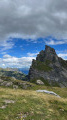
The path winds through mountain pastures at the foot of the Diablerets on the border between the cantons of Vaud and Valais, circling the Grand Muveran (3,051 m) and crossing the pass linking it to the Petit Muveran (2,811 m). The panoramic views it offers of the great Alpine peaks (Grand Combin, Dents du Midi, Mont Blanc, etc.) are magnificent.

This walk is part of a multi-day hike: Tour des Muverans

Details

58981937
Creation:
Last update:
Last review:
  • Walking
    Activity: Walking
  • ↔
    Distance: 14.26 mi
  • ◔
    Average duration: 12h 45 
  • ▲
    Difficulty: Very difficult

  • ⚐
    Back to start: No
  • ↗
    Ascent: + 7,126 ft
  • ↘
    Descent: - 7,428 ft

  • ▲
    Highest point: 8,445 ft
  • ▼
    Lowest point: 4,245 ft

Description of the walk

Start from the Lac de Derborence mountain hut (1,464 m).

(S) Take the path that climbs through the forest immediately above the refuge towards the Pas de Cheville (signpost). At Côte 1643 m, continue straight along the path, keeping to the right bank of the Chevillence. Reach the Pas de Cheville (2038 m).

(1) Continue due west along a path that descends very gently to the hamlet of Anzeinde. From there, climb to the left to the Giacomini Refuge, then pass close to the Cabane Barraud (1955 m) on your right. Head south towards the Col des Essets (signpost).

(2) From the Col des Essets, head south-west towards Pont de Nant. Reach the hamlet of La Varre (1,766 m) and continue to follow the signposts towards Pont de Nant. Cross the Alpage du Richard (1,537 m).

(3) Continue the descent through the forest to the hamlet of Les Planets (1289 m), where there is a blue sign indicating, on the left, Cabane Rambert 5h20 and Frête de Saille 4h20. Do not descend all the way to Pont de Stream.

(4) From this point, there is only one path and no junctions or signposts until you reach the pass (Frête de Saille at 2,584 m). From Les Planets (1,289 m), follow the fairly steep path – first south-east, then due south – which climbs through the forest to La Larze Côte (1,584 m), where there is an alpine hut.

(5) From there, the gradient steepens further, with the forest giving way to alpine meadows; the path then narrows, is very often on a slope, and the walking takes place on fairly slippery, glossy schist slabs. Continue to the 1,879 m ridge, following the blue markings. Handrails (chains) are in place at exposed sections. From there, the path crosses numerous scree gullies or waterfalls (usually dry) descending from the Grand Muveran, though residual snowfields may still be present. Reach the 2199 m pass.

(6) Continue along the path towards the hamlet of La Truche du Liapay (2301 m), which you leave on your right. From there, the slope of the path levels out slightly and you reach La Frête de Saille (2584 m).

(7) The descent follows the only path down from the pass, always following the blue paint markings. However, as these are barely visible on the scree, you must head straight on, leaving the junction at the 2,364 m pass (signpost) on your left, which points towards the Cabane Rambert.

(8) Continue along the path, on the left bank of the Salentse, to Plan Coupel and then to the 2124 m pass (sheepfold). Continue to the 1960 m pass.

(9) Turn left onto the Sentier de la Pierre à Vatseron, which is subsequently known as the Sentier de la Cabane Rambert. Continue to the 1786 m pass (buildings) and stay on the Sentier de la Cabane Rambert until you reach the 1516 m pass.

(10) Leave the Sentier de la Cabane Rambert on your left and follow the Chemin de la Grande Corniche to the right, until you reach the Route d’Odonne, which you cross to join the Route de l’Avintier. At the first junction, take the path on the left which crosses the Route d’Odonne once more and leads to the Ovronnaz chairlift car park (E).

Waypoints

  1. S : mi 0 - alt. 4,852 ft - Lac de Derborence Mountain Hut
  2. 1 : mi 1.67 - alt. 6,680 ft - Pas de Cheville (2038 m)
  3. 2 : mi 4.2 - alt. 6,673 ft - Col des Essets (2,029 m)
  4. 3 : mi 6.88 - alt. 5,049 ft - Alpage du Richard (1,537 m)
  5. 4 : mi 7.79 - alt. 4,245 ft - Les Planets (1,289 m)
  6. 5 : mi 8.25 - alt. 5,200 ft - La Larze (1,584 m)
  7. 6 : mi 9.29 - alt. 7,149 ft - Elevation 2199 m
  8. 7 : mi 10.19 - alt. 8,428 ft - Frête de Saillie - Petit Muveran
  9. 8 : mi 10.68 - alt. 7,762 ft - Junction with the outbound route - Grand Muveran
  10. 9 : mi 11.94 - alt. 6,440 ft - Junction (1955 m)
  11. 10 : mi 13.55 - alt. 5,003 ft - Elevation 1516 m
  12. E : mi 14.26 - alt. 4,551 ft - Ovronnaz (chairlift car park)

Notes

The route is relatively easy as far as the hamlet of Les Planets (1,289 m) (4).

(4) The landmarks to follow are the blue paint markings (partially faded in places), applied here and there on the rocks. Generally speaking, the path runs beneath the summits of the Pointe de l’Encrenne and the Grand Muveran, crossing spurs and gullies.

However, from there to the Frête de Saille (the name of the ridge linking the two Muverans, which is in fact a pass), it is intended for experienced hikers who are not prone to vertigo and are able to tread confidently along a faint, though fairly well-marked, very narrow, exposed, particularly steep and exposed path (averaging a 30% gradient from Les Planets to the Frête de Saille) (7). Sustained effort required. A truly alpine atmosphere. Walking poles are very useful, due to the slippery nature of the terrain and the possible presence of snow. Some handrails (chains) are fitted here and there. Similarly, you may encounter residual snow in shaded gullies; this is why it is recommended to undertake the hike once the snow has more or less melted.

There are no specific water sources, but streams upstream of the mountain pastures provide a supply of water.

Worth a visit

There are many herds of magnificent alpine cows (Hérens breed) with beautiful cowbells, particularly on the splendid, gentle section leading from the Pas de Cheville (2,038 m) to the Giacomini Refuge (1,893 m).

The panorama is truly stunning, offering views of the Alps, the Rhône Valley and, further afield, the Lake Geneva region.

Occasionally, chamois can be seen roaming freely.

Other walks in the area

For more walks, use our search engine .

The GPS track and description are the property of this route's author. Please do not copy them without permission.