Circular Tour of Sex Rouge including the Summit

This walk starts in Anzere and uses the cable car to the Pas de Maimbre.
The walk takes you around the Sex Rouge and includes the short but steep ascent to the summit for the great views across the Pennine Alps. It descends to pass the Cabane de Audannes and then through the Combe des Andins to Serin. After this is uses one of the established Bisse walks to return to Anzere.
⚠️(Note in 2024 the path between point 2616m and the col at La Selle was affected by a landslide and is unsafe. This route uses a deviation set up by local mountain guides; it is marked with posts but is not yet as obvious as it will be, once it is used by many people)

Details

60054281
Creation:
Last update:
Last review:
  • Walking
    Activity: Walking
  • ↔
    Distance: 18.88 km
  • ◔
    Average duration: 7h 50 
  • ▲
    Difficulty: Difficult

  • ⚐
    Back to start: No
  • ↗
    Ascent: + 851 m
  • ↘
    Descent: - 1,651 m

  • ▲
    Highest point: 2,881 m
  • ▼
    Lowest point: 1,549 m

Photos

Description of the walk

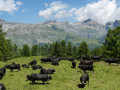
Start: Park at the cable car station in Anzere. Take the cable car to the top station (Pas de Maimbre), the walk starts here. (There are good views across to the Mont Blanc Massif and the Pennine Alps with an interpretation board to help you identify key mountains)

(S/E) From the cable car station take the wide track Northwards, signposted Pas de Maimbre. The broad track passes the top of a chair lift and turns left (West) to follow a narrower mountain path. This leads to the Pas de Maimbre and after after a short descent of a rocky section with a rope handrail the path leads gently downwards and into a ravine marked 2309 on the official Swiss map.

(1) Just after the ravine the path splits. Ignore the left hand path and continue straight on; now ascending gently to a signpost and junction with another track.

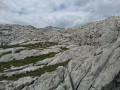
(2) Again continue straight on, above you on the right will be an impressive limestone buttress which forms the lower Southerly end of the Sex Rouge. The path now climbs more steeply into a combe and from around the 2500m contour it starts to zig-zag upwards, sometimes over outcrops but always well marked with white-red-white paint flashes. The path emerges on the top of a slabby limestone ridge which slopes down to the North into a large barren combe. There is a marker post and deviation information.

(3) (Note: the deviation information may not survive mountain storms but there is a copy in the cable-car ticket office in Anzere and again at the top station. The information is a photograph of the combe with the route overlaid; make sure you familiarise yourself with it before setting off. The deviation is now also shown the interactive Swiss map here.
The route is marked with wooden poles that have been flashed with white-red-white paint and some small cairns also help you navigate but these are not always obvious and the trail underfoot is not yet sufficiently trodden to make it clear.
Take a good look and aim to descend in a curve to the bottom of the combe where there is a flat wet area. You will be descending over bare rock with alpine plants; as you walk down the first post should become obvious. From the bottom, keep following the posts and cairns upwards to curve rightwards over more rocks and to ascend to La Selle and the sign post.
Note: the gpx track log shown for this walk is the route that we took. We did bypass one or two less obvious marker posts but only by a few metres and the route we walked was not difficult underfoot. If you follow the track you will not go wrong and this might be useful if there is clouds obscuring the route in full.

(4) From La Selle follow the narrow path in a South-Easterly direction. It starts to climb almost immediately and without let up in a series of narrow zig-zags up to the first false summit. From there the path eases off as it climbs to the top of the Sex Rouge.

(5) A further (lower) summit has a cross and a cairn with a metal box and log book for your name.
Note: even in August there will be the remains of snow patches on the north side of the summit ridge, the path should avoid these but if you are attempting the route earlier in the season you will need to take care crossing any sloping neve as these lie above very steep slopes and outcrops.

(5) From the summit return to La Selle.

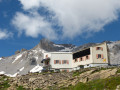
(4). Now turn right and follow the path, again marked with poles and some of the occasion cairns plus paint flashes painted on boulders. At first, this path will also cross patches of snow which are less steep but take care when crossing. Later on, it descends across an outcrop of slabby limestone which slopes down to the left, take care when crossing and follow the paint flashes. After this, the path leads to the Cabane des Audannes.

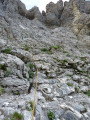
(6) From the mountain hut take the path leading South East to curve around the small lake. Keep following this well made path which has a water pipe beside it for much of the way. The path will start to descend steeply into the Combe des Andins. There is one short section across steep rocky ground where there is a rope handrail and a couple of metal staples for steps as you climb down. This steep section leads to point 2315 on the Swiss map.

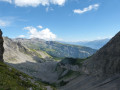
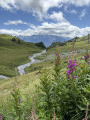
(7) At this point, the track splits and a feinter (less obvious) mountain path leads off on the right. It is important that you do not take this branch unless you are competent in crossing steep and exposed ground, as it leads across the top of the Combe des Andins to pass beneath and then through a band of very steep craggs. The path is clear on the other side of the combe but the section through the craggs is narrow and more dangerous. At the split keep to the left hand (more obvious) path and start to zig-zag down wards. The views across the combe are impressive and lower down you will see a jumble of huge stone blocks. The path then curves around the combe towards a set of limestone crags on the South side. It passes beneath these and then curves South East to pass an information sign and then arrives at a junction with a track.

(8) At the junction turn left (downhill) and follow the track for about 100m looking out for a marker post on the left. Turn left and follow a path downhill to the farm buildings at Serin (note this is a working farm). (If you miss the path, don't worry as the track will also take you there.) Pass beside the barn and house to an area where there is a bench and post with many signs.

(9) The track on the left bends around and down to lead to Les Rousses and then back to Anzere, marked 2 hours 20 min. You want to take the narrow path directly ahead of you leading through an electric fence and into the woods. It is marked with an arrow labeled Sex Rouge (Tour of Sex Rouge Trail) which leads to Anzere in 1 hour 50 mins. Go through the electric fence and into the wood. Follow the delightful path with an old weed filled bisse on the right to pass beside a stone chalet with four concrete drinking troughs beside it.

(10) Continue following the path, through pastures and pine trees to descend to a junction with another track and signpost at Ravouene 1750m.

(11) Turn right and follow the path towards Anzere, this leads into a ravine, then onwards to some chalets and a road just after you pass beneath the chair lift for Les Grillesses.

(12) Take the track on the left which slants downwards and away from the road. It is marked occasionally with yellow arrows or 'home made; arrows marked Anzere. After passing a water works station you will come to another fork.

(13) The main track takes the left hand fork and you could follow this. However; the signposted path takes the right hand fork and after a short way a yellow arrow points to a path on the left. Walk down this path and re-join the main track. After a bend turn off on the right on a path between two more water works buildings, follow this path which takes a turn to the left and traverses the hillside to join the main track again. Now follow the main track downhill to the junction with a track on the right next to a chalet. (Probon)

(14) Turn right and follow the track above the chalet, this contours around the hillside and passes over two streams which may be dry in summer. It arrives at some more chalets on either side and a bisse on the right. Keep following the path with the bisse on the right all the way back to Anzere just above the cable car station. Take a slanting path back to your car. (S/E)

Waypoints

  1. S : km 0 - alt. 2,355 m - Pas de Maimbre Cable Car Station
  2. 1 : km 1 - alt. 2,328 m - Ravine
  3. 2 : km 1.92 - alt. 2,419 m - Junction with path
  4. 3 : km 2.71 - alt. 2,627 m - Top of ridge / cairn and marker post
  5. 4 : km 4.45 - alt. 2,709 m - La Selle
  6. 5 : km 5.54 - alt. 2,869 m - Summit Sex Rouge - Sex Rouge Summit
  7. 6 : km 7.97 - alt. 2,497 m - Cabane des Audannes - Cabanes des Audannes
  8. 7 : km 9.65 - alt. 2,306 m - Pt 2315 Junction with path
  9. 8 : km 12.03 - alt. 1,998 m - Junction with track
  10. 9 : km 12.7 - alt. 1,938 m - Serin
  11. 10 : km 13.6 - alt. 1,938 m - Chalet with 4 concrete troughs
  12. 11 : km 14.69 - alt. 1,742 m - Ravouene / sign post
  13. 12 : km 16.18 - alt. 1,711 m - Les Griselles
  14. 13 : km 16.68 - alt. 1,667 m - Junction in track
  15. 14 : km 17.08 - alt. 1,569 m - Probon
  16. E : km 18.88 - alt. 1,549 m - Anzere Cable Car Station

Notes

Start: Park at the cable car station in Anzere.

Rech the start: Take the cable car to the top station (Pas de Maimbre), the walk starts here. (There are good views across to the Mont Blanc Massif and the Pennine Alps with an interpretation board to help you identify key mountains)

This is a walk which uses a cable car to help you make height. Sections of the walk are above 2500m and are in mountain terrain.

Waymarkers: Swiss mountain trails are well marked and a grading system was introduced to coincide with the markings and signposts.

Gears: Boots with a good sole are important as you will be crossing rocky terrain and it is easy to turn an ankle. You will also encounter patches of snow and a sole which provides grip and support is essential. If you choose to use a more robust approach shoe consider taking ankle gaiters to stop snow going into your shoes.

⚠️You should check the forecast before setting out and should dress accordingly and with a back up for a change in the weather. (Take a mid-layer and a waterproof/windproof jacket)

Setting off early allows you to do the ascent to (3) using shade from the mountain, but this part of the track soon comes into full sun.

Early in the season there may be more snow and you may need to cross steep and exposed neve to get to the top of the Sex Rouge. In these conditions you will need to kick steps or wear crampons (boots essential) if the neve is firm. If you encounter these conditions and do not have the right equipment and experience then turn back as a slip could be fatal.

Refreshments: Refreshments are available at the Cabane des Audannes.
Even in good weather the cloud can develop quickly and it would be easy to become disorientated whilst navigating the deviation. Download the GX track posted and use if you are uncertain as it will get you to La Selle.

Grading: T2 to (3) then T3 to the summit of the Sex Rouge to Cabane des Audannes, then mostly T2 to Serin from where the return is T1

T1 – Valley Hikes

Paths are well cleared. In case they are marked according to SAW standards: marking is yellow. Flat or slightly sloped, no danger of falling. Requirements: None, tennis shoes are fine. No problem to get oriented, even without a map. Tour examples: Männlichen – Kleine Scheidegg, Hut path to Jura Hut, Cabane Mont Raimeux, Strada Alta Leventina, Vermigel Hut.

T2 – Mountain Hikes

Paths with continuous marked-out route. In case it is marked according to SAW standards: white-red-white. Sometimes steep, the danger of falling possible. Requirements: Sure footedness sometimes needed. Trekking shoes are recommended. Basic orientation skills. Tour examples: Wildhorn Hut, Bergsee Hut, Täsch Hut from Täschalp, Passo Campolungo, Capanna Cristallina from Ossasco.

T3 – Challenging Mountain Hikes

Paths are not always visible. Exposed sections can be safeguarded with ropes or chains. The hands might be needed for balance. In case the path is marked: white-red-white. Can have exposed sections with the danger of falling, scree slopes, pathless craggy ground. Requirements: sure footedness, good trekking shoes. Average orientation skills. Basic alpine experience required. Tour examples: Hohtürli, Sefinenfurgge, Fründen Hut, Grosser Mythen, Pizzo Centrale from Gotthrab pass.

T4 – Alpine Hikes

Path traces are not always present. Some sections require the use of hands. In case paths are marked: white-blue-white. Grounds are relatively exposed, tricky grass slopes, craggy ground, simple firn fields and snow-free glacier sections. Requirements: Stable trekking shoes. Basic ability to judge grounds and good orientation skills. Alpine experience required. A sudden change in the weather can make a retreat/fallback difficult. Tour examples: Forno Hut, Schreckhorn Hut Dossen Hut, Mischabel Hut, section Voralp Hut – Bergsee Hut, Vorder Glärnisch, Steghorn (ladder), Piz Teri, Pass Casnile Sud.

T5 – Challenging Alpine Hikes

Often without paths. Some easy climbing sections. In case it is marked: white-blue-white. Exposed, demanding grounds, steep craggy ground. The danger of slipping on glaciers and firn fields. Requirements: Climbing boots. Experienced to judge grounds and very good orientation skills. Good alpine experience also in high alpine areas. Basic knowledge in the use of pick and rope. Tour examples: Cabane Dent Blanche, Büttlasse, Salbitbiwak, Sustenjoch North flank, Bristen, Pas Cacciabella.

T6 – Difficult Alpine Hikes

Mostly without a path. Climbing sections up to II. Paths are not marked most of the time. Often very exposed. Tricky craggy ground. Glaciers with an increased danger of slipping. Requirements: Excellent orientation skills. Advanced alpine experience and well acquainted with the use of technical alpine appliances. Tour examples: Niesen ridge (Fromberghorn North), Glärnisch Guppen ridge, Via alta della Verzasca.

Worth a visit

Good views from the restaurant at the top cable car station with a panoramic infographic.

Interesting geology as you ascend to (3) and then take the deviation La Selle. Look for the different colours in the underlying rock which give the names to the Sex Noir and Sex Rouge.

Great views from the summit of the Sex Rouge.

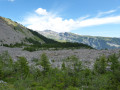
The boulder field at the bottom of the Combe des Andins was formed in 1946 when a magnitude 5.8 earthquake shook the area. This caused a huge rockfall which now lies at the foot of the combe. An information board before (8) provides more information and historic photographs.

The return path beside the bise is a pleasant end to the walk.

Other walks in the area

For more walks, use our search engine .

The GPS track and description are the property of this route's author. Please do not copy them without permission.