


 Country:

 City:
City:


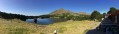
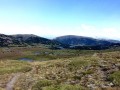
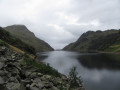
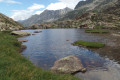
(S) Leave the Refuge d'En Beys and walk back up the left bank of the lake, still on theGR®®7.
(1) At the end of the lake, climb up to the right until you come to a kind of aqueduct, which you should follow instead of the more uneven path. The trail descends slightly until it reaches the fork betweenthe GR®®7andGRP®® Tour des Peyrics.
(2) Leave theGR®®7and continue climbing up the hillside on the right (yellow and red markings)
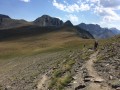
Caution: from this point onwards, the path is narrow and slippery: the slope can be steep and some sections require concentration for less sure-footed walkers.
Follow a large arc to the right to reach the Cabane de la Jasse de Delà.
(3) Continue north, walk alongside the Jasse de Deçà, then continue to the Jasse des Espagnols.
This passage alternates between ascents and traverses along the hillside.
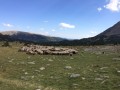
At the Jasse des Espagnols, there is also a shepherd's hut: the path has been diverted to go around the hut and preserve the peace and quiet of the shepherd and his flocks. (read the warning sign).
(4) Keep to the right and climb up to pass under the Costa de Mortes and reach the Col de Terrers.
Be careful: at this point, numerous drovers' roads (drovers' tracks) lead to paths that are only used by sheep. The signposting is excellent around the hut, but disappears shortly afterwards.
The climb to the pass is very steep: there are few hairpin bends and the path often climbs straight up the slope (400m elevation gain).
(5) From the pass, turn right (red and yellow markings on wooden posts) and follow the ridge between the Pyrénées Orientales and Ariège via Puig de Terrers. Continue along the ridge for a long way. Pass a few metres below Pic de Mortiers. The markings do not reach the summit, but the landscape is worth the detour.
(6) After Puig de Mortiers, descend towards Ras de la Sal across grassy areas. Join theGRP®® Tour du Tour du Capcir.
(7) Continue the descent towards Estany del Mig to reach the Camporells Refuge (E).

 Visorando Member
 Very difficult
 Moderate
 Easy
Easy 
