A walk in the wet Champagne region: the Gros Chêne

This route leads to a local landmark, Le Gros Chêne, where a sign recounts the history of this three-hundred-year-old oak tree, which is no longer there, but where an oak tree from the year 2000 was planted by the village schoolchildren in 2002 to mark the turn of the century and to remember our venerable ancestor.

Details

86510301
Creation:
Last update:
Last review:
  • Walking
    Activity: Walking
  • ↔
    Distance: 3.44 km
  • ◔
    Average duration: 1h 05 
  • ▲
    Difficulty: Easy

  • ⚐
    Back to start: Yes
  • ↗
    Ascent: + 22 m
  • ↘
    Descent: - 22 m

  • ▲
    Highest point: 183 m
  • ▼
    Lowest point: 159 m

Description of the walk

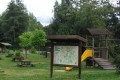
Park at Crot Saint-Marc, playground and at the end of the botanical trail.

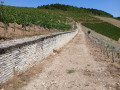
(S/E) Start on the forest road with the agricultural slope on your right and the forest on your left, continue for about 1 km until you reach the sign indicating the Bois Communal de Flogny-la-Chapelle.

(1) At this point, at the end of the old cider pear orchard, take the small path on the left.

(2) After the first right-hand bend, turn left at the crossroads and you will arrive at the top of the small plateau on a cross path.

(3) Turn left again, then 100 metres further on, turn right downhill and join a stony path.

(4) Follow it to the left for over a kilometre, with cultivated fields on either side, until you reach several piles of wood.

(5) Take the path on the left that leads to Crot Saint-Marc (S/E).

Waypoints

  1. S/E : km 0 - alt. 161 m - Crot Saint-Marc
  2. 1 : km 0.95 - alt. 175 m - Communal Wood Panel
  3. 2 : km 1.19 - alt. 183 m - First crossroads on the left
  4. 3 : km 1.44 - alt. 177 m - Small plateau
  5. 4 : km 1.95 - alt. 169 m - Place known as Le Gros Chêne, on the left
  6. 5 : km 3.03 - alt. 159 m - Bifurcation
  7. S/E : km 3.44 - alt. 161 m - Crot Saint-Marc

Notes

On the edge of the forest, these lands, which are now cultivated, were once mostly pasture, like many in the humid Champagne region. The clay subsoil, so characteristic of the geology of the humid Champagne region, retained moisture in the surface layers of the soil for too long to allow for easy tillage, so permanent grassland was more suited to these lands, with the livestock farming that goes with it. Mechanisation and drainage have enabled the clearing of many pastures, which have now been converted to annual crops. These drainage works are now highly regulated and subject to strict administrative authorisations aimed at maintaining the last remaining functional wetlands.

Worth a visit

There is a forest botanical trail nearby. It showcases the different tree species found in the wet Champagne region.

As you approach the communal forest sign, you will pass an old orchard of cider pear trees on your left. These were planted following the phylloxera epidemic at the end of the 19th century, which destroyed most of France's vineyards. These pear and apple trees compensated for the shortage of wine, as their pressed fruit produced cider, which was drunk by the large rural workforce of the time.

Other walks in the area

For more walks, use our search engine .

The GPS track and description are the property of this route's author. Please do not copy them without permission.