Hermalle-sous-Argenteau
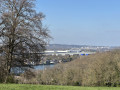
The town originated as a villa (agricultural estate) established on both banks of the river. In the 8th century, the name Hermalle was Harimalia, a Germanic compound word meaning army assembly (or military court). Alternatively, it could be malus (mill), in which case Hermalle would mean army mill. Whatever the case, the Frankish origin of the name is certain.
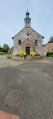
(S/E) Saint-Lambert Church
This building is one of the municipality's listed monuments. It is very old, as there are records of Pépin de Herstal (640-714) donating the parish of Hermalle to Chèvremont.
This church is special in two ways.
Firstly, it is located on the waterfront; it was built in this location because there was a ford nearby. As a result, parishioners from both banks could attend services.
Secondly, it contains a mausoleum with recumbent effigies, i.e. representations of a lord and lady, in this case the Lord of Argenteau and his wife.
(1) Les Cramignon
You will then head towards the centre of the village where you will find a sculpture (by the Haccourt artist Henri Caps) at the roundabout symbolising one of the most important folk traditions of the Lower Meuse: Les Cramignons.
The Cramignon is a popular dance that has been practised in the Lower Meuse and the Geer valley since the 12th century. The dancers (in tuxedos for the boys and long dresses for the girls) form a chain, a kind of joyful farandole, which travels through the streets of the village for hours on end. Seen from above, this chain gives the impression of a toothed shape, a rack, or 'cramillon' in Old French.
Participating in the Cramignon is a ritual that marks the desire to contribute to the village's entertainment and seals one's belonging to the community. In Hermalle, two folk societies are represented during the Cramignons: the "Rouges" and the "Bleus". It is during the local village festival, on the4th weekend of August, that this folklore is in full swing and it is essential to take part (or attend).
(3) The gravel pit
Once on the cycle path and before starting the normal route of the walk, you can turn left and make a round trip along the beautiful lake at Gravière Brock. Completely redeveloped in 2012, this former industrial area (gravel extraction) is now a place of great biological interest, ideal for birds to winter and amphibians to reproduce. It is also a great place for anglers and walkers to enjoy themselves.
The Trilogiport
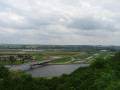
Returning to the original route, you will cross the Trilogiport site. This 100-hectare area between the Albert Canal and the Meuse River is designed to accommodate the ever-growing logistics activities of the autonomous port of Liège, particularly those related to container transport.
This multimodal platform (rail, river and road traffic), inaugurated in November 2015 and named
"Liège Trilogiport", is set to become a veritable "logistics village" in the heart of Europe. The development of this area has also led to the discovery of traces of human presence dating back to the Stone Age (10,000 BCE), as well as traces of the first farmers who occupied the region in the4th millennium BCE and even remains (jewellery, urns, furniture) from a necropolis dating back around 3,000 years.
Finally, the vegetation and plantations surrounding the Trilogiport are extensively maintained by flocks of sheep and certain breeds of hardy cattle. You are sure to spot them during your walk, as well as several community vegetable gardens created at the instigation of the Port Autonome de Liège.
(5) The Euregio Bridge
After reaching the banks of the Meuse, you will pass under the new "Euregio" bridge, also inaugurated in November 2015 in the presence of His Majesty King Philippe I. This bridge spans the Meuse and connects Trilogiport to the E25 motorway (Liège-Maastricht).
(6) Holiday resort in the "Belle Époque"
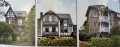
As you walk along the Meuse, you will soon see some beautiful residences dating from the Belle Époque.
These villas were built between 1900 and 1914 by wealthy residents of Liège and Maastricht who were attracted to the banks of the Meuse. They evoke a period when riverboats bound for Robinson Island would drop off tourists at the lock (Hemlot) and opposite Saint-Lambert Church.
These houses share many architectural similarities with the villas on the coast: balconies, verandas, half-timbering (mostly fake)...
The relocation of the Meuse riverbed in the 1970s deprived most of these villas of the pleasure gardens that once stood in front of them.
(7) The flea market
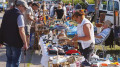
You are now back at your starting point, and if you have chosen to take your walk on a Friday, there is a good chance you will come across the flea market traders who occupy the towpath near the church on the first Friday of every month from May to September (from 9 a.m. to 1 p.m.).



 Country:
 City:
City:




 Local authority
 Visorando Member
 Moderate
 Difficult