Hermalle-sous-Argenteau
The town originated as a villa (agricultural estate) established on both banks of the river. Inthe 7th century, the name Hermalle was Harimalia, a Germanic compound word meaning army assembly (or military court). Alternatively, it could be malus (mill), in which case Hermalle would mean army mill. Whatever the case, the Frankish origin of the name is certain.
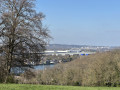
This walk will allow you to discover the Hermalle peninsula surrounded by the river (Meuse), the Hemlot spawning ground, the municipal gravel pit, the Albert Canal and its trilogiport, and finally the largest water treatment plant in Wallonia.
Leave Place Gérard Froidmont and head towards the Meuse.
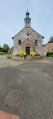
Saint-Lambert Church
This building is one of the municipality's listed monuments. It is very old, as there are records of Pépin de Herstal (640-714) donating the parish of Hermalle to Chèvremont. This church is special in two ways.
Firstly, it is located on the waterfront; it was built in this location because there was a ford nearby. As a result, parishioners from both banks could attend services. Secondly, it contains a mausoleum with recumbent statues, i.e. representations of a lord and lady: in this case, the Lord of Argenteau and his wife.
Take the towpath to the right and walk upstream. Admire the magnificent centuries-old trees that adorn the gardens of the beautiful villas on the banks of the Meuse. In the middle of the river, you will approach the Île de Franche-Garenne.
(1) Île de Franche-Garenne
This is the largest natural island in the Lower Meuse. On 14 September 1437, Renaud, Lord of Argenteau, exchanged the island with the inhabitants for a few bonniers of wood. The inhabitants were then able to graze their cattle there without paying any fees.
Later, Renaud III waged war against the people of Liège and accused (?) the inhabitants of siding with his adversaries. The response was swift: he granted them his pardon in exchange for the return of the island.
After 1789, the privileges of the feudal lords were abolished and plans were made to return the island to the inhabitants.
After numerous negotiations, the municipalities of Hermalle and Argenteau exploited the island in various ways: cows and horses were grazed there, places were rented out for washing clothes and walnuts were sold. During the 1914-1918 war, the Germans cut down the walnut trees to make rifle butts.
In 1937, Hermalle and Argenteau sold the island to the State for 640,000 francs.
You are sure to encounter many water birds.
Swans, great crested grebes, Bering geese, mallards and cormorants populate this magnificent stretch of the Meuse. Recently, beavers born at the Brock gravel pit have begun to inhabit the island.
(4) Hemlot
The name is thought to be of Germanic origin, with 'hemelote' meaning marshy land. Covering an area of just over one hectare, this former branch of the Meuse, consisting of three small ponds lined with trees, is of exceptional biological value.
It is undoubtedly one of the most interesting sites in the Oupeye area from an ecological point of view. It is also a protected site.
If you are lucky, you may spot the majestic kingfisher.
The floodplain is home to a wide variety of fish, including rudd, roach, carp, tench, perch, bream, pike and the very rare bouvière.
The vegetation around the water consists mainly of spiny water lilies and yellow water lilies, which are found mainly in the sunniest areas.
The coastal vegetation mainly consists of reed beds and broad-leaved cattails. In the right season, you can find Japanese knotweed, valerian and sometimes hops.
As for trees, they are generally species found in wet areas: willows, alders, birches, etc.
(5) Notre-Dame-de-Lourdes Chapel
This small chapel was built in 1750. It was restored in 1947 in honour of Our Lady of Lourdes in memory of her special protection during the wars of 1914-1918 and 1940-1945.
(6) The Gravel Pit
The recently developed municipal gravel pit is now a haven for water birds, recreational fishermen, walkers and... beavers. Enjoy discovering these new, somewhat invasive inhabitants, whose building enthusiasm the municipality is working to channel.
To the right of the floating bridge, you can see their lodge with an entrance below water level.
The observation post will open your eyes to the small islands where they rest and nest. After crossing the amphibian zone on the wooden pontoons, you will reluctantly leave this family-friendly place for walks and picnics.
On the way back, take a look at the many Anglo-Norman style villas that line the river and tell the story of Hermalle's past as a holiday resort in the early 20th century.
But no visit to Hermalle would be complete without mentioning the 'Cramignons'.
"Cramignons" (Crâmignons): As early as 1404, these may have been a human chain accompanied by songs that took place periodically in the village.
In 1575, writings attest that the "cramillons" were a dance from the Liège region.
The "cramignons" take the form of a long human chain made up of couples, which twists, turns and unravels, often during parish festivals. But from the19th century onwards, the "cramignons" were transformed into farandoles with political connotations. They then distinguished themselves from each other by their political colour: the Blues represented the liberals and the Reds symbolised the Catholics. These colours were adopted almost everywhere. The leader, i.e. the first in the chain, carried a bouquet.
Each man was accompanied by his partner, known as a fillette. The men wore suits or tuxedos, while the women wore long, elegant dresses. However, this attire was not always adopted everywhere in the Lower Meuse region.
The "cramignons" are always followed by a brass band. Sometimes the "cramignons" cross paths: the brass bands then enter into a competition whose aim is to play the company's tune as long and as loud as possible.
This peaceful contest has replaced the clashes that used to occur during these encounters (before the municipalities merged). To avoid them, the municipal police, who had their work cut out for them, imposed different routes on each of the "cramignons"... which were not always respected.
The tradition of the 'cramignons' has remained very much alive in three other villages in the area: Haccourt, Heure-le-Romain and Houtain.
In Hermalle, two folklore societies are represented during the "cramignons": the Rouges and the Bleus, founded over a hundred years ago. This folklore has become a competition whose aim is to bring together as many couples as possible.
Throughout the year, these societies organise their own events. But it is during the local festival, on the fourth weekend of August, that the folklore really comes into its own.



 Country:
 City:
City:


 Local authority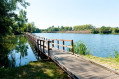

 Visorando Member
 Moderate

 Difficult