Pointe de Bellegarde from Sixt, loop via Vogealle and Salvadon

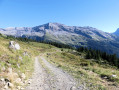
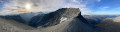
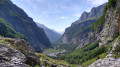
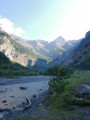
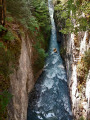
A superb circular hike to Pointe de Bellegarde, offering magnificent panoramic views throughout: after passing through Cirque du Fer-à-Cheval, the ascent is via Pas du Boret, the Vogealle area and Col des Chambres. The return route is via Vallon du Salvadon.

Details

83806364
Creation:
Last update:
Last review:
  • Walking
    Activity: Walking
  • ↔
    Distance: 22.34 km
  • ◔
    Average duration: 11h 25 
  • ▲
    Difficulty: Extremely difficult

  • ⚐
    Back to start: Yes
  • ↗
    Ascent: + 1,753 m
  • ↘
    Descent: - 1,750 m

  • ▲
    Highest point: 2,477 m
  • ▼
    Lowest point: 803 m

Photos

Description of the walk

Update by the author on 14/09/2025:

  • the point (18) was incorrectly located and has been moved
  • the point (19) was incorrectly located and has been moved back to the former position of point (18)
  • Corresponding adjustments have been made in the "Practical information" section of the sections (18) to (20). One of the descriptions has been deleted as it was superfluous.
  • renaming of point (1) (this is the Passerelle du Saugy), point (2) (this is the locality known as stream du Dard), point (24) (this is the locality known as Les Miches), and point (25) (this is the locality known as Bellecombe)

Departure from the hamlet of Le Crot, about 2 km from Sixt-Fer-à-Cheval via the D907. There is a small car park at the end of the access road.

(S/E) Return to the access road to the car park and cross the hamlet of Le Crot. At the bottom, turn right, then left to carefully cross the D907 and take the bridge over the Giffre (Passerelle du Saugy).

(1) On the other side, continue left on a path towards the Cirque du Fer à Cheval (follow the signs to point (5)). Further on, cross a stream via a footbridge.

(2) At the fork on the other side, turn left. Head north-east to a bridge over the Giffre at a place called Le Molliet.

(3) Continue straight ahead on the path (do not cross the bridge). Walk along the Giffre river on your left.

(4) At an intersection near the Pont de l'Eau Rouge bridge and the D907, turn right. Ignore a turn-off on the right and continue heading east-northeast.

(5) Join the D907 and follow it carefully to the right for about 250 metres.

(6) Then turn left, carefully cross the D907 and cross the Giffre once again. Then follow a path that immediately turns right and climbs up the mountainside.

(7) At an intersection in a place called Giffrenant, veer slightly left towards the Chalet de Prazon and leave a few buildings on your right. Continue straight ahead, north-northeast, and walk along the Giffre river below on your right. Reach the Giffre at a bridge that crosses it.

(8) Continue straight ahead (do not cross the bridge). Look for a trailhead on the left just before a turning area and the Chalet de Prazon (refreshment bar).

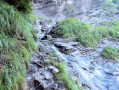
(9) Turn left onto this path towards the Refuge de la Vogealle via the Pas du Boret. Climb up a few slab passages while crossing a few streams. Then continue along a long exposed passage; the whole section is very well equipped with numerous cables but requires caution: for more details, see the Practical Information section. Then climb up through the forest to reach the Chalet du Boret (refreshment bar) in open terrain.

(10) Continue to the left, west-northwest, towards the Refuge de la Vogealle, indicated as a 1.5-hour walk. Go around the Pierre du Dard (elevation 1635) on the left. Continue climbing, keeping north until you reach an intersection near the Refuge de la Vogealle.

(11) Continue towards Lac de la Vogealle (do not cross the stream). Continue to the first intersection, about a ten-minute walk away.

(12) Turn left, leaving the path leading to the lake. Follow a steep path running alongside a stream until you reach a rocky outcrop.

(13) Proceed very carefully along the Pas à l'Ours. In an environment of black schist, continue along a narrow, very exposed ledge, where any misstep is truly forbidden (see the practical information section for more details). This will take you to a flat area.

(14) Then head right (west) and leave a hillock (elevation 2193) on your left. Next, head west-southwest, first across a lawn and then over scree. Then take a sort of pass. At the foot of Pointe Rousse des Chambres, head south to reach Col des Chambres on the edge of Grand Névé. In the past, snow was present in the area all year round, but this is no longer the case.

(15) Continue south-southeast off the trail and without markings, following the cairns. Be careful of possible snow and sharp limestone pavement (see the practical information section for more details). You will reach the summit ofPointe de Bellegarde and its magnificent panorama.

(16) Turn right (south-west) and cross some sharp limestone pavement to reach the Col de la Boîte aux Lettres. Then turn left to quickly reach the Boîte aux Lettres itself.

(17) Bend down to take a long crack in the rock (hence the name of this passage). Descend steadily down a rugged slope with a few passages equipped with cables or chains. You will reach a flat area.

(18) Continue downhill along the edge of the scree slope, following the cairns: be careful, as this is off-trail and there are several possible routes. When you reach another flat area, head right (west) to the start of a path marked by a cairn.

(19) Follow this path to the left; it is not very well marked on a short section where you may hesitate. Reach another flat area.

(20) Continue descending south-west on a fairly regular path. Then head south and descend steadily.

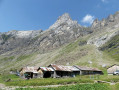
(21) Further on, head west-southwest and descend via a series of tight bends. Continue along a fairly gentle slope to the Chalets de Salvadon.

(22) Continue straight ahead on the path to reach the bottom of the valley. Then turn left. Join a track suitable for vehicles and follow it as it continues.

(23) At an intersection at a place called Croix à Augustin, veer slightly to the right (south) and enter the forest. Descend steadily with several turns.

(24) At a stream (waterfall on the right), continue downhill for a long time, following the winding path through the forest.

(25) At an intersection, continue straight ahead and downhill, ignoring the path that goes up to the right. Then pass a few paths on the left and reach the Crot car park (S/E).

Waypoints

  1. S/E : km 0 - alt. 825 m - Car park - Le Crot
  2. 1 : km 0.63 - alt. 806 m - Saugy footbridge
  3. 2 : km 1.49 - alt. 840 m - Stream du Dard - Fourche
  4. 3 : km 2.32 - alt. 834 m - Le Molliet
  5. 4 : km 3.81 - alt. 870 m - Intersection - Pont de l'Eau Rouge
  6. 5 : km 4.41 - alt. 900 m - Route D907
  7. 6 : km 4.67 - alt. 907 m - Bridge over the - Giffre (rivière)
  8. 7 : km 5.17 - alt. 964 m - Intersection - Giffrenant
  9. 8 : km 6.7 - alt. 1,015 m - Bridge over the - Giffre (rivière)
  10. 9 : km 7.18 - alt. 1,023 m - Trail start - Chalet de Prazon
  11. 10 : km 8.42 - alt. 1,388 m - Chalet du Boret
  12. 11 : km 10.57 - alt. 1,901 m - Intersection - Refuge de la Vogealle
  13. 12 : km 10.87 - alt. 1,968 m - Crossroads at Pas à l'Ours
  14. 13 : km 11.13 - alt. 2,082 m - Pas à l'Ours
  15. 14 : km 11.29 - alt. 2,126 m - Flat section at the top of Pas à l'Ours
  16. 15 : km 12.53 - alt. 2,325 m - Col des Chambres
  17. 16 : km 13.33 - alt. 2,469 m - Pointe de Bellegarde
  18. 17 : km 13.53 - alt. 2,453 m - La Boîte aux Lettres
  19. 18 : km 13.68 - alt. 2,388 m - Flat section
  20. 19 : km 13.92 - alt. 2,285 m - Start of the path - Cairn
  21. 20 : km 14.74 - alt. 2,031 m - Flat section
  22. 21 : km 15.49 - alt. 1,864 m - Downhill switchbacks
  23. 22 : km 16.88 - alt. 1,715 m - Chalets de Salvadon
  24. 23 : km 17.69 - alt. 1,668 m - Intersection - Croix à Augustin
  25. 24 : km 19.75 - alt. 1,307 m - Les Miches - Torrent Crossing
  26. 25 : km 21.69 - alt. 934 m - Bellecombe - Intersection
  27. S/E : km 22.34 - alt. 825 m - Car park - Le Crot

Notes

Good hiking boots and walking sticks are recommended. This challenging hike is not recommended for people who are unsteady on their feet or prone to vertigo. It is best to do this hike when the ground is dry and there is no significant snow cover (June to October).

The route is presented as a one-day hike, but it is possible to complete it in two days with a stop at the Refuge de la Vogealle (book in advance).

Alternatively, you can also reach the Chalet du Boret via the Bout du Monde: this route is less difficult but longer (additional time of approximately 1 hour 30 minutes).

Update on 07/09/2025: following the collapse of a cliff in the Méridienne sector (opposite the route), the route leading to Fond de la Combe and Bout du Monde via the left bank is no longer accessible until further notice.

You can shorten the route by avoiding the long 5 km approach between Le Crot (S/E) and Giffrenant (8), either by using two vehicles (please note: the Fer-à-Cheval car park is subject to a charge) or by taking a shuttle bus during the summer (July-August).

______________________________________________________________________________________________________________________________________________

Below is a detailed breakdown of the difficulty level for each section (a route is not uniform):
- green: fairly easy route with no significant elevation changes or difficulties.
- blue: steeper slopes and/or gradients on a well-marked route.
- orange: route presenting some technical difficulties and/or poor route viability (markings or visibility of the path).
- red: difficult route due to significant elevation changes that may require some climbing in an environment with some hazards.
- black: fairly difficult route and/or involving contiguous hazards.
- white: route in very difficult technical environments requiring certain equipment.

From (S/E) to (1): Green difficulty
A small road is followed easily.
Unmarked sector.

From (1) to (2): Blue difficulty
This section is on a path with no difficulties.
Markings: Yellow arrows + signposts.

From (2) to (6): Green difficulty
A relatively easy-to-follow road suitable for vehicles.
Markings: Yellow arrows + signposts.

From (6) to (9): Blue difficulty
The route follows a path with a few ascents that do not present any particular difficulties.
Markings: Yellow arrows + signposts.

From (9) to (10): Red difficulty
Please note that this section is exposed to the void and potential rock falls. Initially, you simply follow a path to the foot of the cliff. Afterwards, the route continues over a few sloping slabs, then a series of ledges close to the edge. The entire section is very well equipped with regular cables to ensure safe progress, but a minimum level of vigilance is required. The route is best undertaken in dry conditions. Please note that the entire area is potentially exposed to rock falls.
After reaching Pas du Boret, the route continues through the undergrowth on an uphill path without any significant difficulties
Markings: Yellow arrows + signposts.

From (10) to (11): Orange difficulty
The route follows a path through the woods, then continues on open terrain in an environment that gradually becomes more rocky. After reaching Le Dardet (recognisable by its hole in the rock), the route continues at the foot of cliffs in an environment that gradually becomes more rocky. Please note that this last section is potentially exposed to rockfalls throughout
Markings: Yellow arrows + signposts.

From (11) to (12): Blue difficulty
Follow a trail with limited difficulties.
Markings: Yellow arrows + signposts.

From (12) to (13): Blue difficulty
On the left bank of a stream, follow a path with fairly steep slopes.
Markings: Yellow arrows + signposts.

From (13) to (14): Red difficulty
Please note that there are difficulties to be encountered at Pas de l'Ours on a short passage that is very exposed to the void and could be quite dizzying for some people! Head towards the cliff on black schist terrain and thefirst difficulty is encountered at a breach that must be descended and climbed back up or crossed with a big step. After that, the route continues without any technical difficulties along a very narrow ledge overlooking a ravine, which is around 20 cm wide at its narrowest point (approximately 3 metres) and where you need to walk in single file, taking great care not to slip. Please note that the passage is not passable when there is snow and may be eroded after heavy rain.

From (14) to (15): Orange difficulty
You will reach a flat area and continue on an uphill path before reaching a rather gentle section. The route then continues along a slope, crossing a scree with a few large boulders. You will then continue with a steep climb up a couloir on fairly steep slopes. At the top of the area, you cross a sharp limestone pavement passage (be careful) before reaching the Col des Chambres. Please note that some areas are potentially exposed to rock falls.
Markings: Yellow arrows and GR® de Pays + a few cairns + signposts.

From (15) to (16): Orange difficulty
Please note that there are some orientation difficulties in the Grand Névé sector. Continue straight ahead towards Pointe de Bellegarde: the route is off-trail, so follow the cairns and the few tracks (which may be hidden by snow) as best you can. Be careful around some crevasses. As you approach the summit, the route is a little less obvious in terms of orientation in a more rugged area with the presence of sharp limestone pavement and slabs: initially, do not be tempted to take a direct route to the summit, then you can head in its direction more directly via a few contours. The entire area is not recommended due to the presence of fog.
Please note that there are other routes to the summit besides the one described here.
Area not marked.

From (16) to (17): Blue difficulty
Follow a few well-marked tracks, interrupted by a few passages of sharp limestone pavement (caution), to the pass, then turn left onto a downhill path to the nearby Passage de la Boîte aux Lettres.
This section is not marked.

From (17) to (19): Red difficulty
Please note that there are difficulties at the Passage de la Boîte aux Lettres: at the top of a cliff, the only solution is to "slide" to the right into a long crack in the rock with a low ceiling, and you have to move in a more or less curved position while holding onto a chain. Next, there is a short descent with a cable for safety. A little further on, there are a few other sections equipped with cables that require some caution. Note that there are a few markers in this area to help with orientation.

Further down, you will reach a small plateau: continue off the trail, following a few cairns; these become increasingly spaced out, and it is best to orientate yourself along the edge of a large scree slope, moving along the best possible route. You will reach a long plateau and follow it to the right, still off the trail, until you reach a cairn.

There are a few yellow arrow markings near the Passage de la Boite aux Lettres.

From (19) to (20): Blue difficulty
Follow a path downhill with no technical difficulty. At most, you may hesitate about the direction on a short section where the path is less marked.
This section is not marked.

From (20) to (22): Blue then Green difficulty
Continue along a path with some fairly steep slopes. Shortly after a shepherd's hut, follow a fairly well-marked path to the bottom of the valley. The route then continues easily along a path leading to the Chalets de Salvadon.
Yellow arrow markings.

From (22) to (24): Green difficulty
Follow an easy trail and then a carriage road on moderate downhill slopes.
Yellow arrow markings.

From (24) to (S/E): Blue difficulty
The route continues along the same carriage road, with a few steep slopes at times.
Markings: Yellow arrow.

Worth a visit

 Always be cautious and plan ahead when you're outdoors. Visorando and the author of this route cannot be held responsible for any accidents occurring on this route.

The GR® and PR® markings are the intellectual property of the Fédération Française de Randonnée Pédestre.

Reviews and comments

5 / 5
Based on 1 review

Reliability of the description
5 / 5
Ease of following the route
5 / 5
Route interest
5 / 5
Jemzolo
Jemzolo

Overall rating : 5 / 5

Date of your route : Oct 13, 2025
Reliability of the description : ★★★★★ Very good
Ease of following the route : ★★★★★ Very good
Route interest : ★★★★★ Very good
Very busy route : No

A very beautiful two-day hike, spending the first day at the end of the world, where the autumn colours were absolutely splendid!

I pushed on to Lake Vogealle, then climbed up to the top of Pérua - a beautiful view overlooking the Cirque du Fer à Cheval - before returning to spend the night at the refuge.

The next day, I found some snow remaining after the Col des Chambres (we were on the north side) and had a bit of trouble finding the route. Fortunately, the trail on the app was accurate and helped me find my way.
At the letterbox (to be avoided if you're even slightly prone to vertigo), my 40L rucksack with mattress and tent underneath had a bit of trouble getting through and still bears a few marks! It got through with a bit of contortion, but be warned: space is limited.

Now that I've found the route, I might try to do it in a day one day. Physical fitness and dry ground are essential.
Many thanks to the author. In two days, with ideal weather conditions, I had plenty of time to enjoy the superb and varied landscapes and the magnificent autumn colours. A real treat.

Machine-translated

Other walks in the area

For more walks, use our search engine .

The GPS track and description are the property of this route's author. Please do not copy them without permission.