


 Country:

 City:
City:


Departure from the village of Le Broc, several parking spaces along the RM 1 (route de Nice), otherwise there is a small car park at the very beginning of the route de la Fuonmurade on the right.
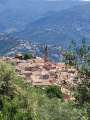
(S/E) From the Route de Nice, take the Route de la Fuonmurade on the left. Start slowly, as the road climbs steeply at the beginning. The road turns south-west and you will begin to see the village on your left. At the end of this road, you will come to a reservoir.
(1) Pass the reservoir and leave the road via the path that climbs down to the left. There is an old signpost indicating the Vallon de la Sine.
After a few hairpin bends, you will reach a junction. Follow the main path that climbs in an S-shape and keep heading south-west along the Vallon de la Sine. Throughout this slow climb, you will have the bottom of the valley on your right.
After a bare and somewhat arid section (burned in the March 2017 fire), you will arrive in a forest of white oaks covered in lichen. The slope levels out until you reach a pretty clearing at the "piste du gaz" (gas track), recognisable by its yellow markers.
(2) Begin the climb on the left along this steep track, then after about ten metres, take the path that branches off to the left to avoid the steepest section. After a right-hand bend, you will rejoin the main track 80 metres higher up!
The slope is gentler and you will arrive at the Plateau du Monséguise at an intersection marked by a new marker.
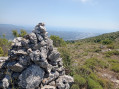
The view begins to open up towards the sea and the mountains, but to enjoy it fully, you need to reach the highest point marked by a cairn about 1.5 m high, which you can see to the north-east.
(3) At the intersection, take the track that descends to the left. After passing a depression on your right, leave the path on the right to reach the summit and its cairn (altitude 945 m).
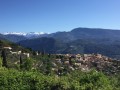
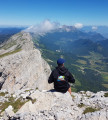
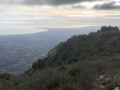
(4) From the summit, the view of the coastline and the city of Nice is breathtaking on a clear day. On your left, you can see the peaks of the Mercantour, from Mont Bégo to Cime de l'Argentéra, passing by Cime du Gélas. Behind you is Mont Mounier, the Saint-Barnabé plateau and, continuing to the left, the Baou de Saint-Jeannet and, in the distance, the Estérel.
After this contemplative break, it's time to return to the trail, either by retracing your steps or cutting directly north (there are a few tracks on the ground). Continue north on the trail, walking towards the mountains.
(5) After a few minutes, ignore the trail that comes up on the left and continue to the right.
(6) At the next intersection (elevation 880), there is a Departmental Council sign indicating the Sommet du Broc on the left. You can make the round trip in half an hour, although it doesn't add much to the view.
To do this, follow the track until you are a few metres from the high-voltage power lines, then leave it on the left towards the first pylon. You will see a trail leading off to the right. Follow it for a few metres, then pass through the trees on your left to reach the faint path that leads to the Sommet du Broc, marked by a large cairn 2 metres high!
(7) Retrace your steps to the marker at an altitude of 880 metres.
(6) Then follow the track that descends to the left (east) towards the Canal de la Gravière. Be careful, this descent is quite steep in places and very stony, so it is slippery.
(8) When you reach the Canal de la Gravière, you will have a beautiful view of Carros village and the Var plain from the cistern. Continue on the left along the canal, following the track for about 300 metres.
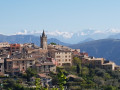
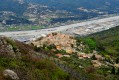
(9) Continue on the same track, which descends to the right. After three hairpin bends, the slope levels out and the path leads you gently to the Route de Nice (RM1) at the entrance to the village. Just before you reach the road, admire the view of the village of Le Broc with the peaks of the Mercantour in the background.
(10) Cross the road and turn left onto the footbridge along the road to reach the Route de Nice and the starting point in the village (S/E).





 Visorando Member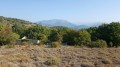

 Easy
Easy 
 Difficult
