Country:
 City:
City:



From Plan-de-Cuques or Peypin, take the D908 to the village of Logis Neuf.
From the centre, take Chemin Notre-Dame des Anges then Chemin de Mimet leading to the Fêve shooting range. These paths, which are difficult to drive on, correspond to the old road connecting Logis Neuf to Mimet via Col Sainte-Anne.
Continue to an underground cistern with a large parking area.
(S/E) Take the track (north-northeast) towards Pilon du Roi for about 200 metres. Leave the track and take a path on the left (north-northwest) which quickly turns into a trail following the track below. Follow this trail to an intersection at the bottom of a small valley.
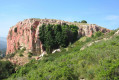
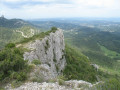
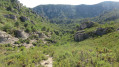
(1) Continue straight ahead; the path (green trail) joins the Vallon du Pilon du Roi. Climb up this valley covered with heath and lined with large limestone blocks reminiscent of medieval fortresses.
About 400 m from Pilon du Roi, the slope becomes steeper and the path more difficult. The trail then splits in two. Take the right branch, which is less difficult than the left branch, which is covered with unstable, very slippery gravel. This passage is the most challenging part of the hike.
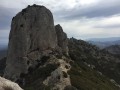
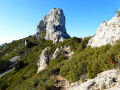
You will emerge about 20 m from the foot of the summit wall (710 m). Join the blue trail leading to Col de La Colle.
(2) Follow the blue trail to the right (east), taking the path at the foot of the south face of Pilon du Roi, then continue along the ridge above a track. After about 250 m, you will reach a crossroads.
(3) Here, there are two options for continuing (see the alternative in the Practical Information section). To minimise the distance on the track, continue opposite towards a pylon (695 m) as close as possible to the ridge. The path descends slightly before climbing back up to the ruins of Notre-Dame du Rot (679 m) before joining the track after about 250 m.
(4) Follow the track to a cistern located at a crossroads. Leave the track and take the path (north) which starts with a slight climb before reaching the ridge. Follow it (east) to a viewpoint before rejoining the track at Col Sainte-Anne (589 m).
(5) Take the path (east) climbing opposite along the ridge of Montagne du Baou Trouca. Walk along the edge of a small north-facing cliff.
Shortly before a pylon, pass close to a chasm opening onto the top of the ridge. A short, easy descent of a few metres on the north side leads to small windows opening onto the interior of the chasm (light effects).
Follow the ridge as closely as possible to the summit of Tête du Grand Puech (778 m), the highest point of the hike. A fire detection lookout post is located nearby.
(6) Begin the descent by taking the path leading south fromthe third pylon at the summit. The route is very beautiful, varied and quite technical, with several passages requiring the use of your hands. Join a track and follow it opposite (south-east) for about 150 m until you reach a cistern located in a bend.
(7) The track continues to the left (east). Leave it and take the path descending opposite (south), which cuts across a few hairpin bends before rejoining the track after 450 m.
(8) Continue right on the track (north-west) slightly downhill for 1 km until you reach a cistern. Leave the track 100 m after the cistern and take a path on the left, which will quickly lead you to a cairn.
(9) Leave the path and take the trail downhill to the left (red markings) below a high-voltage pylon. After about 400 m, pass at the foot of the Aire de la Moure cliff with its characteristic red colour before rejoining the track you left earlier.
(10) Follow the track (south-west). After 300 metres, it passes close to two chasms secured by barriers before crossing a track that leads off to the right at a cistern.
(11) Take this track on the right and follow it to its end, where there is another cistern, at the intersection of a path.
(12) Take this path on the right. After a wide bend, it becomes winding and heads south. Further on, you will reach a large clearing about 100 m before the pylon and the Canal de Provence manhole.
(13) Take the path on the right at the bottom of a small valley. Follow this path (green trail). A short but steep climb leads to an olive grove. Cross it before coming out onto Chemin de Mimet near the car park (S/E).





 Visorando Member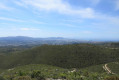
 Difficult
 Association / Club / Walk leader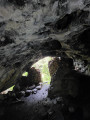
 Easy
Easy