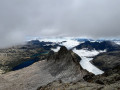
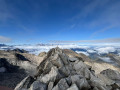
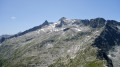
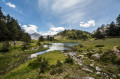
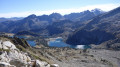
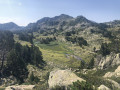
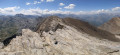
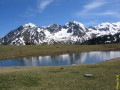
Pic de Néouvielle from Lac d'Aubert

The Néouvielle massif is the highest massif in the Pyrenees entirely within France. The Pic du Néouvielle (3,091 m) is its emblem, if not its highest peak, in the heart of a regional nature reserve where every lake is a marvel.

This hike offers the ascent via the usual route, through the ancient Néouvielle glaciers, and a less easy but more fun descent via boulders. Starting from Lac d'Aubert, the route is fairly easy, especially in spring and early summer when the snow in the north-east couloir is still present, allowing you to avoid the scree, and is fairly well marked. In the last section, you cross the area of the former Néouvielle glaciers, partially replaced by snowfields, scree and large boulders. Finally, a short, easy climb up a chimney takes you to the summit, where you can enjoy exceptional views of the surrounding area and the entire Pyrenees mountain range!

Details

79141982
Creation:
Last update:
Last review:
  • Walking
    Activity: Walking
  • ↔
    Distance: 7.67 km
  • ◔
    Average duration: 4h 50 
  • ▲
    Difficulty: Very difficult

  • ⚐
    Back to start: Yes
  • ↗
    Ascent: + 919 m
  • ↘
    Descent: - 925 m

  • ▲
    Highest point: 3,053 m
  • ▼
    Lowest point: 2,140 m

Photos

Description of the walk

Departure from the Lac d'Aubert car park. The road to get there is a toll road with an hourly rate and a maximum charge of £9 (06/2025). Park in the car park at the end of the road, about 100 metres from the lake shore. If necessary, the bivouac area is located just below the dam wall. It can only be reached on foot.

(S/E) From the car park, head towards the lake, go through a wooden barrier and continue left (south-south-east) on a track to the dam.

(1) Walk along the top of the dam. On the other side, follow a path marked with cairns south-south-west. You will soon reach a crossroads.

(2) Turn right towards Néouvielle (leaving the path leading to Pas du Gat on your left). The path remains clearly visible and well marked, but the climb becomes steep, through granite boulders, as you approach the north-eastern end of the Barris d'Aubert ridge that separates the two valleys.

(3) Cross the Brèche de Barris d'Aubert. The route heads west-northwest towards the Crête d'Espade. Aim for the Brèche de Chausenque, clearly visible in the middle of the landscape. Depending on snow conditions, crampons may be necessary to cross the persistent snowfields.

(4) Far below the breach, at an altitude of around 2,630 metres, the route turns west, then west-southwest.

(5) Pass the junction (not visible on the ground) where the ascent and descent tracks cross and continue south-west. This will take you to the Anciens Glaciers de Néouvielle (now, due to global warming, it would be more accurate to call them snowfields).

(6) Then head south, then south-east until you reach large boulders: you will often need to use your hands. Numerous cairns show the direction (and can be useful in addition to the GPS track in case of fog).

(7) Pass the junction (not visible on the ground) where the outward and return tracks cross again. You will arrive at the north-east ridge of the peak, about a hundred metres below the summit. Continue the final ascent with an easy climb up a narrow chimney. Reach the summit ridge, then the summit of Pic de Néouvielle.

(8) Take the same route back down, losing about 100 metres in altitude.

(7) There are two options here:
- Take the same route as on the way up, heading north-west towards the Anciens Glaciers de Néouvielle. Then head north-east to rejoin the main route at (5).
- For a more original and fun descent, continue almost due north. Reach a large, smooth, almost horizontal slab. Make your way down the large boulders, almost due north. Leave the large boulders and cross an area of rocks and very occasional persistent snowfields (the slope becomes gentler). Keep as far to the right as possible to avoid the large snowfield in the centre of the couloir you climbed up. This option requires confidence in downclimbing, grade F.

(5) Take roughly the same route as on the way up, in reverse, to reach the dam and then the lake car park (S/E).


Waypoints

  1. S/E : km 0 - alt. 2,159 m - Parking - Lac d'Aubert
  2. 1 : km 0.26 - alt. 2,150 m - Barrage d'Aubert
  3. 2 : km 0.92 - alt. 2,216 m - Crossroads
  4. 3 : km 1.64 - alt. 2,433 m - Brèche de Barris d'Aubert
  5. 4 : km 2.63 - alt. 2,628 m - Trail deviation
  6. 5 : km 3.21 - alt. 2,786 m - North intersection of the loop
  7. 6 : km 3.47 - alt. 2,895 m - Former glaciers of Néouvielle
  8. 7 : km 3.68 - alt. 2,954 m - South junction of the loop
  9. 8 : km 3.89 - alt. 3,053 m - Pic de Néouvielle ou d'Aubery (3091m)
  10. S/E : km 7.67 - alt. 2,159 m - Parking - Lac d'Aubert

Notes

The description is for a mid-winter, mid-summer hike completed by two people at the end of June 2025. There was a large snowfield between (3) and (8).

In winter, only attempt this route if you are highly skilled at snowshoeing or ski touring.

Parking at the start
At an altitude of 2,158 m (Lac d'Aubert), there is an official car park, marked on road maps. Payment is made at the Lac d'Orédon toll gate on the way back, using credit card terminals. There is a contactless payment sensor that also works with mobile phones.

Time indicated
I completed this route in 6 hours, including a 1-hour break at the summit and photo stops, leaving the car park at 7 a.m. This is a fairly short time. Allow between 6 and 8 hours.

Difficulty
This hike is classified as Very Difficult for a number of reasons: significant elevation gain; extremely steep sections (between 30% and 55%) between (3) and (8); challenging descent over boulders between (7) and (5); partial lack of signage; high mountain conditions. The IBP Index is 129 HKG, which corresponds to a Very Difficult route for a hiker with average physical fitness. Please note that shortly before the summit (8), the trail follows a short, easy climbing section where you will need to use your hands for 50 metres of elevation gain.

Water
There are no drinking water points on the route. In spring and summer conditions, meltwater from snowfields, springs, lakes, rivers or runoff are not guaranteed to be drinkable, even if there are no herds in the area. Bring at least 1.5 litres per person.

Shelter
There is no shelter on the route.

Equipment
In summer, bring the usual equipment for high-altitude hiking, including hiking boots, suitable clothing, rain gear, water, food, a survival blanket, a knife, a compass, a map, a whistle, sunglasses, a hat and sunscreen.

Visitor
During spring and summer weekends, the route is very busy up to the summit. Whatever the season, don't forget to tell someone where you are going and let them know if you change your plans by text or phone.

Check the weather forecast.
If you notice any errors in the signposting or place names on your route or on the map you are using, you can become a contributor and report them:
- marking errors, safety issues, conflicts of use, environment: click here.
- mapping errors, place names: here.

This route passes through a protected area, which may be subject to special regulations:

Worth a visit

Place names

  • the word Néouvielle comes from Nèu vielha, composed of nèu meaning "snowfield" and vielha meaning "old, ancient". The northern and western slopes of Néouvielle used to feature three small glaciers, which have now almost disappeared, and snowfields. The Nèu Bielhe mountain is a high-altitude pasture area in Betpouey, in the Barèges valley.
  • the Lac d'Aubert means "green water" (colour);
  • the Lac d'Aumar means "sea water" (colour);
  • cap de Long lake includes the former natural lake of Cap de Long, which means "the head (of the valley) of the (peak) Long".
    Source: Wikipedia

Néouvielle Regional Reserve

The Néouvielle National Nature Reserve (RNN4) is a national nature reserve located in the Occitanie region. Created in 1935 and classified in 1968, it covers an area of 2,313 hectares to the north-east of the Pic de Néouvielle in the Pyrenees mountain range. Ranging in altitude from 1,800 to 3,091 metres, it is a site rich in flora and fauna. It is home to nearly 370 animal species and 570 species of algae.
See the Reserve's website

Reviews and comments

4.7 / 5
Based on 1 review

Reliability of the description
5 / 5
Ease of following the route
4 / 5
Route interest
5 / 5
MCTOUL
MCTOUL

Hello LeaT,
Thank you for your feedback!
Indeed, we are in the high mountains. Without snow, it may be much more difficult without the tracks of previous hikers.
The trail (and the IGN map) are essential tools, you're right to point that out!
Enjoy your stay in the Pyrenees!
Kind regards

Machine-translated

LéaT
LéaT

Overall rating : 4.7 / 5

Date of your route : Sep 11, 2025
Reliability of the description : ★★★★★ Very good
Ease of following the route : ★★★★☆ Good
Route interest : ★★★★★ Very good
Very busy route : No

Hike completed on 11 September at sunrise. Thank you MCTOUL for creating the page on VisoRando, which I believe did not exist until now.
A magnificent but demanding hike; be careful not to underestimate the elevation gain and altitude. On a clear day, the route is easy to follow, but be careful in foggy conditions or when climbing at night, as there are cairns everywhere...
It is recommended that you have the route map with you and are used to walking on scree. This is definitely not your average hike.
It took us 6 hours and 45 minutes, including all breaks and taking the time to admire the landscape at sunrise

Machine-translated

Other walks in the area

For more walks, use our search engine .

The GPS track and description are the property of this route's author. Please do not copy them without permission.