Country:

 City:
City:


Parking is available along the cycle path at the start of the D101 towards Maisières-Notre-Dame. No signposts.
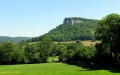
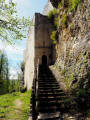
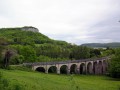
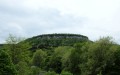
(S/E) Leaving the car park, turn right onto the cycle path towards the viaduct. At the Maizières viaduct, there is a beautiful view of La Roche du Grand on the right and Le Grand Barmaud on the left. At the entrance to the bridge on the right, descend under the arches via a small stairway (take care). You will arrive at a small platform, ideal for a picnic. Go back up and cross the bridge.
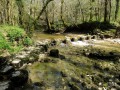
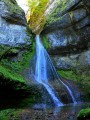
(1) Shortly after an old small train station, look for the signpost on the right and the path that leads you to La Brême and its well (direction Puits de la Brême). Cross the river on its pretty little round stone bridge to enjoy the view. Cross back over to climb up to the Puits de la Brème.
(2) Go back up to the cycle route via the path that starts there. Then turn right onto the cycle path.
(3) A hundred metres after a small bridge, leave the cycle path and climb the hill on the left via a farm track, which is unfortunately sometimes badly damaged by machinery. Stay on this track to reach the main road, ignoring a track on the right halfway up the hill that leads to a clearing and another higher up on the left.
(4) Carefully turn left onto the D67 for 300 metres and then turn left onto the D260 towards Malbrans for about 1.6 kilometres. There is a bit of tarmac, but the road is not too unpleasant and, above all, there is little traffic.
(5) When the road stops climbing, look for two double telegraph poles on the right. At the second pole (small blue plaque no. 208595), turn left onto the path that climbs perpendicularly up the wooded hillside. On the ridge, cross a wider farm track and descend the other side via the cart track opposite.
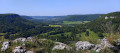
At the bottom of the hill, you will come to some barbed wire that is easy to cross. Cross the field in a straight line to reach the small tarmac road. There is a lovely view of the Loue valley, from Roche de Hautepierre to Mont Poupet. Walk along the fence, turning left (staying in the meadow) until you reach a small copse, which you cross via a short stony path to find a gate, which you must remember to close behind you.
(6) Continue left on the small road, which soon becomes stony, then turns into a simple field path to the end of the meadows.
(7) At the edge of the woods, turn right and walk for about 100 metres. When the edge of the woods forms a right angle, cross this small section of meadow diagonally, keeping slightly to the left, and look for the entrance to a path opposite you that leads into the forest and runs along the ledges. At forest signs 33 and 34, continue straight ahead.
(8) At the new signs 33 and 34 and an old stone marker, you will come to a wider path at a right angle. Turn left for an unsecured viewpoint over the Brême valley. Return to the marker and continue straight ahead. At signs 27 and 29, which are slightly hidden in the foliage, turn left at the fork. At signs 28 and 29, continue straight ahead.
(9) You will soon reach a path at right angles (signs 27 and 28) and turn left towards the cliff, where you may be lucky enough, as I was, to encounter a beautiful leaping deer. Quickly locate signs 13 and 12 and turn right.
(10) You will arrive at a pretty, cool, mossy pine forest. At the foot of the hill, carefully turn left onto a more or less visible path towards the cliff to discover a pretty corner of the forest through a large rocky crevice, hoping to surprise, as I did in the early morning, a shy chamois that disappeared as it ran down the hill. On your way down, you will no doubt have spotted an old leaning boundary stone (marked III and V) and an ONF27 sign. Go back up to it and climb to the left. The path is not very visible, but if you continue straight ahead, leaving the ledges about a hundred metres to your left and with your back to the marker, you will soon find a more clearly marked path. At signs 25 and 27, you will reach a wider and better-marked path.
(11) A little further on, at signpost 25, when the wide path makes a 90° turn to the right, turn left. After about thirty steps, you will see a new stone marker (marked IV and VI) and signposts 26 and 28 on your right. Pass in front of them and continue straight ahead to the unsecured viewpoint (caution) over Ornans. Return to the signs and the marker and turn left onto a path that will lead you to a second, unobstructed but still unsecured viewpoint over the Loue valley, Castel Saint-Denis.
(12) Turn your back on the viewpoint and set off along a small path that runs parallel to the edge of the cliffs for about 30 metres. Continue for about 300 metres and, at forest signpost No. 14, look for a small passage between the rocks on the left. There is no real path, but the wood is sparse. Descend the hillside, leaving the fault behind you and choosing the most open areas. The descent can be a little slippery. If you have followed the trail correctly, you should pass between signs ONF13 and 14.
Guided by the murmur of a stream, you will soon come to a path that you will follow downhill on your left. It will lead you to a gate, which you should close behind you. Cross the pasture along the left edge. Look up to see the silhouette of Castel Saint-Denis against the sky. To the right of the house, you will see a small metal ladder at a second gate. Continue along the gravel road to the D101, which you will follow to the left until you reach Notre-Dame-du-Chêne.
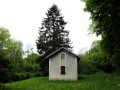
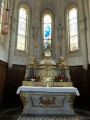
(13) At the statue of the Virgin Mary, on the site where the oak tree once stood, which concealed a statuette buried in its bark, climb up to the left to the hermitage, then take the small path that goes around the Way of the Cross to climb up to the hermitage. To leave, facing the hermitage, turn right, passing in front of an open-air altar. Leave the enclosure and immediately on your left you will see a statue of the Virgin Mary and the stony path you need to climb. You will come to a stony road at right angles, which you take to the right for a few metres, crossing a small bridge over pretty waterfalls, and continue climbing to the left.
(14) At the fork, fifty metres higher up, at the foot of an old wall, turn right to pass in front of the beautiful Malcôte residence. On the left, there is a view of the rocks of the Narpent cornices and on the right, a pretty view of the viaduct, topped by the Roche du Grand. Feel free to enter the pasture, as the barbed wire fence is not too difficult to cross. Return to the path, which has become grassy. You will enter the forest and continue along this beautiful stone path to the old Tacot station.
(1) Turn right onto the cycle path to cross the viaduct again and return to the car park (S/E).




 Visorando Member
 Easy
Easy