


Refine your search for walks in Brême (ruisseau) - Affluent de la Loue
Brême (ruisseau) - Affluent de la Loue walks


 The Ravin du Puits Noir and the Belvédère du Tourbillon
 Visorando Member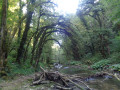
 8.40 mi
 +1,119 ft
 -1,122 ft
 4h 50
4h 50
 Moderate
 Departure from Scey-Maisières (Doubs)
Following in the footsteps of Gustave Courbet, the Ravin du Puits Noir was one of the painter's favourite places. You will follow the course of the Brême, walk peacefully along the old Tacot road, climb the Roche du Tourbillon for superb views of the picturesque and steep-sided Brême valley, and finally end at the Prieuré de Bonnevaux, of which only a charming chapel and its 12th-century bell tower remain.
The Brême Well
 3.98 mi
+627 ft
-650 ft
2h 20
3.98 mi
+627 ft
-650 ft
2h 20
 Easy
Departure from Scey-Maisières (Doubs)
Easy
Departure from Scey-Maisières (Doubs)
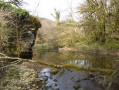
Walking along the banks of the emerald-green Brême, you will enter a dense forest until you reach the Ravin du Puits Noir, a dark, hidden, impenetrable and wild place where Gustave Courbet set up his easel more than fifty times. You will emerge at La Gouille, where goats once drank, and return peacefully via the old Tacot road and its viaduct, passing by the Puits de la Brême, the entrance to the underworld or the crystal palace of the fairies.
Le Saut du Chevalier
 4.31 mi
+755 ft
-725 ft
2h 40
Easy
Departure from Bonnevaux-le-Prieuré (Doubs)
4.31 mi
+755 ft
-725 ft
2h 40
Easy
Departure from Bonnevaux-le-Prieuré (Doubs)
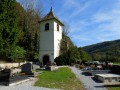
Starting from the bell tower of the former medieval priory, you will cross the cool Brème valley, so often painted by Courbet. Then, climbing back up to the Saut du Chevalier viewpoint, you will descend into the valley via a picturesque mule track.
The Brême Valley: The priory, the Roche du Grand and the castle
 8.31 mi
+1,348 ft
-1,348 ft
5h 00
Moderate
Departure from Bonnevaux-le-Prieuré (Doubs)
8.31 mi
+1,348 ft
-1,348 ft
5h 00
Moderate
Departure from Bonnevaux-le-Prieuré (Doubs)
Starting from the bell tower of the old medieval priory, you will cross the cool Brême valley so often painted by Courbet. Then you will climb through a beautiful fir forest sheltered by stunning rocks, passing large boulders detached from the cliffs, towards the Grand viewpoint overlooking the upper Loue valley, Ornans and the Val de Scey. Continuing towards the Fontaine aux Vipères and then the castle overlooking the town, you will descend into the valley via a picturesque mule track.
The Belvédère de Gougnot, the Roche Bottine and the Saut du Chevalier
 8.10 mi
+1,053 ft
-1,037 ft
4h 40
Moderate
Departure from Ornans (Doubs)
8.10 mi
+1,053 ft
-1,037 ft
4h 40
Moderate
Departure from Ornans (Doubs)
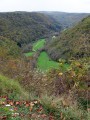
The Loue Valley, an inexhaustible source of hiking opportunities, offers the rugged, wild charm of its rocks, ending more peacefully at the Saut du Chevalier waterfall in the cool Brême Valley, so often painted by Courbet.
From Brême to Loue
 7.64 mi
+1,040 ft
-1,010 ft
4h 25
Moderate
Departure from Bonnevaux-le-Prieuré (Doubs)
7.64 mi
+1,040 ft
-1,010 ft
4h 25
Moderate
Departure from Bonnevaux-le-Prieuré (Doubs)
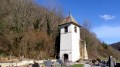
Starting from the bell tower of the old medieval priory, you will cross the cool Brême valley, so often painted by Courbet. You will climb up to the Saut du Chevalier viewpoint to reach the Vierge de la Roche du Mont, continuing along the cornices towards the Roche des Pins and its views over the Loue valley. You will climb up to the Septfontaine plateau and its views of the Jura mountains, before finally descending towards the Brême via a picturesque mule track.
The Belvédère du Grand and the Château
 6.52 mi
+1,299 ft
-1,302 ft
4h 10
Moderate
Departure from Scey-Maisières (Doubs)
6.52 mi
+1,299 ft
-1,302 ft
4h 10
Moderate
Departure from Scey-Maisières (Doubs)
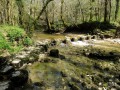
From a beautiful pine forest, sheltered by beautiful rocks and crossing large boulders detached from the cliffs, you will arrive at the Belvédère de la Roche du Grand viewpoint at the head of the valley, overlooking Ornans and the Val de Scey. Continuing towards the Fontaine aux Vipères, where Courbet's cancan dancers once performed, then to the castle overlooking the town, you will return through meadows overlooking the upper Loue valley, finally descending into the Brême valley through a beautiful, light-filled rocky forest.
The Plaisir Fontaine Cave
 3.29 mi
+571 ft
-574 ft
2h 00
Easy
Departure from Bonnevaux-le-Prieuré (Doubs)
3.29 mi
+571 ft
-574 ft
2h 00
Easy
Departure from Bonnevaux-le-Prieuré (Doubs)
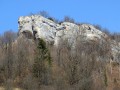
It is difficult to walk through our Loue valley without mentioning Gustave Courbet, who made this stream famous with his painting The Deer Slaughter at the Plaisir Fontaine Stream. He is also said to have painted his Self-Portrait with Black Dog here. Once again, you will follow in his footsteps to climb the Rocher du Tourbillon for superb views of the steep-sided Brême valley and finally return via the Ancien Prieuré de Bonnevaux, of which only the 12th-century bell tower remains.
The Corniches de Narpent and the Hermitage of Notre-Dame-du-Chêne
 8.52 mi
+1,148 ft
-1,175 ft
4h 55
Moderate
Departure from Ornans (Doubs)
8.52 mi
+1,148 ft
-1,175 ft
4h 55
Moderate
Departure from Ornans (Doubs)
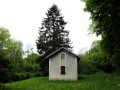
Crossing the Brême via its old bridge, you will descend to its mysterious well, gateway to the underworld or the fairy kingdom, and climb back up more prosaically to the industrious tile factory. The cornices of Narpent offer another kind of magic, with their rocky crevices silhouetted against the sky and the outline of Castel Saint-Denis, ending at the sanctuary where, long ago, a little girl discovered a small statue of the Virgin Mary, placed there and forgotten, in the hollow of an oak tree.
The Brême Valley and the Plaisir Fontaine Caves
 7.58 mi
+1,093 ft
-1,102 ft
4h 25
Moderate
Departure from Bonnevaux-le-Prieuré (Doubs)
7.58 mi
+1,093 ft
-1,102 ft
4h 25
Moderate
Departure from Bonnevaux-le-Prieuré (Doubs)
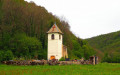
From the old priory, you will climb to the Rocher du Tourbillon viewpoint overlooking the charming little valley of La Brême, then walk along an old railway line converted into a footpath, before climbing back up to the wild cornices via sunken paths reminiscent of enchanted forests, and finally descending to the foot of the rocks towards the Plaisir Fontaine caves.
The Saut de la Brême
 5.14 mi
+725 ft
-748 ft
3h 00
Easy
Departure from Saules (Doubs)
5.14 mi
+725 ft
-748 ft
3h 00
Easy
Departure from Saules (Doubs)
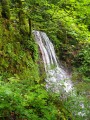
Off the beaten track, discover the little-known Saut de la Brême waterfall and the deep Ravin de Saules by following the stream and hopping from stone to stone. You may get your feet wet, but you will discover a wild world of moss, rocks and freshness. Return via the ruins of the Moulin du Défois mill.
The Brême Gorges
 4.48 mi
+486 ft
-492 ft
2h 30
Easy
Departure from Charbonnières-les-Sapins (Doubs)
4.48 mi
+486 ft
-492 ft
2h 30
Easy
Departure from Charbonnières-les-Sapins (Doubs)
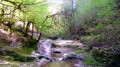
A countryside and woodland walk to explore the small, wild gorges of the Brême stream, complementing a visit to the Dino-Zoo.
Notre-Dame du Chêne et tour du plateau de Narpent
4.03 mi
+810 ft
-804 ft
2h 35
Easy
Departure from Scey-Maisières (Doubs)
Au départ de l'Ermitage de Notre-Dame du Chêne, une petite balade facile sans prétention sur les coteaux et le plateau de Narpent. Le retour s'effectue par l'ancienne voie ferrée Ornans-Hôpital du Grosbois, aujourd'hui Voie Verte et un court crochet au passage pour aller voir le Puits de la Brème.
From Ravin du Pré Noir to Saut du Chevalier from Ornans
 16.44 mi
+2,733 ft
-2,733 ft
9h 55
16.44 mi
+2,733 ft
-2,733 ft
9h 55
 Very difficult
Departure from Ornans (Doubs)
Very difficult
Departure from Ornans (Doubs)
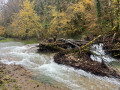
Hike north of Ornans with many points of interest and viewpoints. On the programme: the Château viewpoint, the Puits de la Brême, the Gouille aux Chèvres, the Grotte du Plaisir Fontaine, the Rocher du Tourbillon, the Saut du Chevalier, Notre-Dame du Mont. The hike can end with a visit to the town centre (§ Practical information). This is a very difficult hike due to its length and elevation gain. You need to be in good physical condition, as some sections are reserved for experienced hikers (ladders, passages requiring the use of your hands, etc.) with areas that are more or less wet and rocky. However, the route is varied and the views are magnificent. In autumn, this route offers a festival of colours.